
Course Features
Price
Study Method
Online | Self-paced
Course Format
Interactive PDFs, Articles & Learning Resources
Duration
19 hours, 15 minutes
Qualification
Professional Skills Development Course
Assessment
Final MCQ Exam (included in price)
Certificate
Verifiable Digital Certificate - Free
Additional info
Lifetime Access | Start Instantly
- Share
Overview
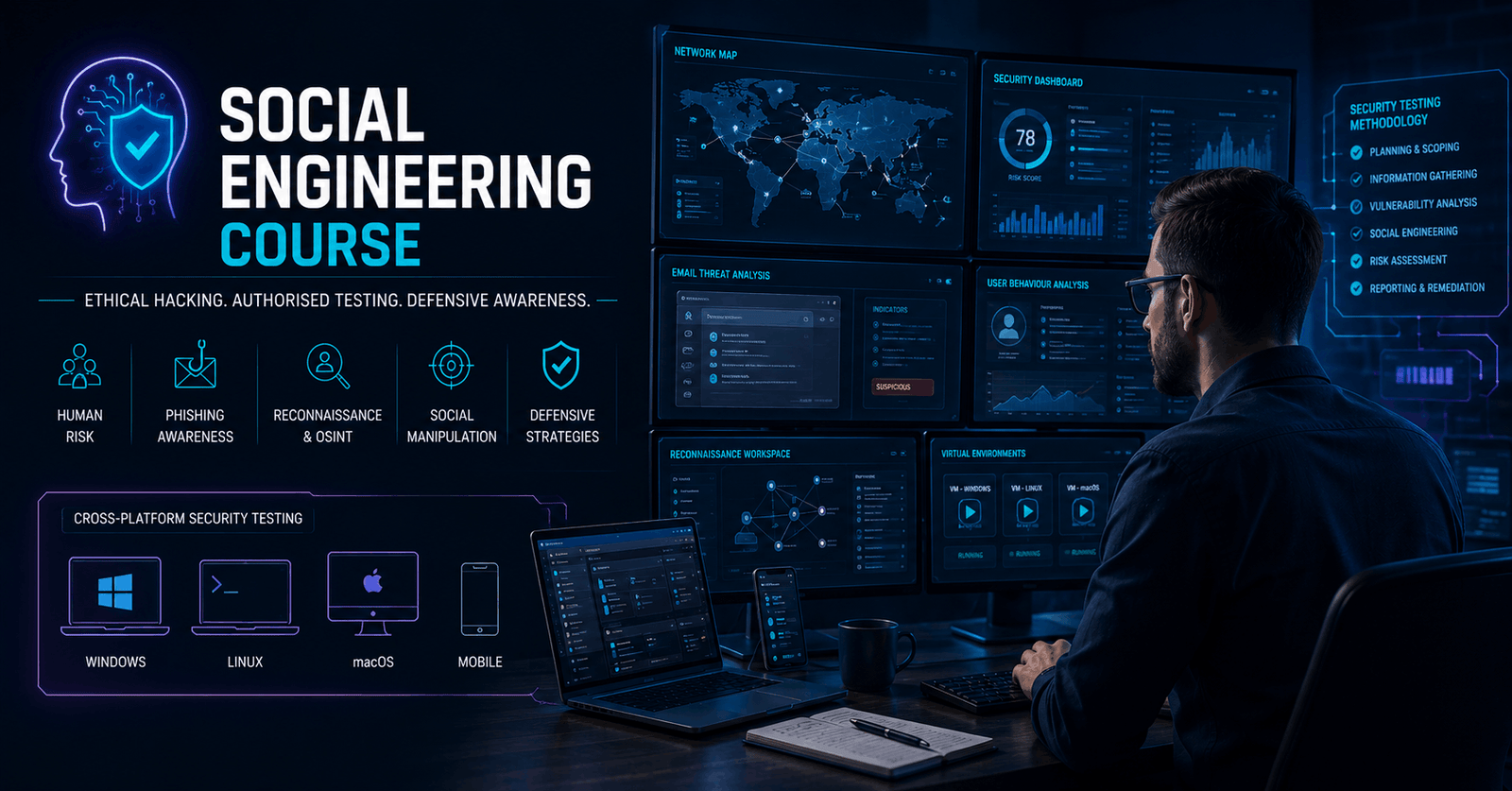
Social Engineering Course provides a comprehensive learning pathway into human-focused cybersecurity, ethical attack simulation, information gathering, controlled penetration testing and security prevention. Designed for learners who want to understand how social engineering and related technical threats operate, the course combines foundational concepts with practical security scenarios conducted within authorised lab environments.
The learning journey begins with building a penetration testing lab and developing essential familiarity with Kali Linux, virtual machines, terminal commands and supporting security tools. Learners then explore reconnaissance and information-gathering concepts, including how publicly available information about organisations, websites and individuals can influence security risk. This helps develop a stronger understanding of how attackers may identify opportunities and why responsible information management matters.
As the course progresses, learners examine malware concepts, backdoors, trojans, keylogging risks, password exposure, file-based threats and common delivery methods from an ethical security-testing perspective. Coverage spans Windows, macOS, Linux and mobile environments, helping learners recognise how threats can vary across different operating systems. The course also introduces email spoofing, deceptive login pages, browser-based attack concepts and other social engineering techniques within controlled and legally authorised settings.
Further lessons explore post-exploitation concepts, remote administration frameworks, persistence risks, network pivoting and privilege-related security concerns. These topics provide insight into what can happen after an initial security compromise and why layered protection, access controls and effective monitoring are essential.
The final section focuses on security and prevention, including recognising suspicious emails, understanding browser-based threats, identifying possible trojans and using sandboxing concepts to investigate potentially unsafe files. By seeing cybersecurity from both offensive-security and defensive perspectives, learners can develop greater awareness of attack patterns, human vulnerabilities and practical risk reduction.
All techniques covered should be practised only on systems you own or have explicit permission to test. Learners will receive a free course completion certificate after successfully completing the course. Multiple premium certificate and transcript options are also available for purchase if additional documentation is desired. Students also receive access to 5-star rated support available 24/7 through email throughout their learning journey.Completing this course can support further development towards roles such as junior cybersecurity analyst, security operations analyst, penetration testing trainee, information security assistant or ethical hacking professional. Learners may also progress to advanced study in penetration testing, cyber defence, threat analysis, security operations, incident response or recognised cybersecurity certification pathways.
Who is this course for?
Social Engineering Course provides a comprehensive learning pathway into human-focused cybersecurity, ethical attack simulation, information gathering, controlled penetration testing and security prevention. Designed for learners who want to understand how social engineering and related technical threats operate, the course combines foundational concepts with practical security scenarios conducted within authorised lab environments.
The learning journey begins with building a penetration testing lab and developing essential familiarity with Kali Linux, virtual machines, terminal commands and supporting security tools. Learners then explore reconnaissance and information-gathering concepts, including how publicly available information about organisations, websites and individuals can influence security risk. This helps develop a stronger understanding of how attackers may identify opportunities and why responsible information management matters.
As the course progresses, learners examine malware concepts, backdoors, trojans, keylogging risks, password exposure, file-based threats and common delivery methods from an ethical security-testing perspective. Coverage spans Windows, macOS, Linux and mobile environments, helping learners recognise how threats can vary across different operating systems. The course also introduces email spoofing, deceptive login pages, browser-based attack concepts and other social engineering techniques within controlled and legally authorised settings.
Further lessons explore post-exploitation concepts, remote administration frameworks, persistence risks, network pivoting and privilege-related security concerns. These topics provide insight into what can happen after an initial security compromise and why layered protection, access controls and effective monitoring are essential.
The final section focuses on security and prevention, including recognising suspicious emails, understanding browser-based threats, identifying possible trojans and using sandboxing concepts to investigate potentially unsafe files. By seeing cybersecurity from both offensive-security and defensive perspectives, learners can develop greater awareness of attack patterns, human vulnerabilities and practical risk reduction.
All techniques covered should be practised only on systems you own or have explicit permission to test. Learners will receive a free course completion certificate after successfully completing the course. Multiple premium certificate and transcript options are also available for purchase if additional documentation is desired. Students also receive access to 5-star rated support available 24/7 through email throughout their learning journey.Completing this course can support further development towards roles such as junior cybersecurity analyst, security operations analyst, penetration testing trainee, information security assistant or ethical hacking professional. Learners may also progress to advanced study in penetration testing, cyber defence, threat analysis, security operations, incident response or recognised cybersecurity certification pathways.
Requirements
Social Engineering Course provides a comprehensive learning pathway into human-focused cybersecurity, ethical attack simulation, information gathering, controlled penetration testing and security prevention. Designed for learners who want to understand how social engineering and related technical threats operate, the course combines foundational concepts with practical security scenarios conducted within authorised lab environments.
The learning journey begins with building a penetration testing lab and developing essential familiarity with Kali Linux, virtual machines, terminal commands and supporting security tools. Learners then explore reconnaissance and information-gathering concepts, including how publicly available information about organisations, websites and individuals can influence security risk. This helps develop a stronger understanding of how attackers may identify opportunities and why responsible information management matters.
As the course progresses, learners examine malware concepts, backdoors, trojans, keylogging risks, password exposure, file-based threats and common delivery methods from an ethical security-testing perspective. Coverage spans Windows, macOS, Linux and mobile environments, helping learners recognise how threats can vary across different operating systems. The course also introduces email spoofing, deceptive login pages, browser-based attack concepts and other social engineering techniques within controlled and legally authorised settings.
Further lessons explore post-exploitation concepts, remote administration frameworks, persistence risks, network pivoting and privilege-related security concerns. These topics provide insight into what can happen after an initial security compromise and why layered protection, access controls and effective monitoring are essential.
The final section focuses on security and prevention, including recognising suspicious emails, understanding browser-based threats, identifying possible trojans and using sandboxing concepts to investigate potentially unsafe files. By seeing cybersecurity from both offensive-security and defensive perspectives, learners can develop greater awareness of attack patterns, human vulnerabilities and practical risk reduction.
All techniques covered should be practised only on systems you own or have explicit permission to test. Learners will receive a free course completion certificate after successfully completing the course. Multiple premium certificate and transcript options are also available for purchase if additional documentation is desired. Students also receive access to 5-star rated support available 24/7 through email throughout their learning journey.Completing this course can support further development towards roles such as junior cybersecurity analyst, security operations analyst, penetration testing trainee, information security assistant or ethical hacking professional. Learners may also progress to advanced study in penetration testing, cyber defence, threat analysis, security operations, incident response or recognised cybersecurity certification pathways.
Career path
Social Engineering Course provides a comprehensive learning pathway into human-focused cybersecurity, ethical attack simulation, information gathering, controlled penetration testing and security prevention. Designed for learners who want to understand how social engineering and related technical threats operate, the course combines foundational concepts with practical security scenarios conducted within authorised lab environments.
The learning journey begins with building a penetration testing lab and developing essential familiarity with Kali Linux, virtual machines, terminal commands and supporting security tools. Learners then explore reconnaissance and information-gathering concepts, including how publicly available information about organisations, websites and individuals can influence security risk. This helps develop a stronger understanding of how attackers may identify opportunities and why responsible information management matters.
As the course progresses, learners examine malware concepts, backdoors, trojans, keylogging risks, password exposure, file-based threats and common delivery methods from an ethical security-testing perspective. Coverage spans Windows, macOS, Linux and mobile environments, helping learners recognise how threats can vary across different operating systems. The course also introduces email spoofing, deceptive login pages, browser-based attack concepts and other social engineering techniques within controlled and legally authorised settings.
Further lessons explore post-exploitation concepts, remote administration frameworks, persistence risks, network pivoting and privilege-related security concerns. These topics provide insight into what can happen after an initial security compromise and why layered protection, access controls and effective monitoring are essential.
The final section focuses on security and prevention, including recognising suspicious emails, understanding browser-based threats, identifying possible trojans and using sandboxing concepts to investigate potentially unsafe files. By seeing cybersecurity from both offensive-security and defensive perspectives, learners can develop greater awareness of attack patterns, human vulnerabilities and practical risk reduction.
All techniques covered should be practised only on systems you own or have explicit permission to test. Learners will receive a free course completion certificate after successfully completing the course. Multiple premium certificate and transcript options are also available for purchase if additional documentation is desired. Students also receive access to 5-star rated support available 24/7 through email throughout their learning journey.Completing this course can support further development towards roles such as junior cybersecurity analyst, security operations analyst, penetration testing trainee, information security assistant or ethical hacking professional. Learners may also progress to advanced study in penetration testing, cyber defence, threat analysis, security operations, incident response or recognised cybersecurity certification pathways.
-
- Teaser – Hacking an Android Phone & Accessing the Camera 00:10:00
- What Is Social Engineering? 00:10:00
- Course Overview 00:10:00
- Lab Setup & Required Tools 00:10:00
- Initial Setup and Configuration 00:10:00
- Installing Kali Linux on Windows (VMware/VirtualBox) 00:10:00
- Installing Kali Linux on macOS 00:10:00
- Installing Kali Linux on Linux 00:10:00
-
- Introduction to Kali Linux 00:10:00
- Terminal and Basic Linux Commands 00:10:00
- Overview of Info Gathering in Social Engineering 00:10:00
- Finding Social Media, Profiles, and Links 00:10:00
- Tracking Twitter Connections 00:10:00
- Finding Emails of the Target’s Friends 00:10:00
- Analysing Info and Building a Personal Attack Strategy 00:10:00
- Installing the Veil Framework 00:10:00
- Overview of Payloads and Veil 00:10:00
- Creating Undetectable Windows Backdoors 00:10:00
- Listening for Reverse Connections 00:10:00
- Hacking Windows 10 Using a Veil Backdoor 00:10:00
- Introduction to TheFatRat 00:10:00
- Creating a Second Backdoor with TheFatRat 00:10:00
- Introduction to Empire Framework 00:10:00
- PowerShell Stager for Windows 10 00:10:00
- Modifying Backdoor Source Code to Evade Antivirus 00:10:00
- Bypassing Antivirus with Hex Editing 00:10:00
- Download & Execute Payload (Method 1) 00:10:00
- Building the Ultimate Spying Tool 00:10:00
- Introduction to macOS Attacks 00:10:00
- Hacking macOS with a Meterpreter Backdoor 00:10:00
- Using Empire Stager on macOS 00:10:00
- Converting Backdoors into Executables 00:10:00
- File Embedding on macOS 00:10:00
- Creating a Basic macOS Trojan 00:10:00
- Customising Trojan Icons 00:10:00
- Running Trojans Silently 00:10:00
- Embedding macOS Backdoors in Office Documents 00:10:00
- Delivery Overview 00:10:00
- Setting Up an SMTP Mail Server 00:10:00
- Email Spoofing Basics 00:10:00
- Email Spoofing (Alternative Method) 00:10:00
- Pure Social Engineering (No File Delivery) 00:10:00
- Creating Fake Login Pages 00:10:00
- Stealing Login Info via Fake Pages 00:10:00
- BeEF Overview & Hooking Basics 00:10:00
- Injecting BeEF Hook in Webpages 00:10:00
- URL Manipulation Techniques 00:10:00
- Luring Victims Without Direct Contact 00:10:00
- Basic BeEF Command Usage 00:10:00
- Stealing Passwords Using Fake Prompts 00:10:00
- Hacking Windows 10 with Fake Updates 00:10:00
- Hacking macOS with Fake Updates 00:10:00
- Hacking Linux with Fake Updates 00:10:00
- Introduction to Post-Exploitation 00:10:00
- Upgrading Shell to Meterpreter or Empire 00:10:00
- Working with Empire Agents 00:10:00
- File System Commands in Empire 00:10:00
- Uploading & Executing Shell Commands 00:10:00
- Injecting Backdoors into Running Processes 00:10:00
- Privilege Escalation on macOS (2 Methods) 00:10:00
- Maintaining Access on macOS via Empire 00:10:00
- Exam of Learn Social Engineering from Scratch: Ethical Hacking with Real-World Attacks 00:50:00

No Reviews found for this course.
Is this certificate recognized?
Yes, our premium certificate and transcript are widely recognized and accepted by embassies worldwide, particularly by the UK embassy. This adds credibility to your qualification and enhances its value for professional and academic purposes.
I am a beginner. Is this course suitable for me?
Yes, this course is designed for learners of all levels, including beginners. The content is structured to provide step-by-step guidance, ensuring that even those with no prior experience can follow along and gain valuable knowledge.
I am a professional. Is this course suitable for me?
Yes, professionals will also benefit from this course. It covers advanced concepts, practical applications, and industry insights that can help enhance existing skills and knowledge. Whether you are looking to refine your expertise or expand your qualifications, this course provides valuable learning.
Does this course have an expiry date?
No, you have lifetime access to the course. Once enrolled, you can revisit the materials at any time as long as the course remains available. Additionally, we regularly update our content to ensure it stays relevant and up to date.
How do I claim my free certificate?
I trust you’re in good health. Your free certificate can be located in the Achievement section. The option to purchase a CPD certificate is available but entirely optional, and you may choose to skip it. Please be aware that it’s crucial to click the “Complete” button to ensure the certificate is generated, as this process is entirely automated.
Does this course have assessments and assignments?
Yes, the course includes both assessments and assignments. Your final marks will be determined by a combination of 20% from assignments and 80% from assessments. These evaluations are designed to test your understanding and ensure you have grasped the key concepts effectively.
Is this course accredited?
We are a recognized course provider with CPD, UKRLP, and AOHT membership. The logos of these accreditation bodies will be featured on your premium certificate and transcript, ensuring credibility and professional recognition.
Will I receive a certificate upon completion?
Yes, you will receive a free digital certificate automatically once you complete the course. If you would like a premium CPD-accredited certificate, either in digital or physical format, you can upgrade for a small fee.
Course Features
Price
Study Method
Online | Self-paced
Course Format
Interactive PDFs, Articles & Learning Resources
Duration
19 hours, 15 minutes
Qualification
Professional Skills Development Course
Assessment
Final MCQ Exam (included in price)
Certificate
Verifiable Digital Certificate - Free
Additional info
Lifetime Access | Start Instantly
- Share

Geometrical Optics Level 3 Advanced Diploma
Course Line239৳ 80,836.28Original price was: ৳ 80,836.28.৳ 2,472.93Current price is: ৳ 2,472.93.GMAT Verbal Skills Builder: Grammar, Style & Logical Flow
Course Line238৳ 80,836.28Original price was: ৳ 80,836.28.৳ 2,472.93Current price is: ৳ 2,472.93.Café Management Essentials
Course Line240৳ 80,836.28Original price was: ৳ 80,836.28.৳ 2,472.93Current price is: ৳ 2,472.93.



Related Courses
PRINCE2 in Practice: Simulated Projects & Case Studies
৳ 80,836.28Original price was: ৳ 80,836.28.৳ 2,472.93Current price is: ৳ 2,472.93.237PRINCE2 Risk Management: Identifying, Assessing & Controlling Risk
৳ 80,836.28Original price was: ৳ 80,836.28.৳ 2,472.93Current price is: ৳ 2,472.93.237PRINCE2 Roles & Responsibilities: Managing Teams in a PRINCE2 Environment
৳ 80,836.28Original price was: ৳ 80,836.28.৳ 2,472.93Current price is: ৳ 2,472.93.237




Related Courses
PRINCE2 in Practice: Simulated Projects & Case Studies
৳ 80,836.28Original price was: ৳ 80,836.28.৳ 2,472.93Current price is: ৳ 2,472.93.237PRINCE2 Risk Management: Identifying, Assessing & Controlling Risk
৳ 80,836.28Original price was: ৳ 80,836.28.৳ 2,472.93Current price is: ৳ 2,472.93.237PRINCE2 Roles & Responsibilities: Managing Teams in a PRINCE2 Environment
৳ 80,836.28Original price was: ৳ 80,836.28.৳ 2,472.93Current price is: ৳ 2,472.93.237

