
Course Features
Price
Study Method
Online | Self-paced
Course Format
Reading Material - PDF, article
Duration
6 hours, 25 minutes
Qualification
No formal qualification
Certificate
At completion
Additional info
Coming soon
- Share
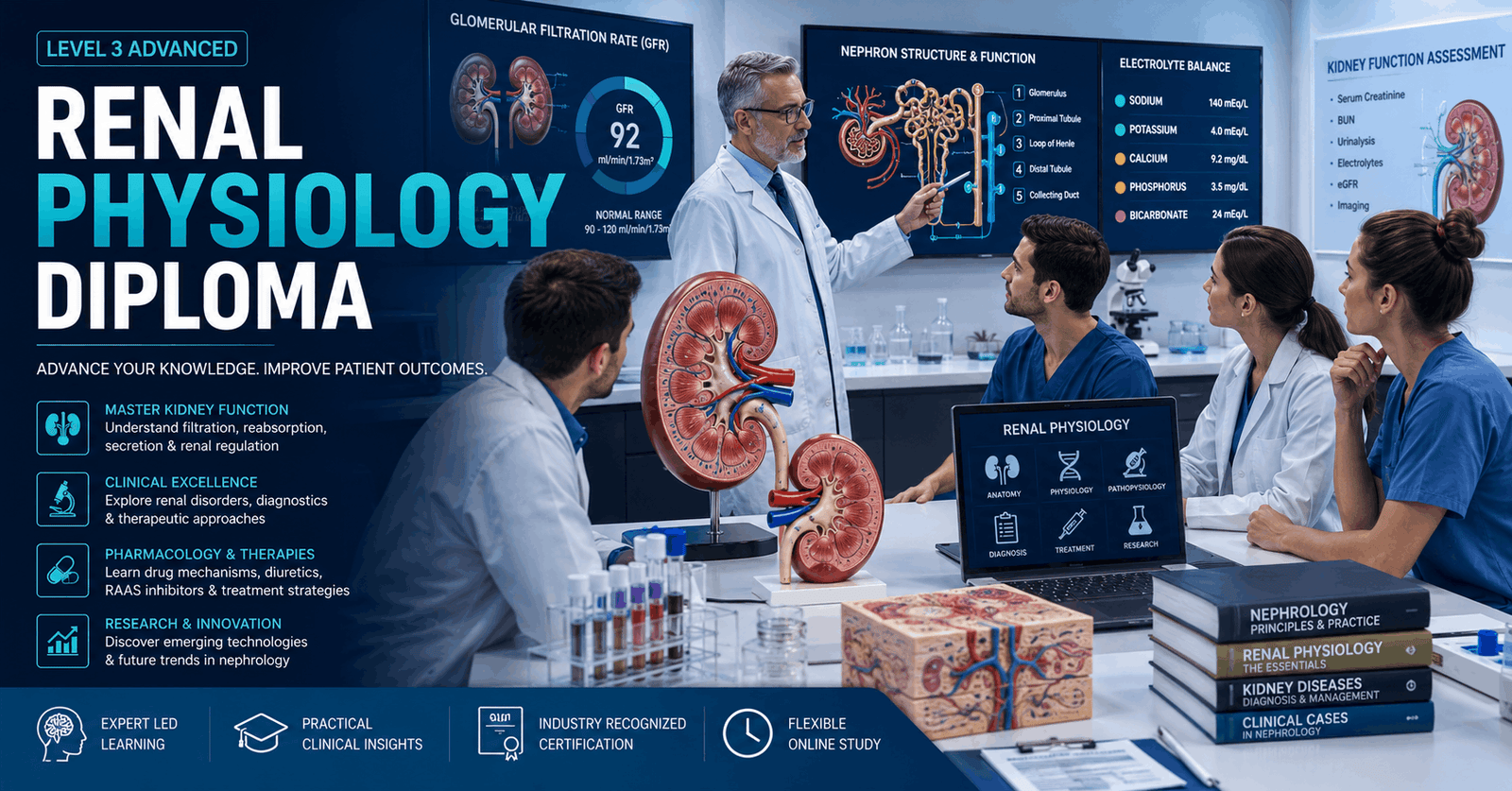
Overview
Renal Physiology Diploma is an advanced programme designed to provide learners with a comprehensive understanding of kidney function, renal regulation, and the physiological mechanisms that maintain fluid, electrolyte, and acid-base balance within the human body. The kidneys play a vital role in overall health, and a detailed knowledge of renal physiology is essential for those studying healthcare, biomedical sciences, nephrology, and clinical practice.
This course explores the structure and function of the renal system, beginning with renal anatomy, histology, and the processes of filtration, reabsorption, and secretion. Learners will gain a deeper understanding of how the kidneys regulate blood composition, maintain homeostasis, and contribute to the body's complex physiological systems. The programme also examines glomerular filtration rate, renal blood flow, and the mechanisms that influence normal kidney function.
As learners progress, they will study the regulation of renal activity through hormonal and neural pathways, including key physiological systems involved in fluid and electrolyte control. The course also investigates tubular transport mechanisms, countercurrent exchange processes, and the renal handling of sodium, potassium, calcium, phosphate, and hydrogen ions. These topics provide essential insight into how the kidneys adapt to changing physiological conditions.
A strong clinical focus is incorporated throughout the programme, helping learners connect physiological principles with real-world healthcare applications. Students will explore kidney disorders, diagnostic testing, pharmacological interventions, and the physiological changes associated with acute and chronic renal disease. Emerging research, innovative therapies, and ethical considerations within nephrology are also examined to provide a contemporary perspective on the field.
Case studies and practical clinical scenarios encourage critical thinking and analytical skills, enabling learners to apply theoretical knowledge to patient-centred situations. The flexible online learning format allows students to study at their own pace while building valuable specialist knowledge that supports academic progression and professional development.
Upon successful completion of the course, learners will receive a free course completion certificate. Multiple premium certificate and transcript options are also available for purchase should learners wish to enhance their professional portfolio. Students additionally benefit from 5-star rated support available 24/7 through email, ensuring assistance is available whenever required throughout their studies.Completion of this course can support progression into healthcare, nursing, nephrology support roles, biomedical sciences, clinical research, laboratory sciences, pharmacy, and medical education pathways. It also provides a valuable foundation for advanced study in physiology, medicine, renal healthcare, and other specialised clinical disciplines.
Who is this course for?
Renal Physiology Diploma is an advanced programme designed to provide learners with a comprehensive understanding of kidney function, renal regulation, and the physiological mechanisms that maintain fluid, electrolyte, and acid-base balance within the human body. The kidneys play a vital role in overall health, and a detailed knowledge of renal physiology is essential for those studying healthcare, biomedical sciences, nephrology, and clinical practice.
This course explores the structure and function of the renal system, beginning with renal anatomy, histology, and the processes of filtration, reabsorption, and secretion. Learners will gain a deeper understanding of how the kidneys regulate blood composition, maintain homeostasis, and contribute to the body's complex physiological systems. The programme also examines glomerular filtration rate, renal blood flow, and the mechanisms that influence normal kidney function.
As learners progress, they will study the regulation of renal activity through hormonal and neural pathways, including key physiological systems involved in fluid and electrolyte control. The course also investigates tubular transport mechanisms, countercurrent exchange processes, and the renal handling of sodium, potassium, calcium, phosphate, and hydrogen ions. These topics provide essential insight into how the kidneys adapt to changing physiological conditions.
A strong clinical focus is incorporated throughout the programme, helping learners connect physiological principles with real-world healthcare applications. Students will explore kidney disorders, diagnostic testing, pharmacological interventions, and the physiological changes associated with acute and chronic renal disease. Emerging research, innovative therapies, and ethical considerations within nephrology are also examined to provide a contemporary perspective on the field.
Case studies and practical clinical scenarios encourage critical thinking and analytical skills, enabling learners to apply theoretical knowledge to patient-centred situations. The flexible online learning format allows students to study at their own pace while building valuable specialist knowledge that supports academic progression and professional development.
Upon successful completion of the course, learners will receive a free course completion certificate. Multiple premium certificate and transcript options are also available for purchase should learners wish to enhance their professional portfolio. Students additionally benefit from 5-star rated support available 24/7 through email, ensuring assistance is available whenever required throughout their studies.Completion of this course can support progression into healthcare, nursing, nephrology support roles, biomedical sciences, clinical research, laboratory sciences, pharmacy, and medical education pathways. It also provides a valuable foundation for advanced study in physiology, medicine, renal healthcare, and other specialised clinical disciplines.
Requirements
Renal Physiology Diploma is an advanced programme designed to provide learners with a comprehensive understanding of kidney function, renal regulation, and the physiological mechanisms that maintain fluid, electrolyte, and acid-base balance within the human body. The kidneys play a vital role in overall health, and a detailed knowledge of renal physiology is essential for those studying healthcare, biomedical sciences, nephrology, and clinical practice.
This course explores the structure and function of the renal system, beginning with renal anatomy, histology, and the processes of filtration, reabsorption, and secretion. Learners will gain a deeper understanding of how the kidneys regulate blood composition, maintain homeostasis, and contribute to the body's complex physiological systems. The programme also examines glomerular filtration rate, renal blood flow, and the mechanisms that influence normal kidney function.
As learners progress, they will study the regulation of renal activity through hormonal and neural pathways, including key physiological systems involved in fluid and electrolyte control. The course also investigates tubular transport mechanisms, countercurrent exchange processes, and the renal handling of sodium, potassium, calcium, phosphate, and hydrogen ions. These topics provide essential insight into how the kidneys adapt to changing physiological conditions.
A strong clinical focus is incorporated throughout the programme, helping learners connect physiological principles with real-world healthcare applications. Students will explore kidney disorders, diagnostic testing, pharmacological interventions, and the physiological changes associated with acute and chronic renal disease. Emerging research, innovative therapies, and ethical considerations within nephrology are also examined to provide a contemporary perspective on the field.
Case studies and practical clinical scenarios encourage critical thinking and analytical skills, enabling learners to apply theoretical knowledge to patient-centred situations. The flexible online learning format allows students to study at their own pace while building valuable specialist knowledge that supports academic progression and professional development.
Upon successful completion of the course, learners will receive a free course completion certificate. Multiple premium certificate and transcript options are also available for purchase should learners wish to enhance their professional portfolio. Students additionally benefit from 5-star rated support available 24/7 through email, ensuring assistance is available whenever required throughout their studies.Completion of this course can support progression into healthcare, nursing, nephrology support roles, biomedical sciences, clinical research, laboratory sciences, pharmacy, and medical education pathways. It also provides a valuable foundation for advanced study in physiology, medicine, renal healthcare, and other specialised clinical disciplines.
Career path
Renal Physiology Diploma is an advanced programme designed to provide learners with a comprehensive understanding of kidney function, renal regulation, and the physiological mechanisms that maintain fluid, electrolyte, and acid-base balance within the human body. The kidneys play a vital role in overall health, and a detailed knowledge of renal physiology is essential for those studying healthcare, biomedical sciences, nephrology, and clinical practice.
This course explores the structure and function of the renal system, beginning with renal anatomy, histology, and the processes of filtration, reabsorption, and secretion. Learners will gain a deeper understanding of how the kidneys regulate blood composition, maintain homeostasis, and contribute to the body's complex physiological systems. The programme also examines glomerular filtration rate, renal blood flow, and the mechanisms that influence normal kidney function.
As learners progress, they will study the regulation of renal activity through hormonal and neural pathways, including key physiological systems involved in fluid and electrolyte control. The course also investigates tubular transport mechanisms, countercurrent exchange processes, and the renal handling of sodium, potassium, calcium, phosphate, and hydrogen ions. These topics provide essential insight into how the kidneys adapt to changing physiological conditions.
A strong clinical focus is incorporated throughout the programme, helping learners connect physiological principles with real-world healthcare applications. Students will explore kidney disorders, diagnostic testing, pharmacological interventions, and the physiological changes associated with acute and chronic renal disease. Emerging research, innovative therapies, and ethical considerations within nephrology are also examined to provide a contemporary perspective on the field.
Case studies and practical clinical scenarios encourage critical thinking and analytical skills, enabling learners to apply theoretical knowledge to patient-centred situations. The flexible online learning format allows students to study at their own pace while building valuable specialist knowledge that supports academic progression and professional development.
Upon successful completion of the course, learners will receive a free course completion certificate. Multiple premium certificate and transcript options are also available for purchase should learners wish to enhance their professional portfolio. Students additionally benefit from 5-star rated support available 24/7 through email, ensuring assistance is available whenever required throughout their studies.Completion of this course can support progression into healthcare, nursing, nephrology support roles, biomedical sciences, clinical research, laboratory sciences, pharmacy, and medical education pathways. It also provides a valuable foundation for advanced study in physiology, medicine, renal healthcare, and other specialised clinical disciplines.
-
- Overview of the renal system 00:10:00
- Renal anatomy and histology 00:10:00
- Filtration, reabsorption, and secretion 00:10:00
- Renal blood flow and glomerular filtration rate (GFR) 00:10:00
-
- Renal clearance and its clinical significance 00:10:00
- Renal autoregulation and extrinsic control mechanisms 00:10:00
- Hormonal regulation of renal function (RAAS, ADH, ANP) 00:10:00
- Renal response to acid-base balance disturbances 00:10:00
- Transport processes in the proximal tubule 00:10:00
- Transport in the loop of Henle 00:10:00
- Distal convoluted tubule and collecting duct transport 00:10:00
- Countercurrent mechanisms in the kidneyb 00:10:00
- Kidney function assessment and clinical tests 00:10:00
- Acute kidney injury (AKI) and chronic kidney disease (CKD) 00:10:00
- Nephrotic and nephritic syndromes 00:10:00
- Renal complications in diabetes and hypertension 00:10:00
- Current research in renal physiology 00:10:00
- Emerging technologies and therapies in nephrology 00:10:00
- Ethical considerations in renal research 00:10:00
- Comprehensive final examination 00:10:00
- Evaluation of case study assignments 00:10:00
- Course completion and certification 00:10:00
- Premium Certificate 00:15:00

No Reviews found for this course.
Is this certificate recognized?
Yes, our premium certificate and transcript are widely recognized and accepted by embassies worldwide, particularly by the UK embassy. This adds credibility to your qualification and enhances its value for professional and academic purposes.
I am a beginner. Is this course suitable for me?
Yes, this course is designed for learners of all levels, including beginners. The content is structured to provide step-by-step guidance, ensuring that even those with no prior experience can follow along and gain valuable knowledge.
I am a professional. Is this course suitable for me?
Yes, professionals will also benefit from this course. It covers advanced concepts, practical applications, and industry insights that can help enhance existing skills and knowledge. Whether you are looking to refine your expertise or expand your qualifications, this course provides valuable learning.
Does this course have an expiry date?
No, you have lifetime access to the course. Once enrolled, you can revisit the materials at any time as long as the course remains available. Additionally, we regularly update our content to ensure it stays relevant and up to date.
How do I claim my free certificate?
I trust you’re in good health. Your free certificate can be located in the Achievement section. The option to purchase a CPD certificate is available but entirely optional, and you may choose to skip it. Please be aware that it’s crucial to click the “Complete” button to ensure the certificate is generated, as this process is entirely automated.
Does this course have assessments and assignments?
Yes, the course includes both assessments and assignments. Your final marks will be determined by a combination of 20% from assignments and 80% from assessments. These evaluations are designed to test your understanding and ensure you have grasped the key concepts effectively.
Is this course accredited?
We are a recognized course provider with CPD, UKRLP, and AOHT membership. The logos of these accreditation bodies will be featured on your premium certificate and transcript, ensuring credibility and professional recognition.
Will I receive a certificate upon completion?
Yes, you will receive a free digital certificate automatically once you complete the course. If you would like a premium CPD-accredited certificate, either in digital or physical format, you can upgrade for a small fee.
Course Features
Price
Study Method
Online | Self-paced
Course Format
Reading Material - PDF, article
Duration
6 hours, 25 minutes
Qualification
No formal qualification
Certificate
At completion
Additional info
Coming soon
- Share

Certification in Akashic Records Reading and Spiritual Healing
Course Line237$648.25Original price was: $648.25.$19.83Current price is: $19.83.Private Investigator Level 8 Advanced Diploma
Course Line239$648.25Original price was: $648.25.$19.83Current price is: $19.83.



Related Courses
Workplace Stress Management: Build Resilience & Reduce Daily Pressure
$648.25Original price was: $648.25.$19.83Current price is: $19.83.237Psychology of Addiction: Alcohol, Drugs & Recovery
$648.25Original price was: $648.25.$19.83Current price is: $19.83.237Clinical Coding level 8 advanced Diploma
$648.25Original price was: $648.25.$19.83Current price is: $19.83.237




Related Courses
Workplace Stress Management: Build Resilience & Reduce Daily Pressure
$648.25Original price was: $648.25.$19.83Current price is: $19.83.237Psychology of Addiction: Alcohol, Drugs & Recovery
$648.25Original price was: $648.25.$19.83Current price is: $19.83.237Clinical Coding level 8 advanced Diploma
$648.25Original price was: $648.25.$19.83Current price is: $19.83.237

