
Course Features
Price
Study Method
Online | Self-paced
Course Format
Interactive PDFs, Articles & Learning Resources
Duration
17 hours, 25 minutes
Qualification
Professional Skills Development Course
Assessment
Final MCQ Exam (included in price)
Certificate
Verifiable Digital Certificate - Free
Additional info
Lifetime Access | Start Instantly
- Share
Overview
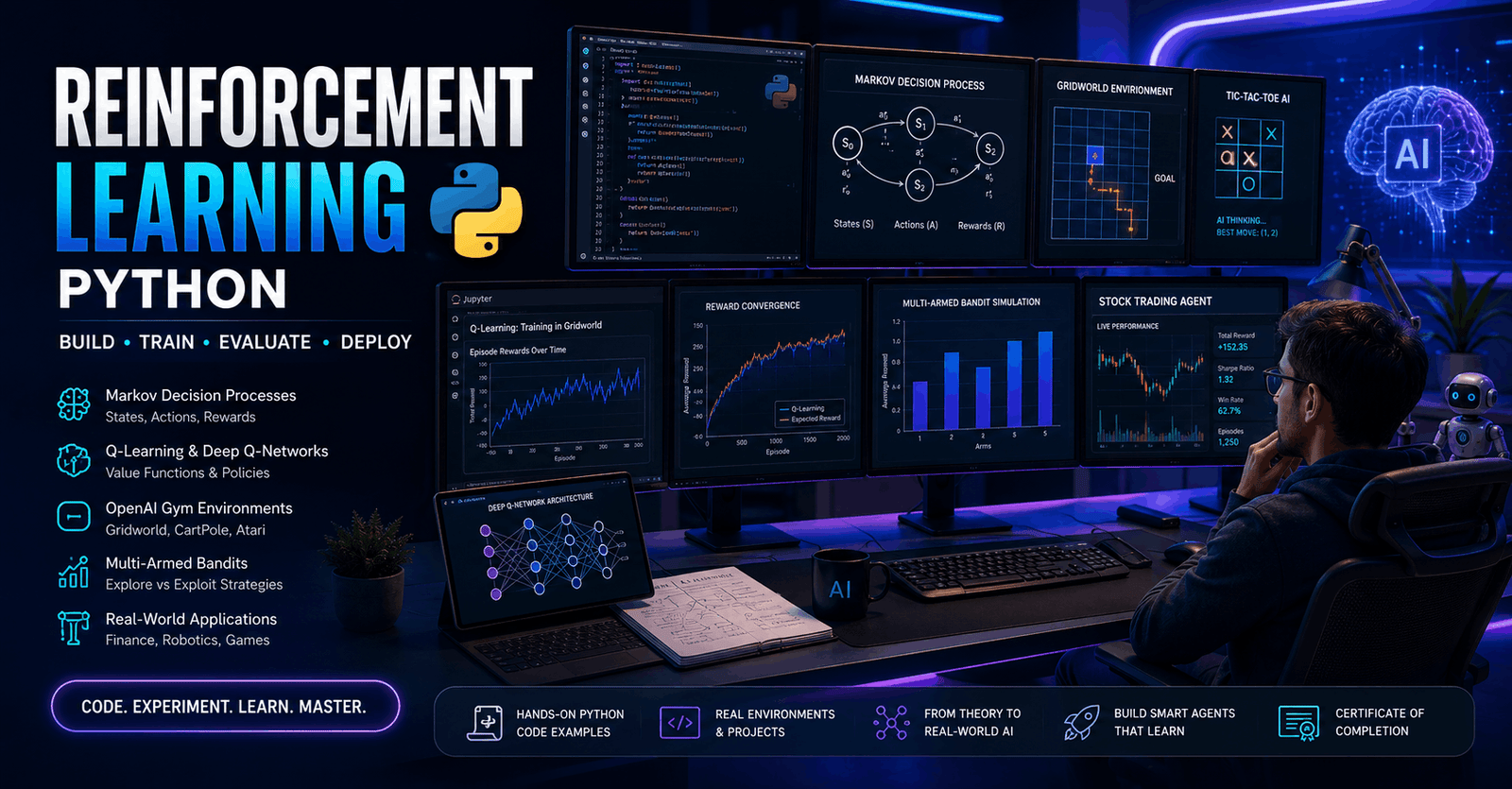
Reinforcement Learning Python is a comprehensive, project-based course designed to help you understand one of the most exciting fields in artificial intelligence. Whether you're a Python developer, data scientist, machine learning enthusiast, or AI student, this course provides the practical knowledge needed to build intelligent systems that learn from experience and improve their decisions over time.
The course begins by introducing the exploration-versus-exploitation challenge through multi-armed bandit problems, giving you an intuitive understanding of how intelligent agents balance learning and decision-making. You'll explore popular strategies such as epsilon-greedy, Upper Confidence Bound (UCB), Thompson Sampling, and online learning techniques before moving into the core principles of reinforcement learning.
As your understanding develops, you'll learn the fundamental concepts behind environments, agents, rewards, policies, value functions, and decision-making processes. These ideas are reinforced through practical coding exercises that demonstrate how reinforcement learning algorithms operate in realistic scenarios. You'll build a complete Tic-Tac-Toe AI agent from scratch, helping you connect theoretical concepts with working Python implementations.
The course then explores advanced reinforcement learning topics, including Markov Decision Processes (MDPs), Bellman equations, Dynamic Programming, Monte Carlo methods, Temporal Difference learning, SARSA, Q-Learning, and function approximation. Each topic is presented with practical Python examples that demonstrate how intelligent agents learn, adapt, and optimise their behaviour in increasingly complex environments.
To bridge the gap between theory and real-world application, you'll complete an end-to-end reinforcement learning project focused on stock trading. This practical experience demonstrates how reinforcement learning techniques can be applied to real business problems involving sequential decision-making and optimisation.
Throughout the course, emphasis is placed on clear explanations, practical implementation, and industry-relevant workflows. By the end of the training, you'll possess a strong foundation in reinforcement learning algorithms, understand how they differ from traditional machine learning approaches, and be prepared to explore advanced AI topics such as deep reinforcement learning and autonomous intelligent systems.
Upon successful completion, you'll receive a free course completion certificate. If you require enhanced credentials, multiple premium certificate and transcript options are also available for purchase. You'll also enjoy 5-star rated support available 24/7 via email, ensuring expert guidance is always available whenever you need assistance during your learning journey.
Who is this course for?
Reinforcement Learning Python is a comprehensive, project-based course designed to help you understand one of the most exciting fields in artificial intelligence. Whether you're a Python developer, data scientist, machine learning enthusiast, or AI student, this course provides the practical knowledge needed to build intelligent systems that learn from experience and improve their decisions over time.
The course begins by introducing the exploration-versus-exploitation challenge through multi-armed bandit problems, giving you an intuitive understanding of how intelligent agents balance learning and decision-making. You'll explore popular strategies such as epsilon-greedy, Upper Confidence Bound (UCB), Thompson Sampling, and online learning techniques before moving into the core principles of reinforcement learning.
As your understanding develops, you'll learn the fundamental concepts behind environments, agents, rewards, policies, value functions, and decision-making processes. These ideas are reinforced through practical coding exercises that demonstrate how reinforcement learning algorithms operate in realistic scenarios. You'll build a complete Tic-Tac-Toe AI agent from scratch, helping you connect theoretical concepts with working Python implementations.
The course then explores advanced reinforcement learning topics, including Markov Decision Processes (MDPs), Bellman equations, Dynamic Programming, Monte Carlo methods, Temporal Difference learning, SARSA, Q-Learning, and function approximation. Each topic is presented with practical Python examples that demonstrate how intelligent agents learn, adapt, and optimise their behaviour in increasingly complex environments.
To bridge the gap between theory and real-world application, you'll complete an end-to-end reinforcement learning project focused on stock trading. This practical experience demonstrates how reinforcement learning techniques can be applied to real business problems involving sequential decision-making and optimisation.
Throughout the course, emphasis is placed on clear explanations, practical implementation, and industry-relevant workflows. By the end of the training, you'll possess a strong foundation in reinforcement learning algorithms, understand how they differ from traditional machine learning approaches, and be prepared to explore advanced AI topics such as deep reinforcement learning and autonomous intelligent systems.
Upon successful completion, you'll receive a free course completion certificate. If you require enhanced credentials, multiple premium certificate and transcript options are also available for purchase. You'll also enjoy 5-star rated support available 24/7 via email, ensuring expert guidance is always available whenever you need assistance during your learning journey.
Requirements
Reinforcement Learning Python is a comprehensive, project-based course designed to help you understand one of the most exciting fields in artificial intelligence. Whether you're a Python developer, data scientist, machine learning enthusiast, or AI student, this course provides the practical knowledge needed to build intelligent systems that learn from experience and improve their decisions over time.
The course begins by introducing the exploration-versus-exploitation challenge through multi-armed bandit problems, giving you an intuitive understanding of how intelligent agents balance learning and decision-making. You'll explore popular strategies such as epsilon-greedy, Upper Confidence Bound (UCB), Thompson Sampling, and online learning techniques before moving into the core principles of reinforcement learning.
As your understanding develops, you'll learn the fundamental concepts behind environments, agents, rewards, policies, value functions, and decision-making processes. These ideas are reinforced through practical coding exercises that demonstrate how reinforcement learning algorithms operate in realistic scenarios. You'll build a complete Tic-Tac-Toe AI agent from scratch, helping you connect theoretical concepts with working Python implementations.
The course then explores advanced reinforcement learning topics, including Markov Decision Processes (MDPs), Bellman equations, Dynamic Programming, Monte Carlo methods, Temporal Difference learning, SARSA, Q-Learning, and function approximation. Each topic is presented with practical Python examples that demonstrate how intelligent agents learn, adapt, and optimise their behaviour in increasingly complex environments.
To bridge the gap between theory and real-world application, you'll complete an end-to-end reinforcement learning project focused on stock trading. This practical experience demonstrates how reinforcement learning techniques can be applied to real business problems involving sequential decision-making and optimisation.
Throughout the course, emphasis is placed on clear explanations, practical implementation, and industry-relevant workflows. By the end of the training, you'll possess a strong foundation in reinforcement learning algorithms, understand how they differ from traditional machine learning approaches, and be prepared to explore advanced AI topics such as deep reinforcement learning and autonomous intelligent systems.
Upon successful completion, you'll receive a free course completion certificate. If you require enhanced credentials, multiple premium certificate and transcript options are also available for purchase. You'll also enjoy 5-star rated support available 24/7 via email, ensuring expert guidance is always available whenever you need assistance during your learning journey.
Career path
Reinforcement Learning Python is a comprehensive, project-based course designed to help you understand one of the most exciting fields in artificial intelligence. Whether you're a Python developer, data scientist, machine learning enthusiast, or AI student, this course provides the practical knowledge needed to build intelligent systems that learn from experience and improve their decisions over time.
The course begins by introducing the exploration-versus-exploitation challenge through multi-armed bandit problems, giving you an intuitive understanding of how intelligent agents balance learning and decision-making. You'll explore popular strategies such as epsilon-greedy, Upper Confidence Bound (UCB), Thompson Sampling, and online learning techniques before moving into the core principles of reinforcement learning.
As your understanding develops, you'll learn the fundamental concepts behind environments, agents, rewards, policies, value functions, and decision-making processes. These ideas are reinforced through practical coding exercises that demonstrate how reinforcement learning algorithms operate in realistic scenarios. You'll build a complete Tic-Tac-Toe AI agent from scratch, helping you connect theoretical concepts with working Python implementations.
The course then explores advanced reinforcement learning topics, including Markov Decision Processes (MDPs), Bellman equations, Dynamic Programming, Monte Carlo methods, Temporal Difference learning, SARSA, Q-Learning, and function approximation. Each topic is presented with practical Python examples that demonstrate how intelligent agents learn, adapt, and optimise their behaviour in increasingly complex environments.
To bridge the gap between theory and real-world application, you'll complete an end-to-end reinforcement learning project focused on stock trading. This practical experience demonstrates how reinforcement learning techniques can be applied to real business problems involving sequential decision-making and optimisation.
Throughout the course, emphasis is placed on clear explanations, practical implementation, and industry-relevant workflows. By the end of the training, you'll possess a strong foundation in reinforcement learning algorithms, understand how they differ from traditional machine learning approaches, and be prepared to explore advanced AI topics such as deep reinforcement learning and autonomous intelligent systems.
Upon successful completion, you'll receive a free course completion certificate. If you require enhanced credentials, multiple premium certificate and transcript options are also available for purchase. You'll also enjoy 5-star rated support available 24/7 via email, ensuring expert guidance is always available whenever you need assistance during your learning journey.
-
- Welcome & Course Introduction 00:10:00
- Where to Get the Course Code 00:10:00
- Strategy for Success 00:10:00
- Course Structure & Learning Outcomes 00:10:00
-
- Introduction to the Multi-Armed Bandit Problem 00:10:00
- Real-World Applications of Explore-Exploit Dilemma 00:10:00
- Epsilon-Greedy Strategy Explained 00:10:00
- Updating the Sample Mean 00:10:00
- Building Your First Bandit Program 00:10:00
- Comparing Different Epsilon Strategies 00:10:00
- Optimistic Initial Values 00:10:00
- Understanding UCB1 00:10:00
- Bayesian Thompson Sampling 00:10:00
- Strategy Comparison: Epsilon-Greedy vs. UCB vs. Thompson Sampling 00:10:00
- Nonstationary Bandits & Online Learning 00:10:00
- Summary & Real-World Insights 00:10:00
- What is Reinforcement Learning? 00:10:00
- Unusual Behaviours in RL 00:10:00
- Key Terms & Definitions in RL 00:10:00
- Understanding Gridworld 00:10:00
- The Markov Property 00:10:00
- MDPs: Definitions & Concepts 00:10:00
- Future Rewards & Discounting 00:10:00
- Introduction to the Value Function 00:10:00
- Deep Dive into Value Functions 00:10:00
- Bellman Equations in Practice 00:10:00
- Optimal Policy & Value Function 00:10:00
- Summary: Solving MDPs 00:10:00
- What is Monte Carlo in RL? 00:10:00
- Monte Carlo Policy Evaluation 00:10:00
- MC Policy Evaluation in Python 00:10:00
- Windy Gridworld Evaluation 00:10:00
- Monte Carlo Control Algorithms 00:10:00
- Monte Carlo Control in Code 00:10:00
- MC Control without Exploring Starts 00:10:00
- MC Control (Code Example without Exploring Starts) 00:10:00
- Monte Carlo Summary 00:10:00
- Why Use Approximation in RL? 00:10:00
- Linear Models for Value Prediction 00:10:00
- Feature Extraction in RL 00:10:00
- Monte Carlo Approximation 00:10:00
- Monte Carlo Approximation in Code 00:10:00
- TD(0) Semi-Gradient Prediction 00:10:00
- SARSA with Function Approximation 00:10:00
- Code: SARSA with Approximation 00:10:00
- Course Wrap-Up & Next Steps 00:10:00
- What’s in the Appendix? 00:10:00
- 2018 Windows Setup Guide 00:10:00
- Installing Python Libraries 00:10:00
- How to Learn Coding Independently (Part 1) 00:10:00
- How to Learn Coding Independently (Part 2) 00:10:00
- How to Succeed in This Course (Extended Advice) 00:10:00
- Course FAQs – Pacing, Background, Practicality 00:10:00
- Jupyter Notebook vs. IDE 00:10:00
- Python 2 vs Python 3 00:10:00
- Recommended Course Order (Part 1) 00:10:00
- Recommended Course Order (Part 2) 00:10:00
- BONUS: Discounts & Free Resources 00:10:00
- Premium Certificate 00:15:00

No Reviews found for this course.
Is this certificate recognized?
Yes, our premium certificate and transcript are widely recognized and accepted by embassies worldwide, particularly by the UK embassy. This adds credibility to your qualification and enhances its value for professional and academic purposes.
I am a beginner. Is this course suitable for me?
Yes, this course is designed for learners of all levels, including beginners. The content is structured to provide step-by-step guidance, ensuring that even those with no prior experience can follow along and gain valuable knowledge.
I am a professional. Is this course suitable for me?
Yes, professionals will also benefit from this course. It covers advanced concepts, practical applications, and industry insights that can help enhance existing skills and knowledge. Whether you are looking to refine your expertise or expand your qualifications, this course provides valuable learning.
Does this course have an expiry date?
No, you have lifetime access to the course. Once enrolled, you can revisit the materials at any time as long as the course remains available. Additionally, we regularly update our content to ensure it stays relevant and up to date.
How do I claim my free certificate?
I trust you’re in good health. Your free certificate can be located in the Achievement section. The option to purchase a CPD certificate is available but entirely optional, and you may choose to skip it. Please be aware that it’s crucial to click the “Complete” button to ensure the certificate is generated, as this process is entirely automated.
Does this course have assessments and assignments?
Yes, the course includes both assessments and assignments. Your final marks will be determined by a combination of 20% from assignments and 80% from assessments. These evaluations are designed to test your understanding and ensure you have grasped the key concepts effectively.
Is this course accredited?
We are a recognized course provider with CPD, UKRLP, and AOHT membership. The logos of these accreditation bodies will be featured on your premium certificate and transcript, ensuring credibility and professional recognition.
Will I receive a certificate upon completion?
Yes, you will receive a free digital certificate automatically once you complete the course. If you would like a premium CPD-accredited certificate, either in digital or physical format, you can upgrade for a small fee.
Course Features
Price
Study Method
Online | Self-paced
Course Format
Interactive PDFs, Articles & Learning Resources
Duration
17 hours, 25 minutes
Qualification
Professional Skills Development Course
Assessment
Final MCQ Exam (included in price)
Certificate
Verifiable Digital Certificate - Free
Additional info
Lifetime Access | Start Instantly
- Share

Materials Science Level 3 Advanced Diploma
Course Line239£490.00Original price was: £490.00.£14.99Current price is: £14.99.Narcissistic Behaviour & Relationships: Understanding and Healing
Course Line237£490.00Original price was: £490.00.£14.99Current price is: £14.99.



Related Courses
Microsoft Excel for Business: Beginner to Advanced Data Analysis
£490.00Original price was: £490.00.£14.99Current price is: £14.99.237C++ Programming for Beginners: From Zero to AI-Ready Developer
£490.00Original price was: £490.00.£14.99Current price is: £14.99.237Microsoft SQL Server & T-SQL Certification Training: Beginner to Advanced
£490.00Original price was: £490.00.£14.99Current price is: £14.99.237



Related Courses
Microsoft Excel for Business: Beginner to Advanced Data Analysis
£490.00Original price was: £490.00.£14.99Current price is: £14.99.237C++ Programming for Beginners: From Zero to AI-Ready Developer
£490.00Original price was: £490.00.£14.99Current price is: £14.99.237Microsoft SQL Server & T-SQL Certification Training: Beginner to Advanced
£490.00Original price was: £490.00.£14.99Current price is: £14.99.237

