
Course Features
Price
Study Method
Online | Self-paced
Course Format
Interactive PDFs, Articles & Learning Resources
Duration
8 hours, 25 minutes
Qualification
Professional Skills Development Course
Assessment
Final MCQ Exam (included in price)
Certificate
Verifiable Digital Certificate - Free
Additional info
Lifetime Access | Start Instantly
- Share
Overview
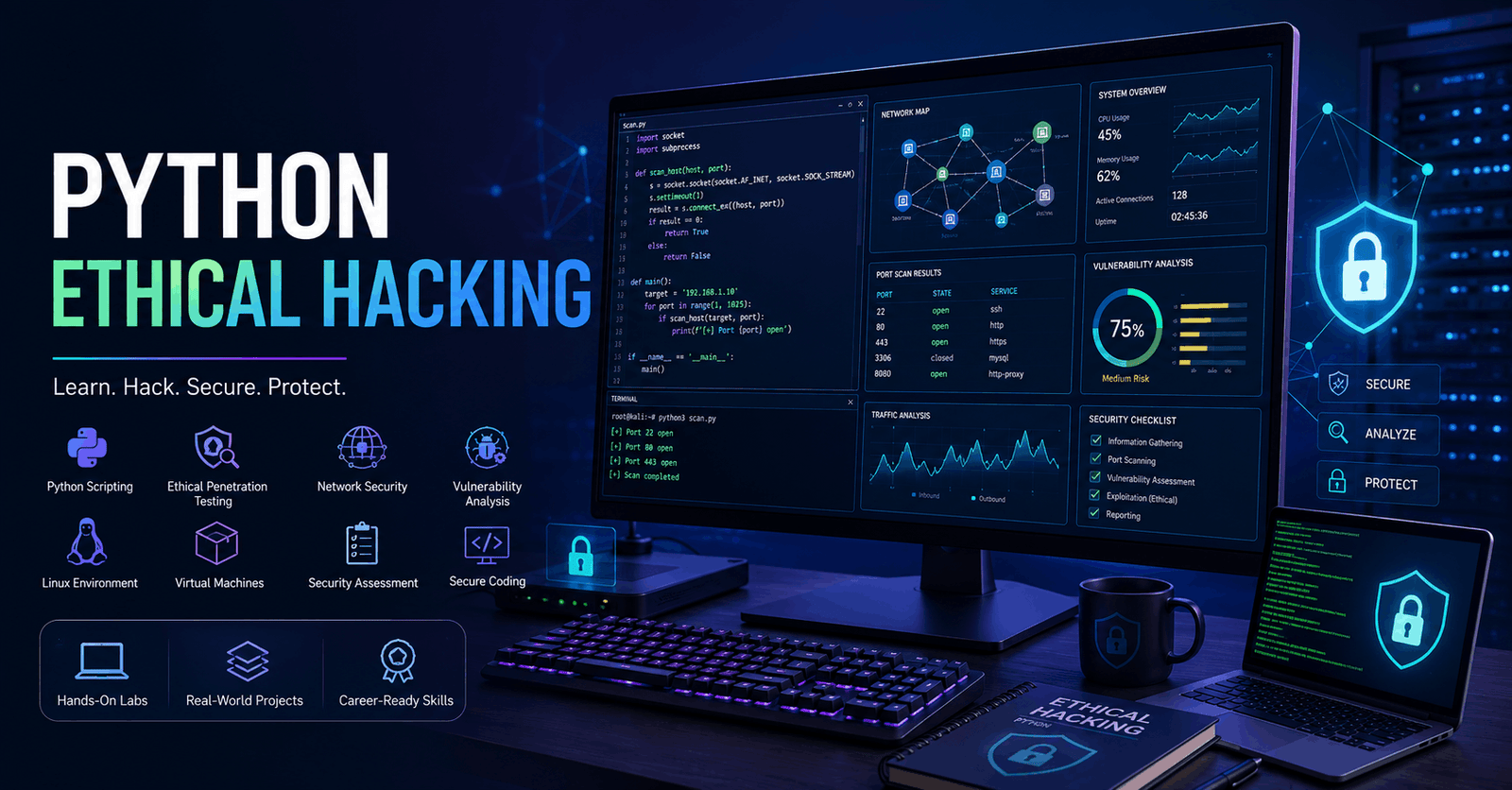
Python Ethical Hacking is a comprehensive cybersecurity learning programme designed to help you understand how Python programming can be applied within ethical security practices. This course introduces the foundations of ethical hacking, responsible security testing, and automation techniques that cybersecurity professionals use to analyse systems, identify weaknesses, and improve digital protection.
Throughout the course, you will build essential Python programming skills that support cybersecurity tasks. You will learn how to work with variables, data structures, operators, user input, conditional logic, loops, functions, modules, object-oriented programming, and exception handling. These programming foundations help you create more organised and effective security-focused scripts while developing stronger problem-solving abilities.
The course also explores practical cybersecurity concepts, including network programming, file handling, information gathering, port scanning, and building controlled testing environments. You will learn how ethical hackers use tools and techniques responsibly within authorised environments, while understanding the importance of legal boundaries, professional conduct, and security ethics.
A key part of the learning experience is setting up a practical cybersecurity lab environment. You will explore virtual machine setups, Linux fundamentals, and controlled practice environments that allow you to understand security concepts safely. The course introduces important areas such as IP discovery, domain information gathering, network analysis, and security testing workflows.
By combining Python development with cybersecurity principles, this course helps you develop skills that are valuable for understanding security automation, penetration testing concepts, and defensive security practices. The practical approach allows you to connect programming knowledge with real-world cybersecurity scenarios and prepare for further learning in information security.
This course is designed to support beginners and aspiring cybersecurity professionals who want a structured introduction to ethical hacking with Python. By the end, you will have a stronger understanding of how scripts, networks, operating systems, and security techniques work together in a professional cybersecurity environment.
After successfully completing the course, learners will receive a free course completion certificate. Multiple premium certificate and transcript options are also available for purchase if you wish to obtain additional professional documentation. Students also receive access to our 5-star-rated support available 24/7 through email for guidance whenever assistance is needed.Who is this course for?
Python Ethical Hacking is a comprehensive cybersecurity learning programme designed to help you understand how Python programming can be applied within ethical security practices. This course introduces the foundations of ethical hacking, responsible security testing, and automation techniques that cybersecurity professionals use to analyse systems, identify weaknesses, and improve digital protection.
Throughout the course, you will build essential Python programming skills that support cybersecurity tasks. You will learn how to work with variables, data structures, operators, user input, conditional logic, loops, functions, modules, object-oriented programming, and exception handling. These programming foundations help you create more organised and effective security-focused scripts while developing stronger problem-solving abilities.
The course also explores practical cybersecurity concepts, including network programming, file handling, information gathering, port scanning, and building controlled testing environments. You will learn how ethical hackers use tools and techniques responsibly within authorised environments, while understanding the importance of legal boundaries, professional conduct, and security ethics.
A key part of the learning experience is setting up a practical cybersecurity lab environment. You will explore virtual machine setups, Linux fundamentals, and controlled practice environments that allow you to understand security concepts safely. The course introduces important areas such as IP discovery, domain information gathering, network analysis, and security testing workflows.
By combining Python development with cybersecurity principles, this course helps you develop skills that are valuable for understanding security automation, penetration testing concepts, and defensive security practices. The practical approach allows you to connect programming knowledge with real-world cybersecurity scenarios and prepare for further learning in information security.
This course is designed to support beginners and aspiring cybersecurity professionals who want a structured introduction to ethical hacking with Python. By the end, you will have a stronger understanding of how scripts, networks, operating systems, and security techniques work together in a professional cybersecurity environment.
After successfully completing the course, learners will receive a free course completion certificate. Multiple premium certificate and transcript options are also available for purchase if you wish to obtain additional professional documentation. Students also receive access to our 5-star-rated support available 24/7 through email for guidance whenever assistance is needed.Requirements
Python Ethical Hacking is a comprehensive cybersecurity learning programme designed to help you understand how Python programming can be applied within ethical security practices. This course introduces the foundations of ethical hacking, responsible security testing, and automation techniques that cybersecurity professionals use to analyse systems, identify weaknesses, and improve digital protection.
Throughout the course, you will build essential Python programming skills that support cybersecurity tasks. You will learn how to work with variables, data structures, operators, user input, conditional logic, loops, functions, modules, object-oriented programming, and exception handling. These programming foundations help you create more organised and effective security-focused scripts while developing stronger problem-solving abilities.
The course also explores practical cybersecurity concepts, including network programming, file handling, information gathering, port scanning, and building controlled testing environments. You will learn how ethical hackers use tools and techniques responsibly within authorised environments, while understanding the importance of legal boundaries, professional conduct, and security ethics.
A key part of the learning experience is setting up a practical cybersecurity lab environment. You will explore virtual machine setups, Linux fundamentals, and controlled practice environments that allow you to understand security concepts safely. The course introduces important areas such as IP discovery, domain information gathering, network analysis, and security testing workflows.
By combining Python development with cybersecurity principles, this course helps you develop skills that are valuable for understanding security automation, penetration testing concepts, and defensive security practices. The practical approach allows you to connect programming knowledge with real-world cybersecurity scenarios and prepare for further learning in information security.
This course is designed to support beginners and aspiring cybersecurity professionals who want a structured introduction to ethical hacking with Python. By the end, you will have a stronger understanding of how scripts, networks, operating systems, and security techniques work together in a professional cybersecurity environment.
After successfully completing the course, learners will receive a free course completion certificate. Multiple premium certificate and transcript options are also available for purchase if you wish to obtain additional professional documentation. Students also receive access to our 5-star-rated support available 24/7 through email for guidance whenever assistance is needed.Career path
Python Ethical Hacking is a comprehensive cybersecurity learning programme designed to help you understand how Python programming can be applied within ethical security practices. This course introduces the foundations of ethical hacking, responsible security testing, and automation techniques that cybersecurity professionals use to analyse systems, identify weaknesses, and improve digital protection.
Throughout the course, you will build essential Python programming skills that support cybersecurity tasks. You will learn how to work with variables, data structures, operators, user input, conditional logic, loops, functions, modules, object-oriented programming, and exception handling. These programming foundations help you create more organised and effective security-focused scripts while developing stronger problem-solving abilities.
The course also explores practical cybersecurity concepts, including network programming, file handling, information gathering, port scanning, and building controlled testing environments. You will learn how ethical hackers use tools and techniques responsibly within authorised environments, while understanding the importance of legal boundaries, professional conduct, and security ethics.
A key part of the learning experience is setting up a practical cybersecurity lab environment. You will explore virtual machine setups, Linux fundamentals, and controlled practice environments that allow you to understand security concepts safely. The course introduces important areas such as IP discovery, domain information gathering, network analysis, and security testing workflows.
By combining Python development with cybersecurity principles, this course helps you develop skills that are valuable for understanding security automation, penetration testing concepts, and defensive security practices. The practical approach allows you to connect programming knowledge with real-world cybersecurity scenarios and prepare for further learning in information security.
This course is designed to support beginners and aspiring cybersecurity professionals who want a structured introduction to ethical hacking with Python. By the end, you will have a stronger understanding of how scripts, networks, operating systems, and security techniques work together in a professional cybersecurity environment.
After successfully completing the course, learners will receive a free course completion certificate. Multiple premium certificate and transcript options are also available for purchase if you wish to obtain additional professional documentation. Students also receive access to our 5-star-rated support available 24/7 through email for guidance whenever assistance is needed.-
- Unlocking Your Cybersecurity Superpower 00:10:00
- Ethical Hacking vs. Malicious Hacking 00:10:00
- Navigating Legal and Ethical Considerations in Ethical Hacking 00:10:00
-
- Why Python is Essential for Ethical Hackers 00:10:00
- Step-by-Step Python Installation Guide 00:10:00
- Creating Your Ideal Ethical Hacking Workspace: VS Code Setup 00:10:00
- Writing Your First Python Ethical Hacking Script 00:10:00
- Managing Data: Variables and Data Storage in Ethical Hacking 00:10:00
- Essential Data Structures for Ethical Hackers: Lists, Tuples, and More 00:10:00
- Python Operators: Powering Your Hacking Scripts 00:10:00
- Capturing User Input in Ethical Hacking Scripts 00:10:00
- Manipulating Strings for Hacking Success 00:10:00
- Mastering While Loops for Continuous Hacking Tasks 00:10:00
- Using For Loops to Automate Ethical Hacking Processes 00:10:00
- Controlling Loop Flow with Conditional Statements 00:10:00
- Creating Custom Functions for Ethical Hacking Tasks 00:10:00
- Passing Arguments to Functions for Flexible Coding 00:10:00
- Utilizing Python Modules to Enhance Your Hacking Toolkit 00:10:00
- Managing Errors Gracefully with Python Exception Handling 00:10:00
- File Input and Output: Managing Data Effectively 00:10:00
- Advanced File Handling: Raising Exceptions and Using Else Clauses 00:10:00
- Navigating Linux: Command Line Basics for Hackers 00:10:00
- IP Address Discovery and Tracking 00:10:00
- Using Whois Lookup for Domain Information 00:10:00
- Password Cracking Part 1: Fundamentals and Methods 00:10:00
- Password Cracking Part 2: Advanced Strategies 00:10:00
- Ethical Hacking Mastery: Final Thoughts and Future Pathways 00:10:00
- Premium Certificate 00:15:00

No Reviews found for this course.
Is this certificate recognized?
Yes, our premium certificate and transcript are widely recognized and accepted by embassies worldwide, particularly by the UK embassy. This adds credibility to your qualification and enhances its value for professional and academic purposes.
I am a beginner. Is this course suitable for me?
Yes, this course is designed for learners of all levels, including beginners. The content is structured to provide step-by-step guidance, ensuring that even those with no prior experience can follow along and gain valuable knowledge.
I am a professional. Is this course suitable for me?
Yes, professionals will also benefit from this course. It covers advanced concepts, practical applications, and industry insights that can help enhance existing skills and knowledge. Whether you are looking to refine your expertise or expand your qualifications, this course provides valuable learning.
Does this course have an expiry date?
No, you have lifetime access to the course. Once enrolled, you can revisit the materials at any time as long as the course remains available. Additionally, we regularly update our content to ensure it stays relevant and up to date.
How do I claim my free certificate?
I trust you’re in good health. Your free certificate can be located in the Achievement section. The option to purchase a CPD certificate is available but entirely optional, and you may choose to skip it. Please be aware that it’s crucial to click the “Complete” button to ensure the certificate is generated, as this process is entirely automated.
Does this course have assessments and assignments?
Yes, the course includes both assessments and assignments. Your final marks will be determined by a combination of 20% from assignments and 80% from assessments. These evaluations are designed to test your understanding and ensure you have grasped the key concepts effectively.
Is this course accredited?
We are a recognized course provider with CPD, UKRLP, and AOHT membership. The logos of these accreditation bodies will be featured on your premium certificate and transcript, ensuring credibility and professional recognition.
Will I receive a certificate upon completion?
Yes, you will receive a free digital certificate automatically once you complete the course. If you would like a premium CPD-accredited certificate, either in digital or physical format, you can upgrade for a small fee.
Course Features
Price
Study Method
Online | Self-paced
Course Format
Interactive PDFs, Articles & Learning Resources
Duration
8 hours, 25 minutes
Qualification
Professional Skills Development Course
Assessment
Final MCQ Exam (included in price)
Certificate
Verifiable Digital Certificate - Free
Additional info
Lifetime Access | Start Instantly
- Share

Mastering German Language B2: Grammar, Structure, and Usage
Course Line237£490.00Original price was: £490.00.£14.99Current price is: £14.99.CPA Marketing Mastery 2025: Launch & Scale Profitable Affiliate Campaigns
Course Line237£490.00Original price was: £490.00.£14.99Current price is: £14.99.



Related Courses
C++ Programming for Beginners: From Zero to AI-Ready Developer
£490.00Original price was: £490.00.£14.99Current price is: £14.99.237Microsoft SQL Server & T-SQL Certification Training: Beginner to Advanced
£490.00Original price was: £490.00.£14.99Current price is: £14.99.237Full Stack Web Developer Bootcamp: HTML, JavaScript, PHP & MySQL
£490.00Original price was: £490.00.£14.99Current price is: £14.99.237



Related Courses
C++ Programming for Beginners: From Zero to AI-Ready Developer
£490.00Original price was: £490.00.£14.99Current price is: £14.99.237Microsoft SQL Server & T-SQL Certification Training: Beginner to Advanced
£490.00Original price was: £490.00.£14.99Current price is: £14.99.237Full Stack Web Developer Bootcamp: HTML, JavaScript, PHP & MySQL
£490.00Original price was: £490.00.£14.99Current price is: £14.99.237

