
Course Features
Price
Study Method
Online | Self-paced
Course Format
Reading Material - PDF, article
Duration
8 hours, 35 minutes
Qualification
No formal qualification
Certificate
At completion
Additional info
Coming soon
- Share
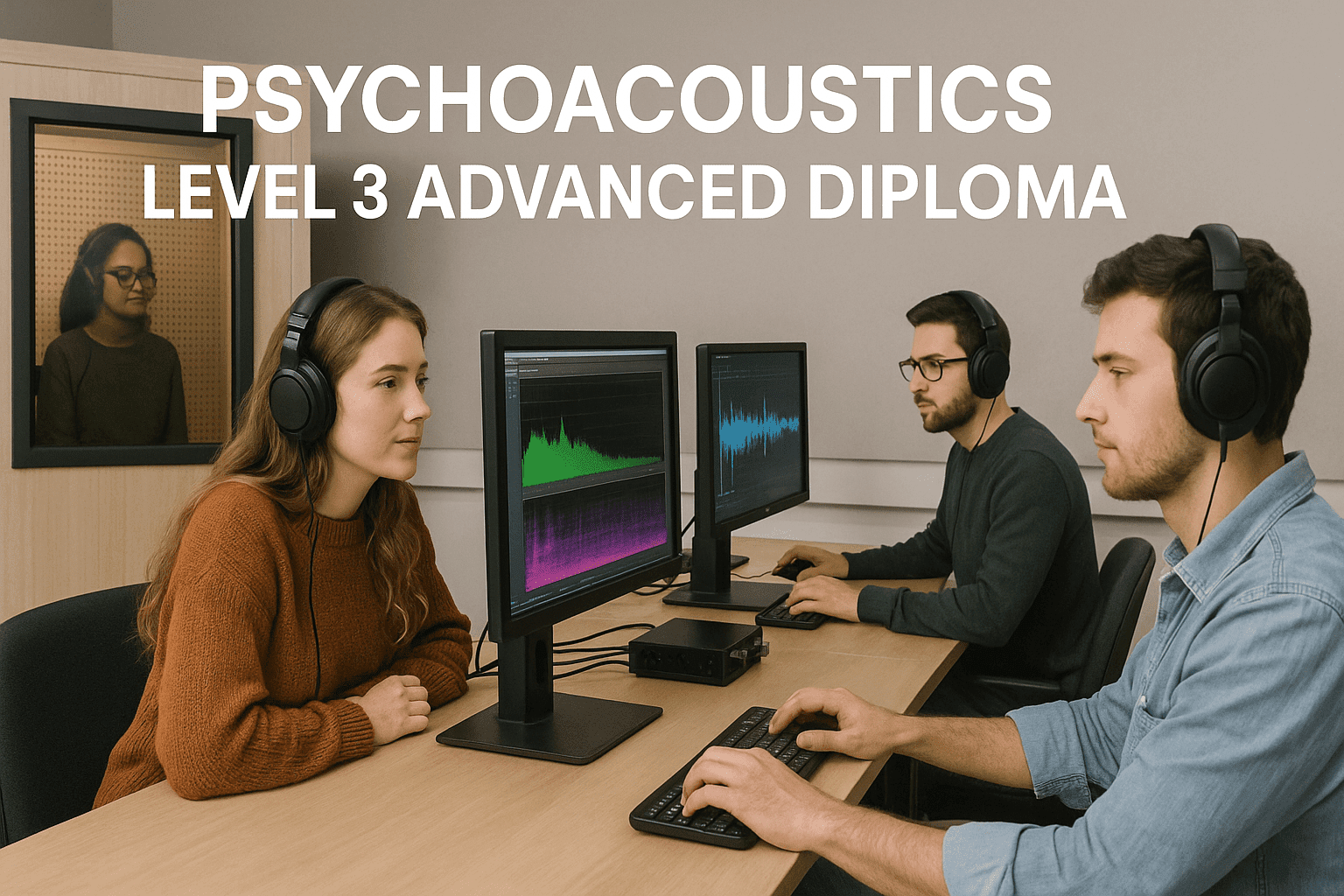
Overview
The Psychoacoustics Course Level 3 Advanced Diploma is a comprehensive exploration of how humans perceive, interpret, and respond to sound. This advanced-level programme bridges the gap between psychology, neuroscience, and acoustical science, offering learners a deep understanding of auditory perception and cognition. You’ll study how sound is processed by the brain, how hearing impairments affect listening, and how psychoacoustic principles apply to fields like music, audio engineering, and hearing research.
Throughout the course, you’ll explore auditory scene analysis, pitch perception, sound localisation, and binaural hearing. You’ll also examine the relationship between emotion and music, investigate the effects of noise pollution, and develop skills in experimental research design and data analysis. By engaging with both theoretical concepts and practical applications, you’ll learn how psychoacoustics influences everything from hearing aid development to sound therapy and architectural acoustics.
Learners will gain the ability to design and interpret psychoacoustic experiments, use auditory testing methods, and understand how sound perception varies across individuals. This makes the qualification ideal for those seeking to build advanced academic or professional expertise in hearing science, sound cognition, or acoustic research.
Upon successful completion, students will receive a free course completion certificate as recognition of their achievement. For those wishing to further showcase their expertise, premium certificate and transcript packages are available for purchase. Additionally, all learners benefit from 5-star rated learner support available 24/7 via email, ensuring a smooth and supportive study experience from start to finish.
Who is this course for?
The Psychoacoustics Course Level 3 Advanced Diploma is a comprehensive exploration of how humans perceive, interpret, and respond to sound. This advanced-level programme bridges the gap between psychology, neuroscience, and acoustical science, offering learners a deep understanding of auditory perception and cognition. You’ll study how sound is processed by the brain, how hearing impairments affect listening, and how psychoacoustic principles apply to fields like music, audio engineering, and hearing research.
Throughout the course, you’ll explore auditory scene analysis, pitch perception, sound localisation, and binaural hearing. You’ll also examine the relationship between emotion and music, investigate the effects of noise pollution, and develop skills in experimental research design and data analysis. By engaging with both theoretical concepts and practical applications, you’ll learn how psychoacoustics influences everything from hearing aid development to sound therapy and architectural acoustics.
Learners will gain the ability to design and interpret psychoacoustic experiments, use auditory testing methods, and understand how sound perception varies across individuals. This makes the qualification ideal for those seeking to build advanced academic or professional expertise in hearing science, sound cognition, or acoustic research.
Upon successful completion, students will receive a free course completion certificate as recognition of their achievement. For those wishing to further showcase their expertise, premium certificate and transcript packages are available for purchase. Additionally, all learners benefit from 5-star rated learner support available 24/7 via email, ensuring a smooth and supportive study experience from start to finish.
Requirements
The Psychoacoustics Course Level 3 Advanced Diploma is a comprehensive exploration of how humans perceive, interpret, and respond to sound. This advanced-level programme bridges the gap between psychology, neuroscience, and acoustical science, offering learners a deep understanding of auditory perception and cognition. You’ll study how sound is processed by the brain, how hearing impairments affect listening, and how psychoacoustic principles apply to fields like music, audio engineering, and hearing research.
Throughout the course, you’ll explore auditory scene analysis, pitch perception, sound localisation, and binaural hearing. You’ll also examine the relationship between emotion and music, investigate the effects of noise pollution, and develop skills in experimental research design and data analysis. By engaging with both theoretical concepts and practical applications, you’ll learn how psychoacoustics influences everything from hearing aid development to sound therapy and architectural acoustics.
Learners will gain the ability to design and interpret psychoacoustic experiments, use auditory testing methods, and understand how sound perception varies across individuals. This makes the qualification ideal for those seeking to build advanced academic or professional expertise in hearing science, sound cognition, or acoustic research.
Upon successful completion, students will receive a free course completion certificate as recognition of their achievement. For those wishing to further showcase their expertise, premium certificate and transcript packages are available for purchase. Additionally, all learners benefit from 5-star rated learner support available 24/7 via email, ensuring a smooth and supportive study experience from start to finish.
Career path
The Psychoacoustics Course Level 3 Advanced Diploma is a comprehensive exploration of how humans perceive, interpret, and respond to sound. This advanced-level programme bridges the gap between psychology, neuroscience, and acoustical science, offering learners a deep understanding of auditory perception and cognition. You’ll study how sound is processed by the brain, how hearing impairments affect listening, and how psychoacoustic principles apply to fields like music, audio engineering, and hearing research.
Throughout the course, you’ll explore auditory scene analysis, pitch perception, sound localisation, and binaural hearing. You’ll also examine the relationship between emotion and music, investigate the effects of noise pollution, and develop skills in experimental research design and data analysis. By engaging with both theoretical concepts and practical applications, you’ll learn how psychoacoustics influences everything from hearing aid development to sound therapy and architectural acoustics.
Learners will gain the ability to design and interpret psychoacoustic experiments, use auditory testing methods, and understand how sound perception varies across individuals. This makes the qualification ideal for those seeking to build advanced academic or professional expertise in hearing science, sound cognition, or acoustic research.
Upon successful completion, students will receive a free course completion certificate as recognition of their achievement. For those wishing to further showcase their expertise, premium certificate and transcript packages are available for purchase. Additionally, all learners benefit from 5-star rated learner support available 24/7 via email, ensuring a smooth and supportive study experience from start to finish.
-
- Overview of Psychoacoustics 00:10:00
- Historical Development 00:10:00
- Research Methods in Psychoacoustics 00:10:00
- Theories of Auditory Perception 00:10:00
- Psychoacoustic Metrics and Measurements 00:10:00
-
- Auditory Scene Analysis 00:10:00
- Auditory Streaming 00:10:00
- Auditory Memory and Recognition 00:10:00
- Auditory Attention and Selective Listening 00:10:00
- Perceptual Organization of Sound 00:10:00
- Types of Hearing Impairments 00:10:00
- Assessment of Hearing Loss 00:10:00
- Hearing Aids and Cochlear Implants 00:10:00
- Auditory Training and Rehabilitation 00:10:00
- Assistive Listening Devices 00:10:00
- Perception of Pitch and Timbre 00:10:00
- Harmony and Melody Perception 00:10:00
- Rhythm and Timing Perception 00:10:00
- Emotional Responses to Music 00:10:00
- Music and Cognitive Development 00:10:00
- Experimental Design in Psychoacoustics 00:10:00
- Data Analysis and Statistics 00:10:00
- Ethical Considerations in Psychoacoustic Research 00:10:00
- Conducting Psychoacoustic Experiments 00:10:00
- Independent research project on a specific psychoacoustics topic 00:10:00
- Proposal development, data collection, analysis, and presentation 00:10:00
- Guidance from faculty advisors 00:10:00
- Exam of Psychoacoustics Level 3 Advanced Diploma 00:50:00

No Reviews found for this course.
Is this certificate recognized?
Yes, our premium certificate and transcript are widely recognized and accepted by embassies worldwide, particularly by the UK embassy. This adds credibility to your qualification and enhances its value for professional and academic purposes.
I am a beginner. Is this course suitable for me?
Yes, this course is designed for learners of all levels, including beginners. The content is structured to provide step-by-step guidance, ensuring that even those with no prior experience can follow along and gain valuable knowledge.
I am a professional. Is this course suitable for me?
Yes, professionals will also benefit from this course. It covers advanced concepts, practical applications, and industry insights that can help enhance existing skills and knowledge. Whether you are looking to refine your expertise or expand your qualifications, this course provides valuable learning.
Does this course have an expiry date?
No, you have lifetime access to the course. Once enrolled, you can revisit the materials at any time as long as the course remains available. Additionally, we regularly update our content to ensure it stays relevant and up to date.
How do I claim my free certificate?
I trust you’re in good health. Your free certificate can be located in the Achievement section. The option to purchase a CPD certificate is available but entirely optional, and you may choose to skip it. Please be aware that it’s crucial to click the “Complete” button to ensure the certificate is generated, as this process is entirely automated.
Does this course have assessments and assignments?
Yes, the course includes both assessments and assignments. Your final marks will be determined by a combination of 20% from assignments and 80% from assessments. These evaluations are designed to test your understanding and ensure you have grasped the key concepts effectively.
Is this course accredited?
We are a recognized course provider with CPD, UKRLP, and AOHT membership. The logos of these accreditation bodies will be featured on your premium certificate and transcript, ensuring credibility and professional recognition.
Will I receive a certificate upon completion?
Yes, you will receive a free digital certificate automatically once you complete the course. If you would like a premium CPD-accredited certificate, either in digital or physical format, you can upgrade for a small fee.
Course Features
Price
Study Method
Online | Self-paced
Course Format
Reading Material - PDF, article
Duration
8 hours, 35 minutes
Qualification
No formal qualification
Certificate
At completion
Additional info
Coming soon
- Share

Microelectronic Engineering Level 3 Advanced Diploma
Course Line239¥4,508.58Original price was: ¥4,508.58.¥137.93Current price is: ¥137.93.Vampire Facials Platelet Rich Plasma
Course Line238¥4,508.58Original price was: ¥4,508.58.¥137.93Current price is: ¥137.93.Environmental Management in Mining Level 3 Advanced Diploma
Course Line241¥4,508.58Original price was: ¥4,508.58.¥137.93Current price is: ¥137.93.


Related Courses
Workplace Stress Management: Build Resilience & Reduce Daily Pressure
¥4,508.58Original price was: ¥4,508.58.¥137.93Current price is: ¥137.93.237Psychology of Addiction: Alcohol, Drugs & Recovery
¥4,508.58Original price was: ¥4,508.58.¥137.93Current price is: ¥137.93.237C++ Programming for Beginners: From Zero to AI-Ready Developer
¥4,508.58Original price was: ¥4,508.58.¥137.93Current price is: ¥137.93.237




Related Courses
Workplace Stress Management: Build Resilience & Reduce Daily Pressure
¥4,508.58Original price was: ¥4,508.58.¥137.93Current price is: ¥137.93.237Psychology of Addiction: Alcohol, Drugs & Recovery
¥4,508.58Original price was: ¥4,508.58.¥137.93Current price is: ¥137.93.237C++ Programming for Beginners: From Zero to AI-Ready Developer
¥4,508.58Original price was: ¥4,508.58.¥137.93Current price is: ¥137.93.237

