
Course Features
Price
Study Method
Online | Self-paced
Course Format
Interactive PDFs, Articles & Learning Resources
Duration
4 hours, 55 minutes
Qualification
Professional Skills Development Course
Assessment
Final MCQ Exam (included in price)
Certificate
Verifiable Digital Certificate - Free
Additional info
Lifetime Access | Start Instantly
- Share
Overview
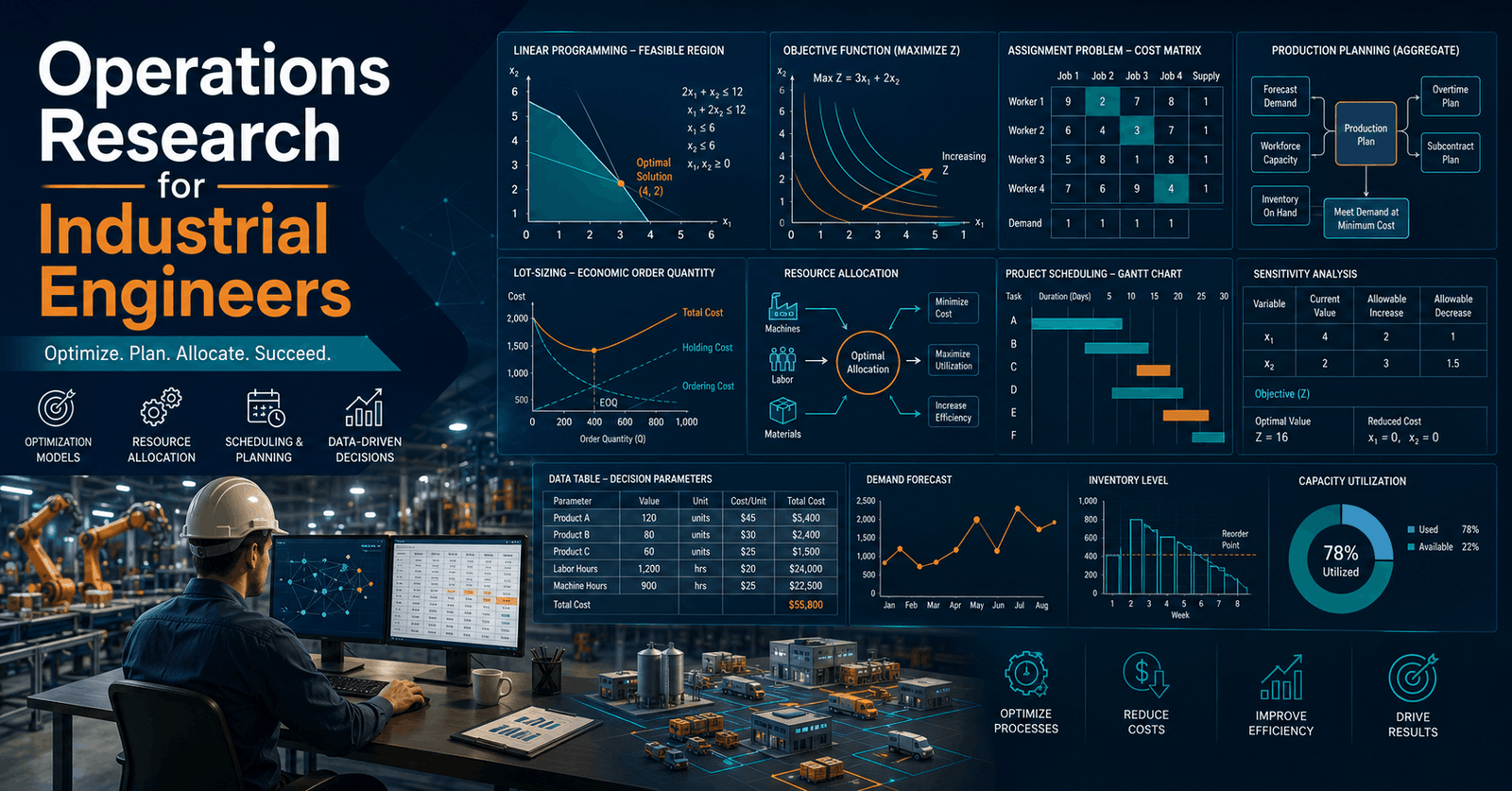
Operations Research provides a structured approach to solving complex industrial and business problems through mathematical modelling, optimization and data-driven decision-making. This course introduces essential operations research techniques in a practical, accessible way, helping learners understand how limited resources can be allocated effectively while working within real-world constraints.
The course begins with simple optimization examples before guiding learners through the process of building mathematical models. You will explore feasible solutions, optimal outcomes and graphical methods, developing a clear understanding of how optimization problems are represented and analysed. Practical Excel-based activities demonstrate how mathematical concepts can be applied to solve problems efficiently without relying solely on manual calculations.
As you progress, you will study linear programming and integer programming in greater depth. The course explains how to define decision variables, objective functions and constraints, while also introducing the formal structure of linear programs and mixed-integer linear programs. These skills are valuable for analysing production, scheduling, resource allocation and other operational challenges.
You will then examine the assignment problem, including its mathematical formulation, generalized assignment models and practical applications. This section develops your ability to match people, machines, tasks or resources efficiently according to specific objectives and limitations. The course also covers lot-sizing, an important area of production and inventory planning, showing how integer programming can support decisions about when and how much to produce.
By the end of the course, you will have developed a practical problem-solving framework for approaching linear and integer optimization problems. Whether you are studying industrial engineering, working in operations or seeking stronger analytical skills, the course provides knowledge that can support more systematic and informed decision-making.
Learners also benefit from access to our 5-star rated support team, available 24/7 through email whenever assistance is needed. Upon successful completion, you will receive a free course completion certificate. If you wish to enhance your professional or academic records further, multiple premium certificate and transcript options are also available for purchase.Who is this course for?
Operations Research provides a structured approach to solving complex industrial and business problems through mathematical modelling, optimization and data-driven decision-making. This course introduces essential operations research techniques in a practical, accessible way, helping learners understand how limited resources can be allocated effectively while working within real-world constraints.
The course begins with simple optimization examples before guiding learners through the process of building mathematical models. You will explore feasible solutions, optimal outcomes and graphical methods, developing a clear understanding of how optimization problems are represented and analysed. Practical Excel-based activities demonstrate how mathematical concepts can be applied to solve problems efficiently without relying solely on manual calculations.
As you progress, you will study linear programming and integer programming in greater depth. The course explains how to define decision variables, objective functions and constraints, while also introducing the formal structure of linear programs and mixed-integer linear programs. These skills are valuable for analysing production, scheduling, resource allocation and other operational challenges.
You will then examine the assignment problem, including its mathematical formulation, generalized assignment models and practical applications. This section develops your ability to match people, machines, tasks or resources efficiently according to specific objectives and limitations. The course also covers lot-sizing, an important area of production and inventory planning, showing how integer programming can support decisions about when and how much to produce.
By the end of the course, you will have developed a practical problem-solving framework for approaching linear and integer optimization problems. Whether you are studying industrial engineering, working in operations or seeking stronger analytical skills, the course provides knowledge that can support more systematic and informed decision-making.
Learners also benefit from access to our 5-star rated support team, available 24/7 through email whenever assistance is needed. Upon successful completion, you will receive a free course completion certificate. If you wish to enhance your professional or academic records further, multiple premium certificate and transcript options are also available for purchase.Requirements
Operations Research provides a structured approach to solving complex industrial and business problems through mathematical modelling, optimization and data-driven decision-making. This course introduces essential operations research techniques in a practical, accessible way, helping learners understand how limited resources can be allocated effectively while working within real-world constraints.
The course begins with simple optimization examples before guiding learners through the process of building mathematical models. You will explore feasible solutions, optimal outcomes and graphical methods, developing a clear understanding of how optimization problems are represented and analysed. Practical Excel-based activities demonstrate how mathematical concepts can be applied to solve problems efficiently without relying solely on manual calculations.
As you progress, you will study linear programming and integer programming in greater depth. The course explains how to define decision variables, objective functions and constraints, while also introducing the formal structure of linear programs and mixed-integer linear programs. These skills are valuable for analysing production, scheduling, resource allocation and other operational challenges.
You will then examine the assignment problem, including its mathematical formulation, generalized assignment models and practical applications. This section develops your ability to match people, machines, tasks or resources efficiently according to specific objectives and limitations. The course also covers lot-sizing, an important area of production and inventory planning, showing how integer programming can support decisions about when and how much to produce.
By the end of the course, you will have developed a practical problem-solving framework for approaching linear and integer optimization problems. Whether you are studying industrial engineering, working in operations or seeking stronger analytical skills, the course provides knowledge that can support more systematic and informed decision-making.
Learners also benefit from access to our 5-star rated support team, available 24/7 through email whenever assistance is needed. Upon successful completion, you will receive a free course completion certificate. If you wish to enhance your professional or academic records further, multiple premium certificate and transcript options are also available for purchase.Career path
Operations Research provides a structured approach to solving complex industrial and business problems through mathematical modelling, optimization and data-driven decision-making. This course introduces essential operations research techniques in a practical, accessible way, helping learners understand how limited resources can be allocated effectively while working within real-world constraints.
The course begins with simple optimization examples before guiding learners through the process of building mathematical models. You will explore feasible solutions, optimal outcomes and graphical methods, developing a clear understanding of how optimization problems are represented and analysed. Practical Excel-based activities demonstrate how mathematical concepts can be applied to solve problems efficiently without relying solely on manual calculations.
As you progress, you will study linear programming and integer programming in greater depth. The course explains how to define decision variables, objective functions and constraints, while also introducing the formal structure of linear programs and mixed-integer linear programs. These skills are valuable for analysing production, scheduling, resource allocation and other operational challenges.
You will then examine the assignment problem, including its mathematical formulation, generalized assignment models and practical applications. This section develops your ability to match people, machines, tasks or resources efficiently according to specific objectives and limitations. The course also covers lot-sizing, an important area of production and inventory planning, showing how integer programming can support decisions about when and how much to produce.
By the end of the course, you will have developed a practical problem-solving framework for approaching linear and integer optimization problems. Whether you are studying industrial engineering, working in operations or seeking stronger analytical skills, the course provides knowledge that can support more systematic and informed decision-making.
Learners also benefit from access to our 5-star rated support team, available 24/7 through email whenever assistance is needed. Upon successful completion, you will receive a free course completion certificate. If you wish to enhance your professional or academic records further, multiple premium certificate and transcript options are also available for purchase.-
- A Simple Real-World Example 00:10:00
- Building a Basic Model 00:10:00
- Visualizing Feasible and Optimal Solutions 00:10:00
- Visualizing All Feasible Choices 00:10:00
- Graphical Method for Optimal Solutions 00:10:00
- Solving Optimization Problems Using Excel 00:10:00
- Understanding Integrality Constraints 00:10:00
- Solving with Integrality Constraints in Excel 00:10:00
-
- High-Level Concepts of Linear Programming 00:10:00
- Defining Linear Programs (LPs) 00:10:00
- Practical Examples of Linear Programs 00:10:00
- Formal Structure of LPs 00:10:00
- Introduction to Mixed-Integer Linear Programs (MILPs) 00:10:00
- Definition and Mathematical Formulation 00:10:00
- Solving the Assignment Problem Using Excel 00:10:00
- Generalized Assignment Model 00:10:00
- Real-World Applications of the Assignment Problem 00:10:00
- High-Level Strategy for Integer Linear Programming 00:10:00
- Course Conclusion and Key Takeaways 00:10:00
- Premium Certificate 00:15:00

No Reviews found for this course.
Is this certificate recognized?
Yes, our premium certificate and transcript are widely recognized and accepted by embassies worldwide, particularly by the UK embassy. This adds credibility to your qualification and enhances its value for professional and academic purposes.
I am a beginner. Is this course suitable for me?
Yes, this course is designed for learners of all levels, including beginners. The content is structured to provide step-by-step guidance, ensuring that even those with no prior experience can follow along and gain valuable knowledge.
I am a professional. Is this course suitable for me?
Yes, professionals will also benefit from this course. It covers advanced concepts, practical applications, and industry insights that can help enhance existing skills and knowledge. Whether you are looking to refine your expertise or expand your qualifications, this course provides valuable learning.
Does this course have an expiry date?
No, you have lifetime access to the course. Once enrolled, you can revisit the materials at any time as long as the course remains available. Additionally, we regularly update our content to ensure it stays relevant and up to date.
How do I claim my free certificate?
I trust you’re in good health. Your free certificate can be located in the Achievement section. The option to purchase a CPD certificate is available but entirely optional, and you may choose to skip it. Please be aware that it’s crucial to click the “Complete” button to ensure the certificate is generated, as this process is entirely automated.
Does this course have assessments and assignments?
Yes, the course includes both assessments and assignments. Your final marks will be determined by a combination of 20% from assignments and 80% from assessments. These evaluations are designed to test your understanding and ensure you have grasped the key concepts effectively.
Is this course accredited?
We are a recognized course provider with CPD, UKRLP, and AOHT membership. The logos of these accreditation bodies will be featured on your premium certificate and transcript, ensuring credibility and professional recognition.
Will I receive a certificate upon completion?
Yes, you will receive a free digital certificate automatically once you complete the course. If you would like a premium CPD-accredited certificate, either in digital or physical format, you can upgrade for a small fee.
Course Features
Price
Study Method
Online | Self-paced
Course Format
Interactive PDFs, Articles & Learning Resources
Duration
4 hours, 55 minutes
Qualification
Professional Skills Development Course
Assessment
Final MCQ Exam (included in price)
Certificate
Verifiable Digital Certificate - Free
Additional info
Lifetime Access | Start Instantly
- Share

Legal Accounting Level 8 Advanced Diploma
Course Line237د.إ2,425.19Original price was: د.إ2,425.19.د.إ74.19Current price is: د.إ74.19.High-Ticket Video Review Mastery: Create Persuasive Testimonials That Sell
Course Line237د.إ2,425.19Original price was: د.إ2,425.19.د.إ74.19Current price is: د.إ74.19.Photonics Engineering Level 3 Advanced Diploma
Course Line237د.إ2,425.19Original price was: د.إ2,425.19.د.إ74.19Current price is: د.إ74.19.



Related Courses
PRINCE2 in Practice: Simulated Projects & Case Studies
د.إ2,425.19Original price was: د.إ2,425.19.د.إ74.19Current price is: د.إ74.19.237PRINCE2 Risk Management: Identifying, Assessing & Controlling Risk
د.إ2,425.19Original price was: د.إ2,425.19.د.إ74.19Current price is: د.إ74.19.237PRINCE2 Roles & Responsibilities: Managing Teams in a PRINCE2 Environment
د.إ2,425.19Original price was: د.إ2,425.19.د.إ74.19Current price is: د.إ74.19.237

Related Courses
PRINCE2 in Practice: Simulated Projects & Case Studies
د.إ2,425.19Original price was: د.إ2,425.19.د.إ74.19Current price is: د.إ74.19.237PRINCE2 Risk Management: Identifying, Assessing & Controlling Risk
د.إ2,425.19Original price was: د.إ2,425.19.د.إ74.19Current price is: د.إ74.19.237PRINCE2 Roles & Responsibilities: Managing Teams in a PRINCE2 Environment
د.إ2,425.19Original price was: د.إ2,425.19.د.إ74.19Current price is: د.إ74.19.237

