
Course Features
Price
Study Method
Online | Self-paced
Course Format
Reading Material - PDF, article
Duration
13 hours, 45 minutes
Qualification
No formal qualification
Certificate
At completion
Additional info
Coming soon
- Share
Overview
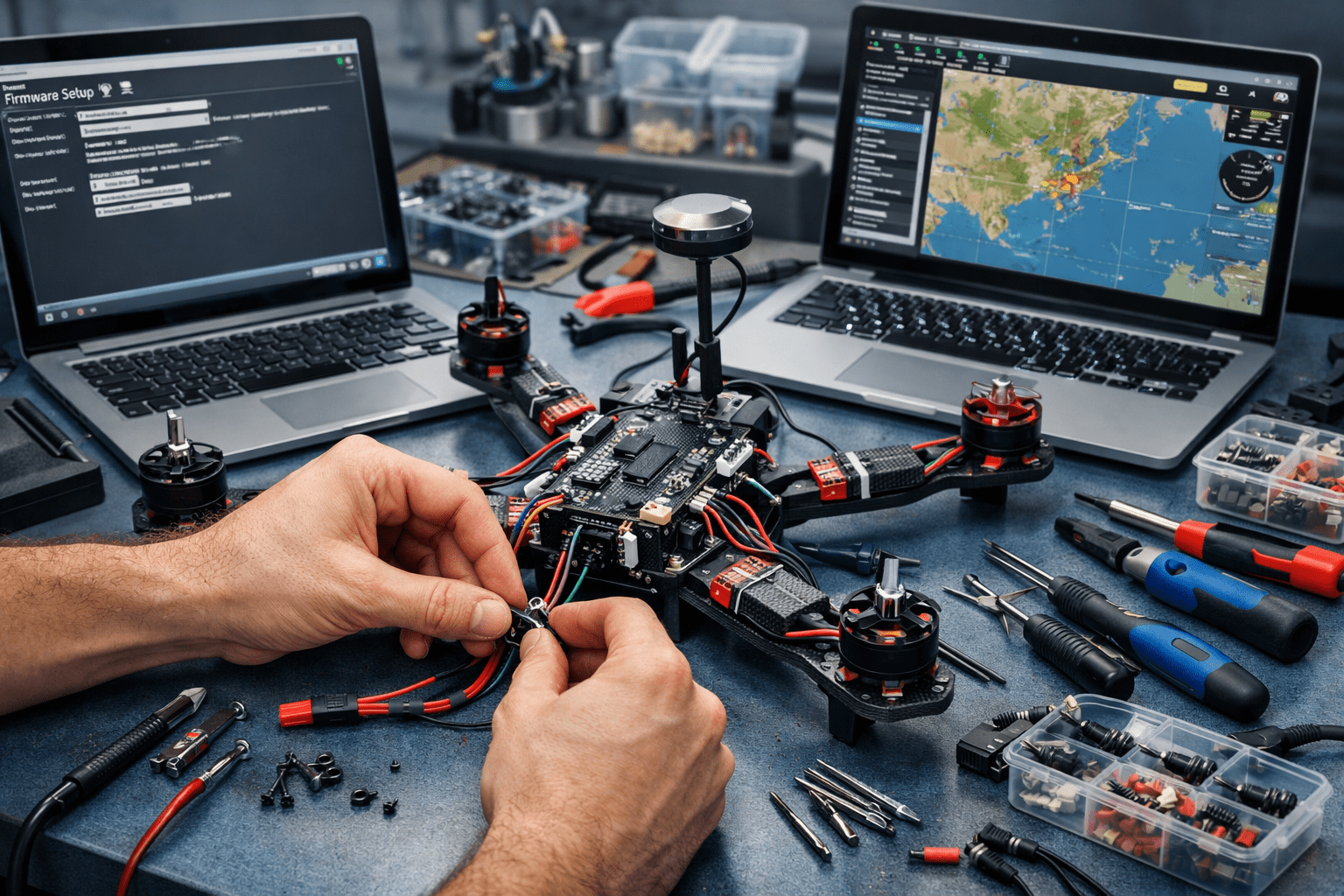
Open source drone technology is changing how people learn electronics, robotics and autonomous flight, and this course gives you a complete hands-on pathway to master it. In this practical, step-by-step training, you will learn how to design, build, configure and fly your own multi-rotor drone using open, customisable hardware and software. Every component is explained clearly, from motors and ESCs to power distribution boards, flight controllers and GPS modules.
You will explore how flight systems work together, including roll, pitch and yaw control, signal processing, power management and firmware configuration. The course also introduces you to industry-standard tools such as mission planning software and transmitter setup, giving you real-world experience that mirrors professional drone workflows. Rather than relying on pre-built kits, you will work with individual parts, gaining a deeper understanding of how drones are engineered and maintained.
A major focus of this training is confidence. You will learn safe battery handling, calibration procedures, wiring techniques and legal and safety considerations before flying. Guided test flights and upgrade projects, including the Pixhawk flight controller, allow you to expand your drone’s capabilities and experiment with advanced navigation and control systems.
By the end of the course, you will be able to assemble a fully functional drone, install and configure firmware, connect navigation modules, and perform stable flight operations. These skills are valuable not only for hobbyists, but also for students and professionals exploring robotics, aerospace, electronics and unmanned systems.
All learners receive a free course completion certificate when they finish the programme. For those who want formal recognition, multiple premium certificate and transcript options are also available for purchase. You will also have access to 5-star rated learner support available 24/7 via email, ensuring you always have expert help whenever you need it.
Who is this course for?
Open source drone technology is changing how people learn electronics, robotics and autonomous flight, and this course gives you a complete hands-on pathway to master it. In this practical, step-by-step training, you will learn how to design, build, configure and fly your own multi-rotor drone using open, customisable hardware and software. Every component is explained clearly, from motors and ESCs to power distribution boards, flight controllers and GPS modules.
You will explore how flight systems work together, including roll, pitch and yaw control, signal processing, power management and firmware configuration. The course also introduces you to industry-standard tools such as mission planning software and transmitter setup, giving you real-world experience that mirrors professional drone workflows. Rather than relying on pre-built kits, you will work with individual parts, gaining a deeper understanding of how drones are engineered and maintained.
A major focus of this training is confidence. You will learn safe battery handling, calibration procedures, wiring techniques and legal and safety considerations before flying. Guided test flights and upgrade projects, including the Pixhawk flight controller, allow you to expand your drone’s capabilities and experiment with advanced navigation and control systems.
By the end of the course, you will be able to assemble a fully functional drone, install and configure firmware, connect navigation modules, and perform stable flight operations. These skills are valuable not only for hobbyists, but also for students and professionals exploring robotics, aerospace, electronics and unmanned systems.
All learners receive a free course completion certificate when they finish the programme. For those who want formal recognition, multiple premium certificate and transcript options are also available for purchase. You will also have access to 5-star rated learner support available 24/7 via email, ensuring you always have expert help whenever you need it.
Requirements
Open source drone technology is changing how people learn electronics, robotics and autonomous flight, and this course gives you a complete hands-on pathway to master it. In this practical, step-by-step training, you will learn how to design, build, configure and fly your own multi-rotor drone using open, customisable hardware and software. Every component is explained clearly, from motors and ESCs to power distribution boards, flight controllers and GPS modules.
You will explore how flight systems work together, including roll, pitch and yaw control, signal processing, power management and firmware configuration. The course also introduces you to industry-standard tools such as mission planning software and transmitter setup, giving you real-world experience that mirrors professional drone workflows. Rather than relying on pre-built kits, you will work with individual parts, gaining a deeper understanding of how drones are engineered and maintained.
A major focus of this training is confidence. You will learn safe battery handling, calibration procedures, wiring techniques and legal and safety considerations before flying. Guided test flights and upgrade projects, including the Pixhawk flight controller, allow you to expand your drone’s capabilities and experiment with advanced navigation and control systems.
By the end of the course, you will be able to assemble a fully functional drone, install and configure firmware, connect navigation modules, and perform stable flight operations. These skills are valuable not only for hobbyists, but also for students and professionals exploring robotics, aerospace, electronics and unmanned systems.
All learners receive a free course completion certificate when they finish the programme. For those who want formal recognition, multiple premium certificate and transcript options are also available for purchase. You will also have access to 5-star rated learner support available 24/7 via email, ensuring you always have expert help whenever you need it.
Career path
Open source drone technology is changing how people learn electronics, robotics and autonomous flight, and this course gives you a complete hands-on pathway to master it. In this practical, step-by-step training, you will learn how to design, build, configure and fly your own multi-rotor drone using open, customisable hardware and software. Every component is explained clearly, from motors and ESCs to power distribution boards, flight controllers and GPS modules.
You will explore how flight systems work together, including roll, pitch and yaw control, signal processing, power management and firmware configuration. The course also introduces you to industry-standard tools such as mission planning software and transmitter setup, giving you real-world experience that mirrors professional drone workflows. Rather than relying on pre-built kits, you will work with individual parts, gaining a deeper understanding of how drones are engineered and maintained.
A major focus of this training is confidence. You will learn safe battery handling, calibration procedures, wiring techniques and legal and safety considerations before flying. Guided test flights and upgrade projects, including the Pixhawk flight controller, allow you to expand your drone’s capabilities and experiment with advanced navigation and control systems.
By the end of the course, you will be able to assemble a fully functional drone, install and configure firmware, connect navigation modules, and perform stable flight operations. These skills are valuable not only for hobbyists, but also for students and professionals exploring robotics, aerospace, electronics and unmanned systems.
All learners receive a free course completion certificate when they finish the programme. For those who want formal recognition, multiple premium certificate and transcript options are also available for purchase. You will also have access to 5-star rated learner support available 24/7 via email, ensuring you always have expert help whenever you need it.
-
- What This Course is About 00:10:00
-
- Introduction to Multi-Copter Drones 00:10:00
- Types of Multi-Rotor Drones 00:10:00
- Understanding Roll, Pitch and Yaw 00:10:00
- Controlling the Motors 00:10:00
- Procuring the Right Parts 00:10:00
- Drone Terminology 00:10:00
- Propellers – Selection and Use 00:10:00
- Battery and Charger Basics (Part 1) 00:10:00
- Battery and Charger Basics (Part 2) 00:10:00
- Flight Controller and Its Peripherals 00:10:00
- Other Tools and Components You’ll Need 00:10:00
- Module Conclusion 00:10:00
- Introduction to ESCs and Motors 00:10:00
- Preparation Steps 00:10:00
- Attaching Connectors to ESC Wires 00:10:00
- Attaching Connectors to Motor Wires 00:10:00
- Module Conclusion 00:10:00
- Introduction to Main Body Assembly 00:10:00
- Attaching the Motors to the Arms 00:10:00
- Attaching the Arms to the Power Distribution Board (Part 1) 00:10:00
- Attaching the Arms to the Power Distribution Board (Part 2) 00:10:00
- Module Conclusion 00:10:00
- How to Charge the Battery Safely 00:10:00
- Attaching the Battery to the Frame 00:10:00
- Module Conclusion 00:10:00
- Binding Receiver and Transmitter 00:10:00
- Understanding Basic Transmitter Operations 00:10:00
- Module Conclusion 00:10:00
- Calibrating the ESCs 00:10:00
- Attaching the Propellers 00:10:00
- Safety and Legal Considerations 00:10:00
- Module Conclusion 00:10:00
- Section Introduction 00:10:00
- Why Upgrade to the Pixhawk Flight Controller 00:10:00
- Disassembly 00:10:00
- Review of Upgrade Components 00:10:00
- Assembly Part 1 – Propellers 00:10:00
- Assembly Part 2 – ESC Red Wire Insulation 00:10:00
- Assembly Part 3 – Pixhawk Base 00:10:00
- Assembly Part 4 – GPS Antenna 00:10:00
- Assembly Part 5 – Pixhawk Assembly 00:10:00
- Assembly Part 6 – Buzzer and Safety Button 00:10:00
- Assembly Part 7 – Wirings 00:10:00
- Battery and Power Connections 00:10:00
- Verifying Wiring in Mission Planner 00:10:00
- Attaching the Propellers 00:10:00
- Calibration and Test Flight 00:10:00
- Exam of Make an Open-Source Drone: Complete Hands-On Guide with Tech Explorations 00:50:00

No Reviews found for this course.
Is this certificate recognized?
Yes, our premium certificate and transcript are widely recognized and accepted by embassies worldwide, particularly by the UK embassy. This adds credibility to your qualification and enhances its value for professional and academic purposes.
I am a beginner. Is this course suitable for me?
Yes, this course is designed for learners of all levels, including beginners. The content is structured to provide step-by-step guidance, ensuring that even those with no prior experience can follow along and gain valuable knowledge.
I am a professional. Is this course suitable for me?
Yes, professionals will also benefit from this course. It covers advanced concepts, practical applications, and industry insights that can help enhance existing skills and knowledge. Whether you are looking to refine your expertise or expand your qualifications, this course provides valuable learning.
Does this course have an expiry date?
No, you have lifetime access to the course. Once enrolled, you can revisit the materials at any time as long as the course remains available. Additionally, we regularly update our content to ensure it stays relevant and up to date.
How do I claim my free certificate?
I trust you’re in good health. Your free certificate can be located in the Achievement section. The option to purchase a CPD certificate is available but entirely optional, and you may choose to skip it. Please be aware that it’s crucial to click the “Complete” button to ensure the certificate is generated, as this process is entirely automated.
Does this course have assessments and assignments?
Yes, the course includes both assessments and assignments. Your final marks will be determined by a combination of 20% from assignments and 80% from assessments. These evaluations are designed to test your understanding and ensure you have grasped the key concepts effectively.
Is this course accredited?
We are a recognized course provider with CPD, UKRLP, and AOHT membership. The logos of these accreditation bodies will be featured on your premium certificate and transcript, ensuring credibility and professional recognition.
Will I receive a certificate upon completion?
Yes, you will receive a free digital certificate automatically once you complete the course. If you would like a premium CPD-accredited certificate, either in digital or physical format, you can upgrade for a small fee.
Course Features
Price
Study Method
Online | Self-paced
Course Format
Reading Material - PDF, article
Duration
13 hours, 45 minutes
Qualification
No formal qualification
Certificate
At completion
Additional info
Coming soon
- Share

OCD and Anxiety: Awareness and Effective Coping Strategies
Course Line238¥4,584.58Original price was: ¥4,584.58.¥140.25Current price is: ¥140.25.Sports Physiotherapy Level 3 Advanced Diploma
Course Line238¥4,584.58Original price was: ¥4,584.58.¥140.25Current price is: ¥140.25.Spray Painting Level 3 Advanced Diploma
Course Line239¥4,584.58Original price was: ¥4,584.58.¥140.25Current price is: ¥140.25.



Related Courses
Computer Network Security & Ethical Hacking: From Zero to Advanced
¥4,584.58Original price was: ¥4,584.58.¥140.25Current price is: ¥140.25.237Software Engineering Level 8 Advanced Diploma
¥4,584.58Original price was: ¥4,584.58.¥140.25Current price is: ¥140.25.239Digital Marketing Strategy 2024 Master Bundle – 6 Practical Courses in 1!
¥4,584.58Original price was: ¥4,584.58.¥140.25Current price is: ¥140.25.237




Related Courses
Computer Network Security & Ethical Hacking: From Zero to Advanced
¥4,584.58Original price was: ¥4,584.58.¥140.25Current price is: ¥140.25.237Software Engineering Level 8 Advanced Diploma
¥4,584.58Original price was: ¥4,584.58.¥140.25Current price is: ¥140.25.239Digital Marketing Strategy 2024 Master Bundle – 6 Practical Courses in 1!
¥4,584.58Original price was: ¥4,584.58.¥140.25Current price is: ¥140.25.237

