
Course Features
Price
Study Method
Online | Self-paced
Course Format
Reading Material - PDF, article
Duration
6 hours, 25 minutes
Qualification
No formal qualification
Certificate
At completion
Additional info
Coming soon
- Share
Overview
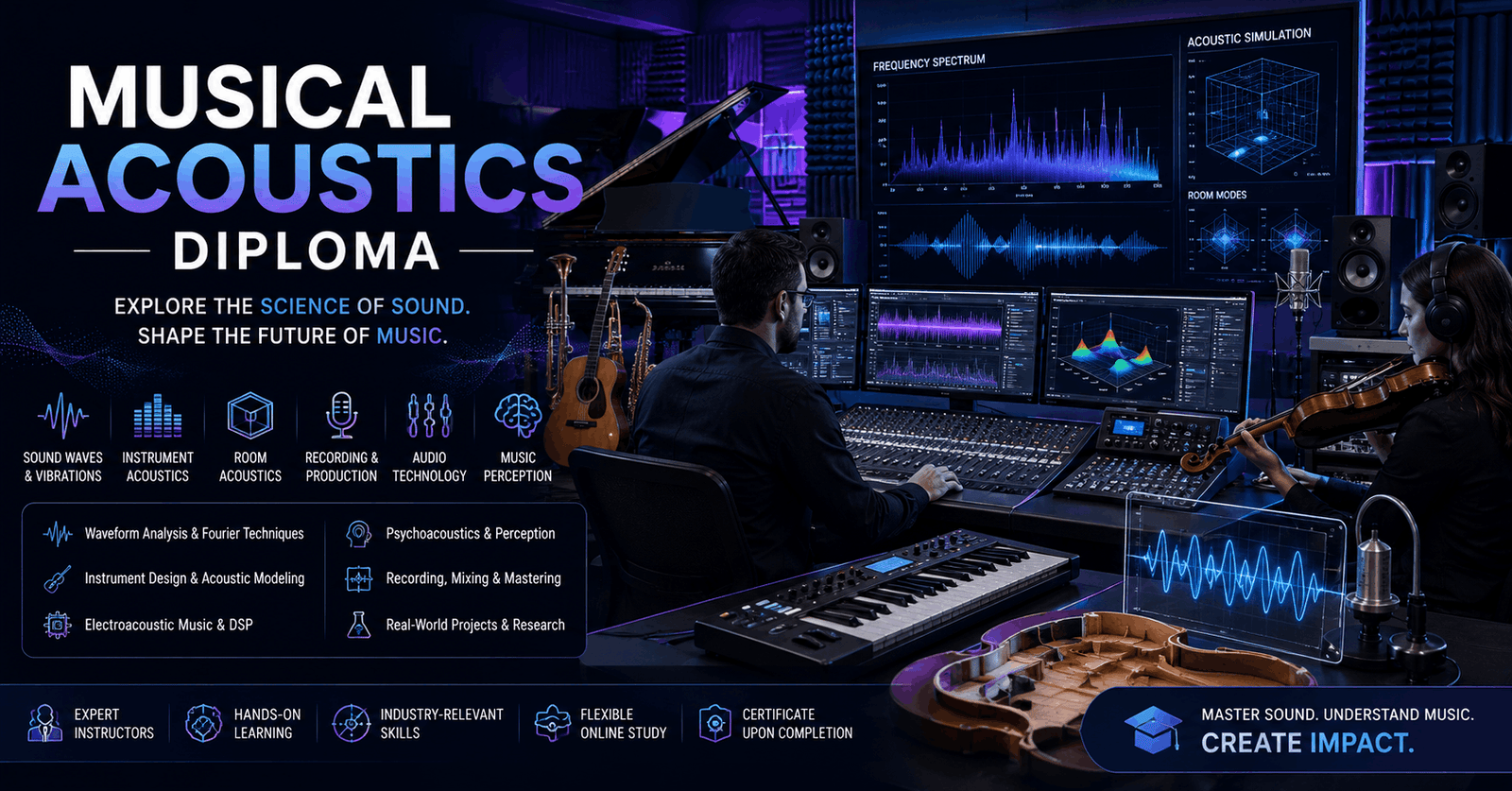
Musical Acoustics Diploma is an engaging online programme designed for learners who want to explore the science of sound, music technology, and acoustic principles within modern musical environments. This course combines theoretical understanding with practical applications, helping students develop specialist knowledge of how sound behaves, how musical instruments produce tone, and how acoustics influence music performance, recording, and listening experiences.
Throughout the course, learners will study sound waves, vibrations, harmonics, waveform analysis, and acoustic modelling while gaining insight into the relationship between music, physics, and technology. The programme also explores the acoustic properties of different instrument families, including strings, brass, woodwinds, and percussion instruments, helping learners understand how instrument design affects timbre and sound production.
Students will also discover the importance of room acoustics and acoustic design in recording studios, performance venues, and live music environments. Topics such as sound reflection, absorption, diffusion, and architectural acoustics provide valuable knowledge for those interested in audio engineering, venue design, music production, or sound consulting. The course additionally introduces electroacoustic music, digital audio processing, mixing, mastering, MIDI technology, and real-time audio effects used in contemporary music production.
Another key focus of this diploma is psychoacoustics and music perception. Learners will examine how humans perceive pitch, timbre, spatial sound, and musical emotion while exploring the psychological and cognitive aspects of music listening. Practical applications in instrument maintenance, sound reinforcement systems, acoustic analysis, and music technology are also included to support career-focused skill development.
This flexible online course allows learners to study from anywhere at their own pace, making it suitable for both beginners and individuals with existing musical or audio experience. By the end of the programme, learners will have developed valuable technical, analytical, and creative skills relevant to music production, sound engineering, acoustic research, and audio technology industries.
Upon successful completion, learners will receive a free course completion certificate. Multiple premium certificate and transcript options are also available for purchase for those wishing to enhance their professional portfolio. Students will also benefit from 5-star rated support available 24/7 through email throughout their learning journey.
Completing this diploma can support progression into roles such as Audio Engineer, Sound Designer, Music Producer, Acoustic Consultant, Recording Technician, Live Sound Technician, or Music Technology Specialist. The qualification may also support further education in acoustics, music production, sound engineering, or audio research disciplines.
Who is this course for?
Musical Acoustics Diploma is an engaging online programme designed for learners who want to explore the science of sound, music technology, and acoustic principles within modern musical environments. This course combines theoretical understanding with practical applications, helping students develop specialist knowledge of how sound behaves, how musical instruments produce tone, and how acoustics influence music performance, recording, and listening experiences.
Throughout the course, learners will study sound waves, vibrations, harmonics, waveform analysis, and acoustic modelling while gaining insight into the relationship between music, physics, and technology. The programme also explores the acoustic properties of different instrument families, including strings, brass, woodwinds, and percussion instruments, helping learners understand how instrument design affects timbre and sound production.
Students will also discover the importance of room acoustics and acoustic design in recording studios, performance venues, and live music environments. Topics such as sound reflection, absorption, diffusion, and architectural acoustics provide valuable knowledge for those interested in audio engineering, venue design, music production, or sound consulting. The course additionally introduces electroacoustic music, digital audio processing, mixing, mastering, MIDI technology, and real-time audio effects used in contemporary music production.
Another key focus of this diploma is psychoacoustics and music perception. Learners will examine how humans perceive pitch, timbre, spatial sound, and musical emotion while exploring the psychological and cognitive aspects of music listening. Practical applications in instrument maintenance, sound reinforcement systems, acoustic analysis, and music technology are also included to support career-focused skill development.
This flexible online course allows learners to study from anywhere at their own pace, making it suitable for both beginners and individuals with existing musical or audio experience. By the end of the programme, learners will have developed valuable technical, analytical, and creative skills relevant to music production, sound engineering, acoustic research, and audio technology industries.
Upon successful completion, learners will receive a free course completion certificate. Multiple premium certificate and transcript options are also available for purchase for those wishing to enhance their professional portfolio. Students will also benefit from 5-star rated support available 24/7 through email throughout their learning journey.
Completing this diploma can support progression into roles such as Audio Engineer, Sound Designer, Music Producer, Acoustic Consultant, Recording Technician, Live Sound Technician, or Music Technology Specialist. The qualification may also support further education in acoustics, music production, sound engineering, or audio research disciplines.
Requirements
Musical Acoustics Diploma is an engaging online programme designed for learners who want to explore the science of sound, music technology, and acoustic principles within modern musical environments. This course combines theoretical understanding with practical applications, helping students develop specialist knowledge of how sound behaves, how musical instruments produce tone, and how acoustics influence music performance, recording, and listening experiences.
Throughout the course, learners will study sound waves, vibrations, harmonics, waveform analysis, and acoustic modelling while gaining insight into the relationship between music, physics, and technology. The programme also explores the acoustic properties of different instrument families, including strings, brass, woodwinds, and percussion instruments, helping learners understand how instrument design affects timbre and sound production.
Students will also discover the importance of room acoustics and acoustic design in recording studios, performance venues, and live music environments. Topics such as sound reflection, absorption, diffusion, and architectural acoustics provide valuable knowledge for those interested in audio engineering, venue design, music production, or sound consulting. The course additionally introduces electroacoustic music, digital audio processing, mixing, mastering, MIDI technology, and real-time audio effects used in contemporary music production.
Another key focus of this diploma is psychoacoustics and music perception. Learners will examine how humans perceive pitch, timbre, spatial sound, and musical emotion while exploring the psychological and cognitive aspects of music listening. Practical applications in instrument maintenance, sound reinforcement systems, acoustic analysis, and music technology are also included to support career-focused skill development.
This flexible online course allows learners to study from anywhere at their own pace, making it suitable for both beginners and individuals with existing musical or audio experience. By the end of the programme, learners will have developed valuable technical, analytical, and creative skills relevant to music production, sound engineering, acoustic research, and audio technology industries.
Upon successful completion, learners will receive a free course completion certificate. Multiple premium certificate and transcript options are also available for purchase for those wishing to enhance their professional portfolio. Students will also benefit from 5-star rated support available 24/7 through email throughout their learning journey.
Completing this diploma can support progression into roles such as Audio Engineer, Sound Designer, Music Producer, Acoustic Consultant, Recording Technician, Live Sound Technician, or Music Technology Specialist. The qualification may also support further education in acoustics, music production, sound engineering, or audio research disciplines.
Career path
Musical Acoustics Diploma is an engaging online programme designed for learners who want to explore the science of sound, music technology, and acoustic principles within modern musical environments. This course combines theoretical understanding with practical applications, helping students develop specialist knowledge of how sound behaves, how musical instruments produce tone, and how acoustics influence music performance, recording, and listening experiences.
Throughout the course, learners will study sound waves, vibrations, harmonics, waveform analysis, and acoustic modelling while gaining insight into the relationship between music, physics, and technology. The programme also explores the acoustic properties of different instrument families, including strings, brass, woodwinds, and percussion instruments, helping learners understand how instrument design affects timbre and sound production.
Students will also discover the importance of room acoustics and acoustic design in recording studios, performance venues, and live music environments. Topics such as sound reflection, absorption, diffusion, and architectural acoustics provide valuable knowledge for those interested in audio engineering, venue design, music production, or sound consulting. The course additionally introduces electroacoustic music, digital audio processing, mixing, mastering, MIDI technology, and real-time audio effects used in contemporary music production.
Another key focus of this diploma is psychoacoustics and music perception. Learners will examine how humans perceive pitch, timbre, spatial sound, and musical emotion while exploring the psychological and cognitive aspects of music listening. Practical applications in instrument maintenance, sound reinforcement systems, acoustic analysis, and music technology are also included to support career-focused skill development.
This flexible online course allows learners to study from anywhere at their own pace, making it suitable for both beginners and individuals with existing musical or audio experience. By the end of the programme, learners will have developed valuable technical, analytical, and creative skills relevant to music production, sound engineering, acoustic research, and audio technology industries.
Upon successful completion, learners will receive a free course completion certificate. Multiple premium certificate and transcript options are also available for purchase for those wishing to enhance their professional portfolio. Students will also benefit from 5-star rated support available 24/7 through email throughout their learning journey.
Completing this diploma can support progression into roles such as Audio Engineer, Sound Designer, Music Producer, Acoustic Consultant, Recording Technician, Live Sound Technician, or Music Technology Specialist. The qualification may also support further education in acoustics, music production, sound engineering, or audio research disciplines.
-
- Overview of wave properties 00:10:00
- Harmonics and overtones 00:10:00
- Waveform analysis 00:10:00
- Fourier analysis in musical contexts 00:10:00
- Sound synthesis techniques 00:10:00
-
- Detailed study of different instrument families 00:10:00
- How instrument design impacts sound production 00:10:00
- Acoustic modeling and simulation of instruments 00:10:00
- Timbre and tone production 00:10:00
- The role of room acoustics in music 00:10:00
- Principles of room acoustics 00:10:00
- Sound reflection, absorption, and diffusion 00:10:00
- Architectural considerations for performance spaces 00:10:00
- Research methods in musical instrument acoustics 00:10:00
- Investigating the acoustical properties of specific instruments 00:10:00
- Case studies and practical experiments 00:10:00
- Ethical considerations in research 00:10:00
- Acoustic instrument design and modif 00:10:00
- Sound reinforcement systems 00:10:00
- Acoustic analysis for instrument maintenance and repair 00:10:00
- Consulting and acoustical design for music venues 00:10:00
- Exam of Musical Acoustics Level 3 Advanced Diploma 00:50:00

No Reviews found for this course.
Is this certificate recognized?
Yes, our premium certificate and transcript are widely recognized and accepted by embassies worldwide, particularly by the UK embassy. This adds credibility to your qualification and enhances its value for professional and academic purposes.
I am a beginner. Is this course suitable for me?
Yes, this course is designed for learners of all levels, including beginners. The content is structured to provide step-by-step guidance, ensuring that even those with no prior experience can follow along and gain valuable knowledge.
I am a professional. Is this course suitable for me?
Yes, professionals will also benefit from this course. It covers advanced concepts, practical applications, and industry insights that can help enhance existing skills and knowledge. Whether you are looking to refine your expertise or expand your qualifications, this course provides valuable learning.
Does this course have an expiry date?
No, you have lifetime access to the course. Once enrolled, you can revisit the materials at any time as long as the course remains available. Additionally, we regularly update our content to ensure it stays relevant and up to date.
How do I claim my free certificate?
I trust you’re in good health. Your free certificate can be located in the Achievement section. The option to purchase a CPD certificate is available but entirely optional, and you may choose to skip it. Please be aware that it’s crucial to click the “Complete” button to ensure the certificate is generated, as this process is entirely automated.
Does this course have assessments and assignments?
Yes, the course includes both assessments and assignments. Your final marks will be determined by a combination of 20% from assignments and 80% from assessments. These evaluations are designed to test your understanding and ensure you have grasped the key concepts effectively.
Is this course accredited?
We are a recognized course provider with CPD, UKRLP, and AOHT membership. The logos of these accreditation bodies will be featured on your premium certificate and transcript, ensuring credibility and professional recognition.
Will I receive a certificate upon completion?
Yes, you will receive a free digital certificate automatically once you complete the course. If you would like a premium CPD-accredited certificate, either in digital or physical format, you can upgrade for a small fee.
Course Features
Price
Study Method
Online | Self-paced
Course Format
Reading Material - PDF, article
Duration
6 hours, 25 minutes
Qualification
No formal qualification
Certificate
At completion
Additional info
Coming soon
- Share

Master IELTS Essay Writing: 7 Essay Types in 7 Focused Sessions
Course Line237$843.83Original price was: $843.83.$25.81Current price is: $25.81.Handyperson Level 8 Advanced Diploma
Course Line238$843.83Original price was: $843.83.$25.81Current price is: $25.81.eBay Dropshipping Mastery: Build, Scale, and Profit from Your Online Business
Course Line241$843.83Original price was: $843.83.$25.81Current price is: $25.81.



Related Courses
AutoCAD Floor Plan Rendering in Photoshop: Architectural Visualisation Professional Training
$843.83Original price was: $843.83.$25.81Current price is: $25.81.237Professional Photography Masterclass: Camera, Lighting, Composition & Portraits
$843.83Original price was: $843.83.$25.81Current price is: $25.81.237Adobe Photoshop CC MasterClass: From Beginner to Advanced Digital Artist
$843.83Original price was: $843.83.$25.81Current price is: $25.81.237




Related Courses
AutoCAD Floor Plan Rendering in Photoshop: Architectural Visualisation Professional Training
$843.83Original price was: $843.83.$25.81Current price is: $25.81.237Professional Photography Masterclass: Camera, Lighting, Composition & Portraits
$843.83Original price was: $843.83.$25.81Current price is: $25.81.237Adobe Photoshop CC MasterClass: From Beginner to Advanced Digital Artist
$843.83Original price was: $843.83.$25.81Current price is: $25.81.237

