
Course Features
Price
Study Method
Online | Self-paced
Course Format
Interactive PDFs, Articles & Learning Resources
Duration
4 hours, 55 minutes
Qualification
Professional Skills Development Course
Assessment
Final MCQ Exam (included in price)
Certificate
Verifiable Digital Certificate - Free
Additional info
Lifetime Access | Start Instantly
- Share
Overview
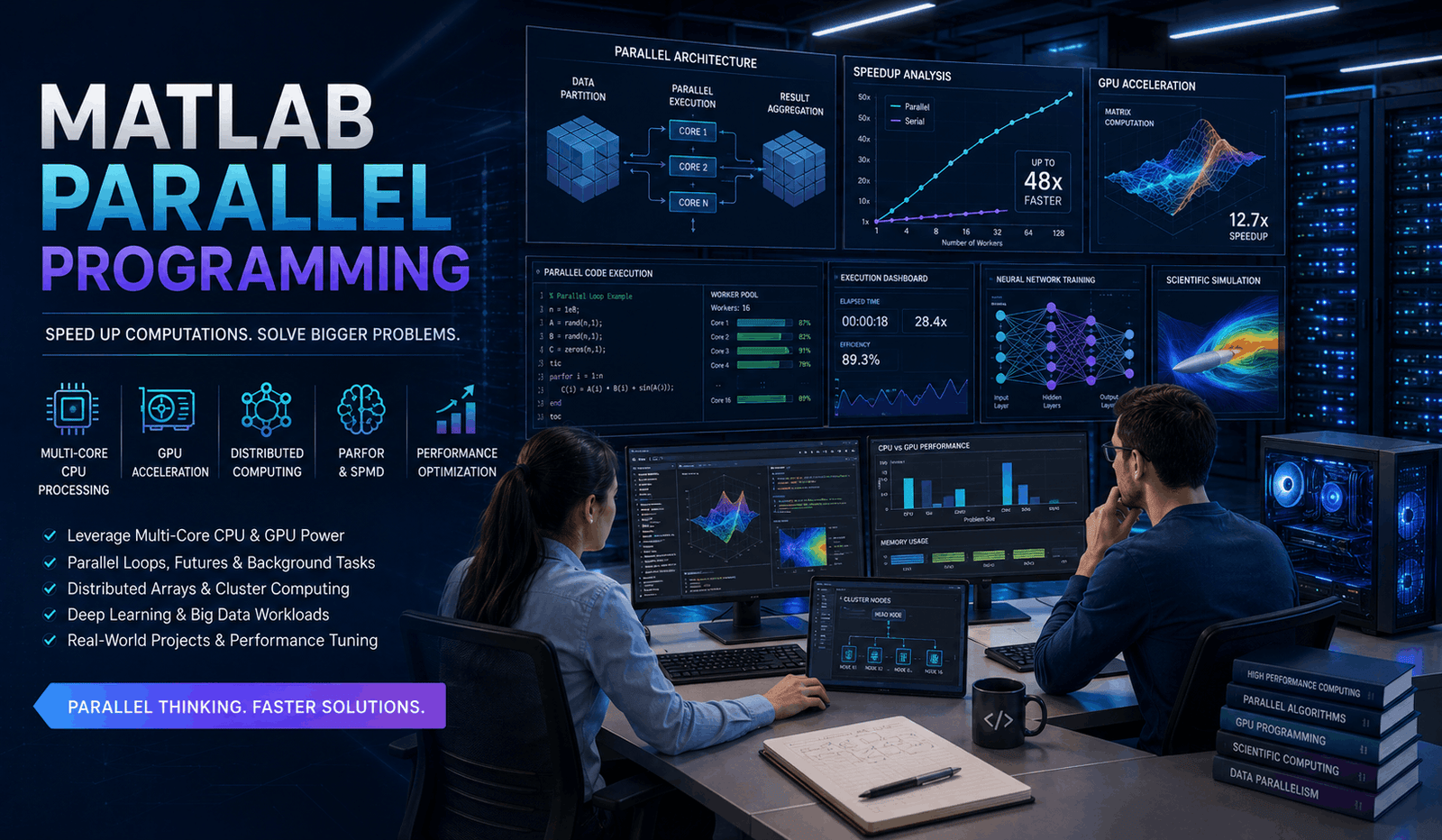
MATLAB Parallel Programming is an essential skill for engineers, researchers, data scientists, and developers who want to accelerate computational workloads and make full use of modern multi-core processors and GPU hardware. This course provides a practical introduction to parallel computing techniques in MATLAB, helping you optimise code execution, reduce processing time, and improve the performance of data-intensive applications and deep learning workflows.
The course begins by introducing the core concepts of parallel computing, including CPUs, processor cores, logical processors, and GPUs. You will gain a clear understanding of how parallel architectures differ from traditional sequential computing and how MATLAB enables efficient execution across multiple computing resources. These foundational concepts prepare you for implementing parallel programming techniques in real-world scientific and engineering projects.
As your knowledge develops, you will explore MATLAB's powerful parallel computing features, including multi-threading, multi-worker execution, parfor loops, nested parallel loops, reduction variables, and techniques for distributing workloads efficiently across available processor cores. You will also learn how to avoid common implementation mistakes while improving the scalability and reliability of your parallel applications.
The course then advances into GPU programming, where you will discover how to verify hardware compatibility, execute computations on graphics processing units, manage multiple GPUs, and accelerate computationally intensive tasks. In addition, you will examine advanced features such as Single Program Multiple Data (SPMD), background execution with parfeval, batch processing, and GPU acceleration for neural network training and deep learning applications. These practical techniques are increasingly valuable for high-performance computing, artificial intelligence, image processing, and large-scale numerical simulations.
By the end of the course, you will have the knowledge and confidence to develop faster MATLAB applications by leveraging parallel computing resources effectively. These skills can significantly improve productivity while preparing you for more advanced work in scientific computing, machine learning, engineering analysis, and computational research.
Upon successful completion, you will receive a free course completion certificate. If you require additional credentials, multiple premium certificate and transcript options are available for purchase. Throughout your learning journey, you will also benefit from 5-star rated support available 24/7 through email, ensuring expert assistance whenever you need guidance.Who is this course for?
MATLAB Parallel Programming is an essential skill for engineers, researchers, data scientists, and developers who want to accelerate computational workloads and make full use of modern multi-core processors and GPU hardware. This course provides a practical introduction to parallel computing techniques in MATLAB, helping you optimise code execution, reduce processing time, and improve the performance of data-intensive applications and deep learning workflows.
The course begins by introducing the core concepts of parallel computing, including CPUs, processor cores, logical processors, and GPUs. You will gain a clear understanding of how parallel architectures differ from traditional sequential computing and how MATLAB enables efficient execution across multiple computing resources. These foundational concepts prepare you for implementing parallel programming techniques in real-world scientific and engineering projects.
As your knowledge develops, you will explore MATLAB's powerful parallel computing features, including multi-threading, multi-worker execution, parfor loops, nested parallel loops, reduction variables, and techniques for distributing workloads efficiently across available processor cores. You will also learn how to avoid common implementation mistakes while improving the scalability and reliability of your parallel applications.
The course then advances into GPU programming, where you will discover how to verify hardware compatibility, execute computations on graphics processing units, manage multiple GPUs, and accelerate computationally intensive tasks. In addition, you will examine advanced features such as Single Program Multiple Data (SPMD), background execution with parfeval, batch processing, and GPU acceleration for neural network training and deep learning applications. These practical techniques are increasingly valuable for high-performance computing, artificial intelligence, image processing, and large-scale numerical simulations.
By the end of the course, you will have the knowledge and confidence to develop faster MATLAB applications by leveraging parallel computing resources effectively. These skills can significantly improve productivity while preparing you for more advanced work in scientific computing, machine learning, engineering analysis, and computational research.
Upon successful completion, you will receive a free course completion certificate. If you require additional credentials, multiple premium certificate and transcript options are available for purchase. Throughout your learning journey, you will also benefit from 5-star rated support available 24/7 through email, ensuring expert assistance whenever you need guidance.Requirements
MATLAB Parallel Programming is an essential skill for engineers, researchers, data scientists, and developers who want to accelerate computational workloads and make full use of modern multi-core processors and GPU hardware. This course provides a practical introduction to parallel computing techniques in MATLAB, helping you optimise code execution, reduce processing time, and improve the performance of data-intensive applications and deep learning workflows.
The course begins by introducing the core concepts of parallel computing, including CPUs, processor cores, logical processors, and GPUs. You will gain a clear understanding of how parallel architectures differ from traditional sequential computing and how MATLAB enables efficient execution across multiple computing resources. These foundational concepts prepare you for implementing parallel programming techniques in real-world scientific and engineering projects.
As your knowledge develops, you will explore MATLAB's powerful parallel computing features, including multi-threading, multi-worker execution, parfor loops, nested parallel loops, reduction variables, and techniques for distributing workloads efficiently across available processor cores. You will also learn how to avoid common implementation mistakes while improving the scalability and reliability of your parallel applications.
The course then advances into GPU programming, where you will discover how to verify hardware compatibility, execute computations on graphics processing units, manage multiple GPUs, and accelerate computationally intensive tasks. In addition, you will examine advanced features such as Single Program Multiple Data (SPMD), background execution with parfeval, batch processing, and GPU acceleration for neural network training and deep learning applications. These practical techniques are increasingly valuable for high-performance computing, artificial intelligence, image processing, and large-scale numerical simulations.
By the end of the course, you will have the knowledge and confidence to develop faster MATLAB applications by leveraging parallel computing resources effectively. These skills can significantly improve productivity while preparing you for more advanced work in scientific computing, machine learning, engineering analysis, and computational research.
Upon successful completion, you will receive a free course completion certificate. If you require additional credentials, multiple premium certificate and transcript options are available for purchase. Throughout your learning journey, you will also benefit from 5-star rated support available 24/7 through email, ensuring expert assistance whenever you need guidance.Career path
MATLAB Parallel Programming is an essential skill for engineers, researchers, data scientists, and developers who want to accelerate computational workloads and make full use of modern multi-core processors and GPU hardware. This course provides a practical introduction to parallel computing techniques in MATLAB, helping you optimise code execution, reduce processing time, and improve the performance of data-intensive applications and deep learning workflows.
The course begins by introducing the core concepts of parallel computing, including CPUs, processor cores, logical processors, and GPUs. You will gain a clear understanding of how parallel architectures differ from traditional sequential computing and how MATLAB enables efficient execution across multiple computing resources. These foundational concepts prepare you for implementing parallel programming techniques in real-world scientific and engineering projects.
As your knowledge develops, you will explore MATLAB's powerful parallel computing features, including multi-threading, multi-worker execution, parfor loops, nested parallel loops, reduction variables, and techniques for distributing workloads efficiently across available processor cores. You will also learn how to avoid common implementation mistakes while improving the scalability and reliability of your parallel applications.
The course then advances into GPU programming, where you will discover how to verify hardware compatibility, execute computations on graphics processing units, manage multiple GPUs, and accelerate computationally intensive tasks. In addition, you will examine advanced features such as Single Program Multiple Data (SPMD), background execution with parfeval, batch processing, and GPU acceleration for neural network training and deep learning applications. These practical techniques are increasingly valuable for high-performance computing, artificial intelligence, image processing, and large-scale numerical simulations.
By the end of the course, you will have the knowledge and confidence to develop faster MATLAB applications by leveraging parallel computing resources effectively. These skills can significantly improve productivity while preparing you for more advanced work in scientific computing, machine learning, engineering analysis, and computational research.
Upon successful completion, you will receive a free course completion certificate. If you require additional credentials, multiple premium certificate and transcript options are available for purchase. Throughout your learning journey, you will also benefit from 5-star rated support available 24/7 through email, ensuring expert assistance whenever you need guidance.-
- Concepts of Cores, CPUs and GPUs 00:10:00
- Difference Between Cores and Logical Processors 00:10:00
-
- Practical Examples: Multi-Threading Concepts 00:10:00
- Practical Examples: Multi-Workers Concept 00:10:00
- Controlling the Number of Cores for Execution 00:10:00
- Common Mistakes with parfor (4 Key Pitfalls) 00:10:00
- Using Nested parfor Loops in MATLAB 00:10:00
- Analyzing Data Distribution in Nested Loops Across Cores 00:10:00
- Functions in parfor 00:10:00
- Reduction Variables 00:10:00
- Displaying Values inside the parfor Loop 00:10:00
- Single Instruction Multiple Data (SPMD) 00:10:00
- Running Functions in the Background using parfeval 00:10:00
- Batch Jobs in MATLAB 00:10:00
- Training Neural Networks in Parallel with GPUs 00:10:00
- Using Multi-GPUs for Neural Network Training 00:10:00
- Training Deep Learning Models in Parallel with GPUs 00:10:00
- Running Deep Neural Networks in Background Parallel Mode 00:10:00
- Premium Certificate 00:15:00

No Reviews found for this course.
Is this certificate recognized?
Yes, our premium certificate and transcript are widely recognized and accepted by embassies worldwide, particularly by the UK embassy. This adds credibility to your qualification and enhances its value for professional and academic purposes.
I am a beginner. Is this course suitable for me?
Yes, this course is designed for learners of all levels, including beginners. The content is structured to provide step-by-step guidance, ensuring that even those with no prior experience can follow along and gain valuable knowledge.
I am a professional. Is this course suitable for me?
Yes, professionals will also benefit from this course. It covers advanced concepts, practical applications, and industry insights that can help enhance existing skills and knowledge. Whether you are looking to refine your expertise or expand your qualifications, this course provides valuable learning.
Does this course have an expiry date?
No, you have lifetime access to the course. Once enrolled, you can revisit the materials at any time as long as the course remains available. Additionally, we regularly update our content to ensure it stays relevant and up to date.
How do I claim my free certificate?
I trust you’re in good health. Your free certificate can be located in the Achievement section. The option to purchase a CPD certificate is available but entirely optional, and you may choose to skip it. Please be aware that it’s crucial to click the “Complete” button to ensure the certificate is generated, as this process is entirely automated.
Does this course have assessments and assignments?
Yes, the course includes both assessments and assignments. Your final marks will be determined by a combination of 20% from assignments and 80% from assessments. These evaluations are designed to test your understanding and ensure you have grasped the key concepts effectively.
Is this course accredited?
We are a recognized course provider with CPD, UKRLP, and AOHT membership. The logos of these accreditation bodies will be featured on your premium certificate and transcript, ensuring credibility and professional recognition.
Will I receive a certificate upon completion?
Yes, you will receive a free digital certificate automatically once you complete the course. If you would like a premium CPD-accredited certificate, either in digital or physical format, you can upgrade for a small fee.
Course Features
Price
Study Method
Online | Self-paced
Course Format
Interactive PDFs, Articles & Learning Resources
Duration
4 hours, 55 minutes
Qualification
Professional Skills Development Course
Assessment
Final MCQ Exam (included in price)
Certificate
Verifiable Digital Certificate - Free
Additional info
Lifetime Access | Start Instantly
- Share

Medical Secretary Level 3 Advanced Diploma
Course Line243৳ 80,836.28Original price was: ৳ 80,836.28.৳ 2,472.93Current price is: ৳ 2,472.93.Buying Level 8 Advanced Diploma
Course Line239৳ 80,836.28Original price was: ৳ 80,836.28.৳ 2,472.93Current price is: ৳ 2,472.93.Solidworks Level 3 Advanced Diploma
Course Line239৳ 80,836.28Original price was: ৳ 80,836.28.৳ 2,472.93Current price is: ৳ 2,472.93.



Related Courses
Microsoft Excel for Business: Beginner to Advanced Data Analysis
৳ 80,836.28Original price was: ৳ 80,836.28.৳ 2,472.93Current price is: ৳ 2,472.93.237C++ Programming for Beginners: From Zero to AI-Ready Developer
৳ 80,836.28Original price was: ৳ 80,836.28.৳ 2,472.93Current price is: ৳ 2,472.93.237Microsoft SQL Server & T-SQL Certification Training: Beginner to Advanced
৳ 80,836.28Original price was: ৳ 80,836.28.৳ 2,472.93Current price is: ৳ 2,472.93.237




Related Courses
Microsoft Excel for Business: Beginner to Advanced Data Analysis
৳ 80,836.28Original price was: ৳ 80,836.28.৳ 2,472.93Current price is: ৳ 2,472.93.237C++ Programming for Beginners: From Zero to AI-Ready Developer
৳ 80,836.28Original price was: ৳ 80,836.28.৳ 2,472.93Current price is: ৳ 2,472.93.237Microsoft SQL Server & T-SQL Certification Training: Beginner to Advanced
৳ 80,836.28Original price was: ৳ 80,836.28.৳ 2,472.93Current price is: ৳ 2,472.93.237

