
Course Features
Price
Study Method
Online | Self-paced
Course Format
Interactive PDFs, Articles & Learning Resources
Duration
1 day, 23 hours
Qualification
Professional Skills Development Course
Assessment
Final MCQ Exam (included in price)
Certificate
Verifiable Digital Certificate - Free
Additional info
Lifetime Access | Start Instantly
- Share
Overview
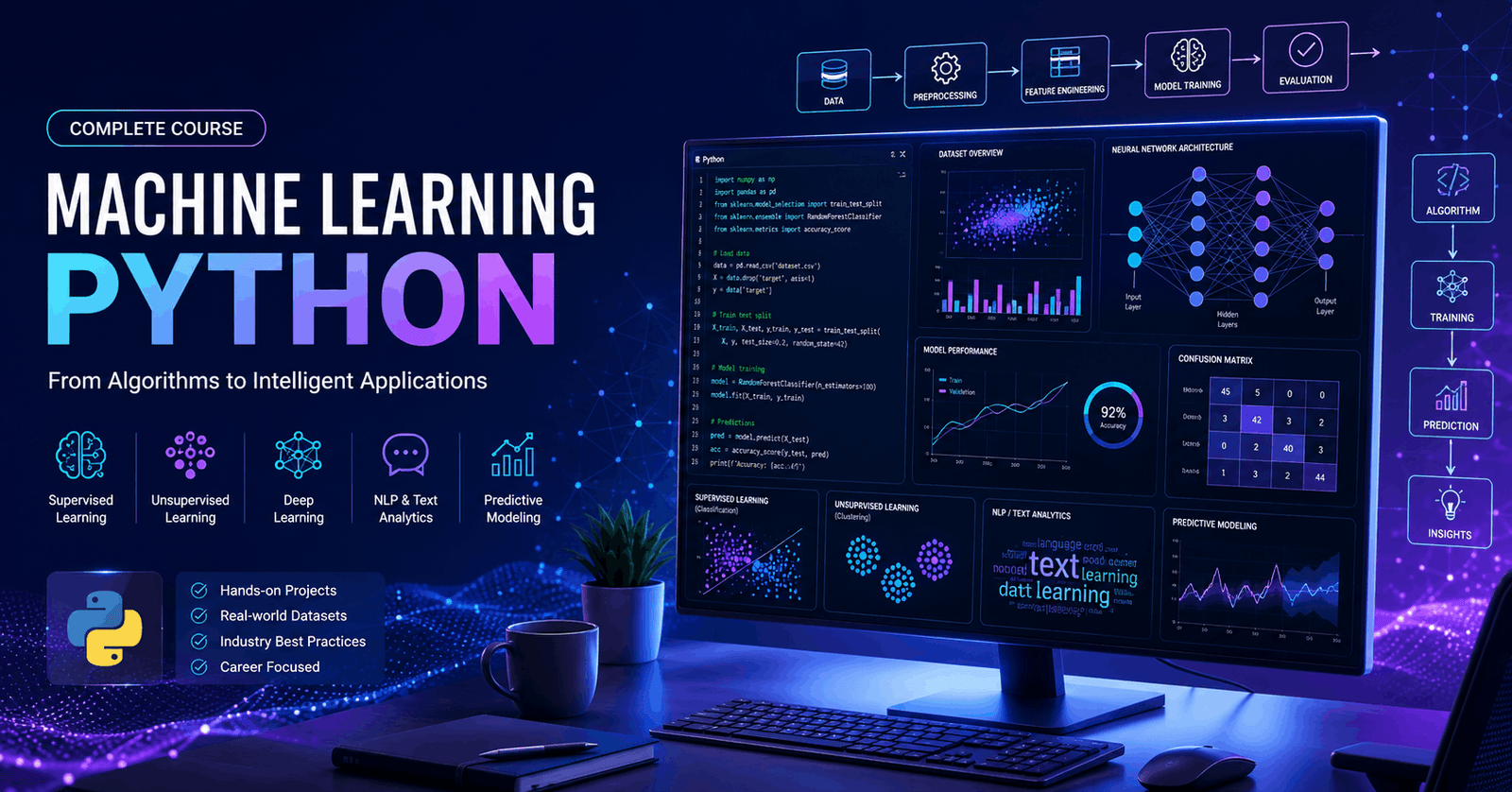
Machine Learning Python is a comprehensive learning experience designed to help you understand how modern artificial intelligence systems are created, trained, evaluated, and applied to real-world problems. This course takes you from essential Python programming concepts through advanced machine learning techniques, deep learning foundations, and natural language processing applications.
You will begin by building a strong foundation in Python, learning core programming concepts such as data types, variables, control flow, functions, file handling, and essential data structures. The course then moves into powerful data science libraries, including NumPy and Pandas, where you will learn how to prepare, manipulate, analyse, and transform datasets for machine learning workflows.
A major focus of the course is developing practical machine learning skills. You will explore important supervised learning algorithms such as linear regression, logistic regression, support vector machines, K-nearest neighbours, decision trees, random forests, and boosting techniques. You will also learn how to evaluate models, improve performance through cross-validation and hyperparameter tuning, and understand the strengths and limitations of different approaches.
The course also introduces unsupervised learning methods, including clustering techniques, dimensionality reduction with PCA, and methods for discovering hidden patterns within data. Through practical examples using real datasets, you will gain experience in preparing data, visualising insights, training models, and interpreting results.
Beyond traditional machine learning, you will explore deep learning concepts, including neural networks, activation functions, optimisation methods, model training, evaluation, and prediction. The course also covers natural language processing fundamentals, text preprocessing, feature extraction, TF-IDF, and building models for text-based applications.
Throughout the learning journey, you will work with industry-relevant tools such as Jupyter Notebook, Scikit-learn, TensorFlow, Matplotlib, Seaborn, and Plotly. The practical approach helps you develop skills that can be applied to academic projects, personal portfolios, and professional AI development tasks.
After completing the course, learners will receive a free course completion certificate. Multiple premium certificate and transcript options are also available for purchase if you wish to obtain additional professional documentation. Students also receive access to our 5-star-rated support available 24/7 through email for continuous learning assistance.Who is this course for?
Machine Learning Python is a comprehensive learning experience designed to help you understand how modern artificial intelligence systems are created, trained, evaluated, and applied to real-world problems. This course takes you from essential Python programming concepts through advanced machine learning techniques, deep learning foundations, and natural language processing applications.
You will begin by building a strong foundation in Python, learning core programming concepts such as data types, variables, control flow, functions, file handling, and essential data structures. The course then moves into powerful data science libraries, including NumPy and Pandas, where you will learn how to prepare, manipulate, analyse, and transform datasets for machine learning workflows.
A major focus of the course is developing practical machine learning skills. You will explore important supervised learning algorithms such as linear regression, logistic regression, support vector machines, K-nearest neighbours, decision trees, random forests, and boosting techniques. You will also learn how to evaluate models, improve performance through cross-validation and hyperparameter tuning, and understand the strengths and limitations of different approaches.
The course also introduces unsupervised learning methods, including clustering techniques, dimensionality reduction with PCA, and methods for discovering hidden patterns within data. Through practical examples using real datasets, you will gain experience in preparing data, visualising insights, training models, and interpreting results.
Beyond traditional machine learning, you will explore deep learning concepts, including neural networks, activation functions, optimisation methods, model training, evaluation, and prediction. The course also covers natural language processing fundamentals, text preprocessing, feature extraction, TF-IDF, and building models for text-based applications.
Throughout the learning journey, you will work with industry-relevant tools such as Jupyter Notebook, Scikit-learn, TensorFlow, Matplotlib, Seaborn, and Plotly. The practical approach helps you develop skills that can be applied to academic projects, personal portfolios, and professional AI development tasks.
After completing the course, learners will receive a free course completion certificate. Multiple premium certificate and transcript options are also available for purchase if you wish to obtain additional professional documentation. Students also receive access to our 5-star-rated support available 24/7 through email for continuous learning assistance.Requirements
Machine Learning Python is a comprehensive learning experience designed to help you understand how modern artificial intelligence systems are created, trained, evaluated, and applied to real-world problems. This course takes you from essential Python programming concepts through advanced machine learning techniques, deep learning foundations, and natural language processing applications.
You will begin by building a strong foundation in Python, learning core programming concepts such as data types, variables, control flow, functions, file handling, and essential data structures. The course then moves into powerful data science libraries, including NumPy and Pandas, where you will learn how to prepare, manipulate, analyse, and transform datasets for machine learning workflows.
A major focus of the course is developing practical machine learning skills. You will explore important supervised learning algorithms such as linear regression, logistic regression, support vector machines, K-nearest neighbours, decision trees, random forests, and boosting techniques. You will also learn how to evaluate models, improve performance through cross-validation and hyperparameter tuning, and understand the strengths and limitations of different approaches.
The course also introduces unsupervised learning methods, including clustering techniques, dimensionality reduction with PCA, and methods for discovering hidden patterns within data. Through practical examples using real datasets, you will gain experience in preparing data, visualising insights, training models, and interpreting results.
Beyond traditional machine learning, you will explore deep learning concepts, including neural networks, activation functions, optimisation methods, model training, evaluation, and prediction. The course also covers natural language processing fundamentals, text preprocessing, feature extraction, TF-IDF, and building models for text-based applications.
Throughout the learning journey, you will work with industry-relevant tools such as Jupyter Notebook, Scikit-learn, TensorFlow, Matplotlib, Seaborn, and Plotly. The practical approach helps you develop skills that can be applied to academic projects, personal portfolios, and professional AI development tasks.
After completing the course, learners will receive a free course completion certificate. Multiple premium certificate and transcript options are also available for purchase if you wish to obtain additional professional documentation. Students also receive access to our 5-star-rated support available 24/7 through email for continuous learning assistance.Career path
Machine Learning Python is a comprehensive learning experience designed to help you understand how modern artificial intelligence systems are created, trained, evaluated, and applied to real-world problems. This course takes you from essential Python programming concepts through advanced machine learning techniques, deep learning foundations, and natural language processing applications.
You will begin by building a strong foundation in Python, learning core programming concepts such as data types, variables, control flow, functions, file handling, and essential data structures. The course then moves into powerful data science libraries, including NumPy and Pandas, where you will learn how to prepare, manipulate, analyse, and transform datasets for machine learning workflows.
A major focus of the course is developing practical machine learning skills. You will explore important supervised learning algorithms such as linear regression, logistic regression, support vector machines, K-nearest neighbours, decision trees, random forests, and boosting techniques. You will also learn how to evaluate models, improve performance through cross-validation and hyperparameter tuning, and understand the strengths and limitations of different approaches.
The course also introduces unsupervised learning methods, including clustering techniques, dimensionality reduction with PCA, and methods for discovering hidden patterns within data. Through practical examples using real datasets, you will gain experience in preparing data, visualising insights, training models, and interpreting results.
Beyond traditional machine learning, you will explore deep learning concepts, including neural networks, activation functions, optimisation methods, model training, evaluation, and prediction. The course also covers natural language processing fundamentals, text preprocessing, feature extraction, TF-IDF, and building models for text-based applications.
Throughout the learning journey, you will work with industry-relevant tools such as Jupyter Notebook, Scikit-learn, TensorFlow, Matplotlib, Seaborn, and Plotly. The practical approach helps you develop skills that can be applied to academic projects, personal portfolios, and professional AI development tasks.
After completing the course, learners will receive a free course completion certificate. Multiple premium certificate and transcript options are also available for purchase if you wish to obtain additional professional documentation. Students also receive access to our 5-star-rated support available 24/7 through email for continuous learning assistance.-
- Course Introduction 00:10:00
- Machine Learning Introduction 00:10:00
- Install Anaconda and Python on Windows 00:10:00
- Install Anaconda on Linux 00:10:00
- Jupyter Notebook Introduction and Keyboard Shortcuts 00:10:00
-
- Arithmetic Operations in Python 00:10:00
- Data Types in Python 00:10:00
- Variable Casting 00:10:00
- String Operations in Python 00:10:00
- String Slicing in Python 00:10:00
- String Formatting and Modification 00:10:00
- Boolean Variables and Evaluation 00:10:00
- Lists in Python 00:10:00
- Tuples in Python 00:10:00
- 10: Sets 00:10:00
- Dictionaries 00:10:00
- Conditional Statements – If Else 00:10:00
- While Loops 00:10:00
- For Loops 00:10:00
- Functions 00:10:00
- Working with Date and Time 00:10:00
- File Handling – Read and Write 00:10:00
- NumPy Introduction – Create NumPy Arrays 00:10:00
- Array Indexing and Slicing 00:10:00
- NumPy Data Types 00:10:00
- Handling np.nan and np.inf 00:10:00
- Statistical Operations 00:10:00
- shape(), reshape(), ravel(), flatten() 00:10:00
- arange(), linspace(), range(), random(), zeros(), and ones() 00:10:00
- np.where 00:10:00
- NumPy Array Read and Write 00:10:00
- Introduction to Matplotlib 00:10:00
- Line Plot Part 1 00:10:00
- IMDB Movie Revenue Line Plot Part 1 00:10:00
- IMDB Movie Revenue Line Plot Part 2 00:10:00
- Line Plot Rank vs Runtime, Votes, Metascore 00:10:00
- Line Styling and Adding Labels 00:10:00
- Scatter, Bar, and Histogram Plot Part 1 00:10:00
- Scatter, Bar, and Histogram Plot Part 2 00:10:00
- Subplots Part 1 00:10:00
- Subplots Part 2 00:10:00
- Using Subplots 00:10:00
- Creating Zoomed Sub-Figure 00:10:00
- xlim, ylim, legend, grid, xticks, yticks 00:10:00
- Pie Chart and Saving Figures 00:10:00
- Introduction to the IRIS Dataset 00:10:00
- Loading the IRIS Dataset 00:10:00
- Line Plot 00:10:00
- Using Secondary Axis 00:10:00
- Bar and Horizontal Bar Plot 00:10:00
- Stacked Bar Plot 00:10:00
- Histogram 00:10:00
- Box Plot 00:10:00
- Area and Scatter Plot 00:10:00
- Hexbin Plot 00:10:00
- Pie Chart 00:10:00
- Scatter Matrix and Subplots 00:10:00
- Linear Regression Introduction 00:10:00
- Regression Examples 00:10:00
- Types of Linear Regression 00:10:00
- Assessing Model Performance 00:10:00
- Bias-Variance Tradeoff 00:10:00
- Introduction to sklearn and train_test_split 00:10:00
- Python Package Upgrade and Import 00:10:00
- Loading Boston Housing Dataset 00:10:00
- Dataset Analysis 00:10:00
- Exploratory Data Analysis – Pair Plot 00:10:00
- Exploratory Data Analysis – Histogram Plot 00:10:00
- Exploratory Data Analysis – Heatmap 00:10:00
- Train-Test Split and Model Training 00:10:00
- Evaluating Regression Model Performance 00:10:00
- Plotting True vs Predicted House Price 00:10:00
- Plotting Learning Curves Part 1 00:10:00
- Plotting Learning Curves Part 2 00:10:00
- Residuals Plot for Model Interpretability 00:10:00
- Prediction Error Plot for Interpretability 00:10:00
- SVM Introduction 00:10:00
- SVM Kernels 00:10:00
- Breast Cancer Dataset Introduction 00:10:00
- Dataset Loading 00:10:00
- Cancer Data Visualization Part 1 00:10:00
- Cancer Data Visualization Part 2 00:10:00
- Data Standardization 00:10:00
- Train-Test Split 00:10:00
- Linear SVM Model Building and Training 00:10:00
- Linear SVM Model on Scaled Features 00:10:00
- Polynomial, Sigmoid, and RBF Kernels in SVM 00:10:00
- KNN Introduction 00:10:00
- How KNN Works 00:10:00
- Wine Dataset Loading 00:10:00
- Data Visualization 00:10:00
- Train-Test Split and Standardization 00:10:00
- KNN Model Building and Training 00:10:00
- Hyperparameter Tuning 00:10:00
- Pros and Cons of KNN 00:10:00
- Ensemble Learning: Bagging and Boosting Introduction 00:10:00
- Random Forest Introduction 00:10:00
- Dataset Introduction 00:10:00
- Data Visualization 00:10:00
- Train-Test Split and One-Hot Encoding 00:10:00
- Random Forest Classifier Training and Evaluation 00:10:00
- Data Loading for Random Forest Regression 00:10:00
- Random Forest Regression Model Building 00:10:00
- Hyperparameter Optimization 00:10:00
- Introduction to Unsupervised Learning 00:10:00
- K-Means Clustering Overview 00:10:00
- Choosing the Best Number of Clusters 00:10:00
- K-Means Clustering with Scikit-Learn 00:10:00
- Applications of Unsupervised Learning 00:10:00
- Customer Data Loading 00:10:00
- Data Visualization 00:10:00
- K-Means Clustering Data Preparation 00:10:00
- Clustering by Age and Spending Score 00:10:00
- Cluster Visualization 00:10:00
- Decision Boundary Visualization 00:10:00
- Full Clustering Workflow 00:10:00
- Selecting the Optimal Number of Clusters 00:10:00
- Clustering by Annual Income vs Spending Score 00:10:00
- 3D Clustering Part 1 00:10:00
- 3D Clustering Part 2 00:10:00
- Hierarchical Clustering Introduction 00:10:00
- Important Terms in Hierarchical Clustering 00:10:00
- Stock Market Data Loading 00:10:00
- Hierarchical Clustering Coding 00:10:00
- What is a Neuron? 00:10:00
- Multi-Layer Perceptron 00:10:00
- Shallow vs Deep Neural Networks 00:10:00
- Activation Functions 00:10:00
- What is Backpropagation? 00:10:00
- Optimizers in Deep Learning 00:10:00
- Steps to Build a Neural Network 00:10:00
- Installing TensorFlow on Windows 00:10:00
- Installing TensorFlow on Linux 00:10:00
- Customer Churn Dataset Loading 00:10:00
- Data Visualization Part 1 00:10:00
- Data Visualization Part 2 00:10:00
- Data Preprocessing 00:10:00
- Importing Neural Network APIs 00:10:00
- Getting Input Shape and Class Weights 00:10:00
- Neural Network Model Building 00:10:00
- Model Summary Explanation 00:10:00
- Model Training 00:10:00
- Model Evaluation 00:10:00
- Model Saving and Loading 00:10:00
- Prediction on Real-Life Data 00:10:00
- Exam of Python Machine Learning Bootcamp 2023: From Data to Deep Learning 00:50:00

No Reviews found for this course.
Is this certificate recognized?
Yes, our premium certificate and transcript are widely recognized and accepted by embassies worldwide, particularly by the UK embassy. This adds credibility to your qualification and enhances its value for professional and academic purposes.
I am a beginner. Is this course suitable for me?
Yes, this course is designed for learners of all levels, including beginners. The content is structured to provide step-by-step guidance, ensuring that even those with no prior experience can follow along and gain valuable knowledge.
I am a professional. Is this course suitable for me?
Yes, professionals will also benefit from this course. It covers advanced concepts, practical applications, and industry insights that can help enhance existing skills and knowledge. Whether you are looking to refine your expertise or expand your qualifications, this course provides valuable learning.
Does this course have an expiry date?
No, you have lifetime access to the course. Once enrolled, you can revisit the materials at any time as long as the course remains available. Additionally, we regularly update our content to ensure it stays relevant and up to date.
How do I claim my free certificate?
I trust you’re in good health. Your free certificate can be located in the Achievement section. The option to purchase a CPD certificate is available but entirely optional, and you may choose to skip it. Please be aware that it’s crucial to click the “Complete” button to ensure the certificate is generated, as this process is entirely automated.
Does this course have assessments and assignments?
Yes, the course includes both assessments and assignments. Your final marks will be determined by a combination of 20% from assignments and 80% from assessments. These evaluations are designed to test your understanding and ensure you have grasped the key concepts effectively.
Is this course accredited?
We are a recognized course provider with CPD, UKRLP, and AOHT membership. The logos of these accreditation bodies will be featured on your premium certificate and transcript, ensuring credibility and professional recognition.
Will I receive a certificate upon completion?
Yes, you will receive a free digital certificate automatically once you complete the course. If you would like a premium CPD-accredited certificate, either in digital or physical format, you can upgrade for a small fee.
Course Features
Price
Study Method
Online | Self-paced
Course Format
Interactive PDFs, Articles & Learning Resources
Duration
1 day, 23 hours
Qualification
Professional Skills Development Course
Assessment
Final MCQ Exam (included in price)
Certificate
Verifiable Digital Certificate - Free
Additional info
Lifetime Access | Start Instantly
- Share

Foraging for Beginners: Discovering Local Wild Foods
Course Line240£490.00Original price was: £490.00.£14.99Current price is: £14.99.Ultimate Keyword Research & Local SEO Masterclass
Course Line237£490.00Original price was: £490.00.£14.99Current price is: £14.99.



Related Courses
PRINCE2 in Practice: Simulated Projects & Case Studies
£490.00Original price was: £490.00.£14.99Current price is: £14.99.237PRINCE2 for Beginners: An Introduction to Project Governance
£490.00Original price was: £490.00.£14.99Current price is: £14.99.237PRINCE2 Project Documentation: Templates & Best Practice
£490.00Original price was: £490.00.£14.99Current price is: £14.99.237


Related Courses
PRINCE2 in Practice: Simulated Projects & Case Studies
£490.00Original price was: £490.00.£14.99Current price is: £14.99.237PRINCE2 for Beginners: An Introduction to Project Governance
£490.00Original price was: £490.00.£14.99Current price is: £14.99.237PRINCE2 Project Documentation: Templates & Best Practice
£490.00Original price was: £490.00.£14.99Current price is: £14.99.237

