
Course Features
Price
Study Method
Online | Self-paced
Course Format
Interactive PDFs, Articles & Learning Resources
Duration
1 day, 2 hours
Qualification
Professional Skills Development Course
Assessment
Final MCQ Exam (included in price)
Certificate
Verifiable Digital Certificate - Free
Additional info
Lifetime Access | Start Instantly
- Share
Overview
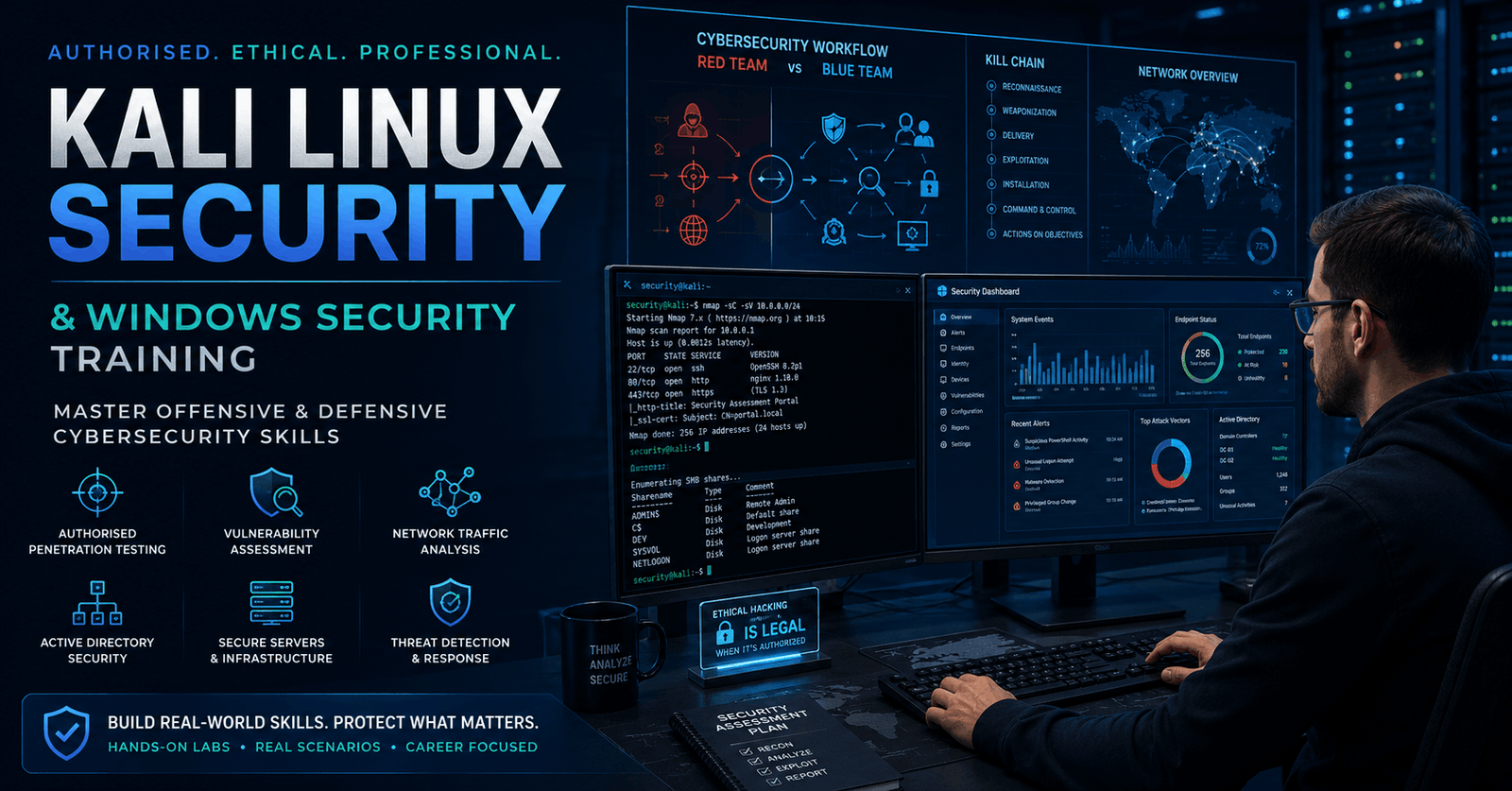
Kali Linux Security training provides an extensive learning path across ethical hacking, penetration testing, Windows security and defensive cybersecurity. Designed for authorised and controlled security environments, the course explores how security professionals assess systems, investigate weaknesses, understand attack techniques and apply defensive practices across Linux and Windows infrastructures.
The course begins with Kali Linux setup, security tools, information gathering, reconnaissance, network scanning, enumeration and vulnerability assessment. You will explore the principles behind exploitation, privilege escalation, post-exploitation, password security and network testing. Web application security topics introduce common risks such as SQL injection, cross-site scripting and command injection, alongside security assessment tools and structured testing approaches.
Network security forms another important part of the training. Topics include Nmap, Wireshark, Netcat, TCP/IP security, wireless assessment, packet analysis, secure communications and network services. You will also examine security automation, Bash scripting, exploit research, malware analysis concepts, reverse engineering fundamentals, cloud and container security, and professional penetration testing documentation. Ethical hacking laws, compliance and responsible testing practices are included to reinforce the importance of permission and defined scope.
The Windows security section develops your understanding of operating system architecture, user controls, Active Directory, Kerberos, credential security, PowerShell and Windows networking. You will explore common enterprise security risks alongside event logs, forensic analysis, incident response, threat hunting, patch management, security policies and system hardening. Red-team and blue-team perspectives help demonstrate how offensive security knowledge can support stronger detection and defence.
Practical projects bring these areas together through realistic, authorised security assessment scenarios. By completing the course, you can develop broader technical awareness across multiple security domains and gain a stronger foundation for further study in penetration testing, security operations, incident response and infrastructure protection.
Learners will receive a free course completion certificate after successfully completing the course. Multiple premium certificate and transcript options are also available for purchase for those who want additional documentation. Students also have access to our 5-star rated support, available 24/7 through email, for assistance throughout their learning journey.Who is this course for?
Kali Linux Security training provides an extensive learning path across ethical hacking, penetration testing, Windows security and defensive cybersecurity. Designed for authorised and controlled security environments, the course explores how security professionals assess systems, investigate weaknesses, understand attack techniques and apply defensive practices across Linux and Windows infrastructures.
The course begins with Kali Linux setup, security tools, information gathering, reconnaissance, network scanning, enumeration and vulnerability assessment. You will explore the principles behind exploitation, privilege escalation, post-exploitation, password security and network testing. Web application security topics introduce common risks such as SQL injection, cross-site scripting and command injection, alongside security assessment tools and structured testing approaches.
Network security forms another important part of the training. Topics include Nmap, Wireshark, Netcat, TCP/IP security, wireless assessment, packet analysis, secure communications and network services. You will also examine security automation, Bash scripting, exploit research, malware analysis concepts, reverse engineering fundamentals, cloud and container security, and professional penetration testing documentation. Ethical hacking laws, compliance and responsible testing practices are included to reinforce the importance of permission and defined scope.
The Windows security section develops your understanding of operating system architecture, user controls, Active Directory, Kerberos, credential security, PowerShell and Windows networking. You will explore common enterprise security risks alongside event logs, forensic analysis, incident response, threat hunting, patch management, security policies and system hardening. Red-team and blue-team perspectives help demonstrate how offensive security knowledge can support stronger detection and defence.
Practical projects bring these areas together through realistic, authorised security assessment scenarios. By completing the course, you can develop broader technical awareness across multiple security domains and gain a stronger foundation for further study in penetration testing, security operations, incident response and infrastructure protection.
Learners will receive a free course completion certificate after successfully completing the course. Multiple premium certificate and transcript options are also available for purchase for those who want additional documentation. Students also have access to our 5-star rated support, available 24/7 through email, for assistance throughout their learning journey.Requirements
Kali Linux Security training provides an extensive learning path across ethical hacking, penetration testing, Windows security and defensive cybersecurity. Designed for authorised and controlled security environments, the course explores how security professionals assess systems, investigate weaknesses, understand attack techniques and apply defensive practices across Linux and Windows infrastructures.
The course begins with Kali Linux setup, security tools, information gathering, reconnaissance, network scanning, enumeration and vulnerability assessment. You will explore the principles behind exploitation, privilege escalation, post-exploitation, password security and network testing. Web application security topics introduce common risks such as SQL injection, cross-site scripting and command injection, alongside security assessment tools and structured testing approaches.
Network security forms another important part of the training. Topics include Nmap, Wireshark, Netcat, TCP/IP security, wireless assessment, packet analysis, secure communications and network services. You will also examine security automation, Bash scripting, exploit research, malware analysis concepts, reverse engineering fundamentals, cloud and container security, and professional penetration testing documentation. Ethical hacking laws, compliance and responsible testing practices are included to reinforce the importance of permission and defined scope.
The Windows security section develops your understanding of operating system architecture, user controls, Active Directory, Kerberos, credential security, PowerShell and Windows networking. You will explore common enterprise security risks alongside event logs, forensic analysis, incident response, threat hunting, patch management, security policies and system hardening. Red-team and blue-team perspectives help demonstrate how offensive security knowledge can support stronger detection and defence.
Practical projects bring these areas together through realistic, authorised security assessment scenarios. By completing the course, you can develop broader technical awareness across multiple security domains and gain a stronger foundation for further study in penetration testing, security operations, incident response and infrastructure protection.
Learners will receive a free course completion certificate after successfully completing the course. Multiple premium certificate and transcript options are also available for purchase for those who want additional documentation. Students also have access to our 5-star rated support, available 24/7 through email, for assistance throughout their learning journey.Career path
Kali Linux Security training provides an extensive learning path across ethical hacking, penetration testing, Windows security and defensive cybersecurity. Designed for authorised and controlled security environments, the course explores how security professionals assess systems, investigate weaknesses, understand attack techniques and apply defensive practices across Linux and Windows infrastructures.
The course begins with Kali Linux setup, security tools, information gathering, reconnaissance, network scanning, enumeration and vulnerability assessment. You will explore the principles behind exploitation, privilege escalation, post-exploitation, password security and network testing. Web application security topics introduce common risks such as SQL injection, cross-site scripting and command injection, alongside security assessment tools and structured testing approaches.
Network security forms another important part of the training. Topics include Nmap, Wireshark, Netcat, TCP/IP security, wireless assessment, packet analysis, secure communications and network services. You will also examine security automation, Bash scripting, exploit research, malware analysis concepts, reverse engineering fundamentals, cloud and container security, and professional penetration testing documentation. Ethical hacking laws, compliance and responsible testing practices are included to reinforce the importance of permission and defined scope.
The Windows security section develops your understanding of operating system architecture, user controls, Active Directory, Kerberos, credential security, PowerShell and Windows networking. You will explore common enterprise security risks alongside event logs, forensic analysis, incident response, threat hunting, patch management, security policies and system hardening. Red-team and blue-team perspectives help demonstrate how offensive security knowledge can support stronger detection and defence.
Practical projects bring these areas together through realistic, authorised security assessment scenarios. By completing the course, you can develop broader technical awareness across multiple security domains and gain a stronger foundation for further study in penetration testing, security operations, incident response and infrastructure protection.
Learners will receive a free course completion certificate after successfully completing the course. Multiple premium certificate and transcript options are also available for purchase for those who want additional documentation. Students also have access to our 5-star rated support, available 24/7 through email, for assistance throughout their learning journey.-
- Introduction to Kali Linux and Ethical Hacking 00:10:00
- Installing and Setting Up Kali Linux 00:10:00
- Kali Linux Tools Overview 00:10:00
- Information Gathering Techniques 00:10:00
- Footprinting and Reconnaissance 00:10:00
- Scanning Networks and Hosts 00:10:00
- Vulnerability Assessment 00:10:00
- Enumeration Techniques 00:10:00
- Exploitation Fundamentals 00:10:00
- Metasploit Framework Basics 00:10:00
- Exploiting Network Services 00:10:00
- Password Attacks and Cracking 00:10:00
- Wireless Network Hacking 00:10:00
- Attacking Web Applications: Introduction 00:10:00
- SQL Injection Basics 00:10:00
- Cross-Site Scripting (XSS) Attacks 00:10:00
- Command Injection and Remote Code Execution 00:10:00
- Exploit Development Basics 00:10:00
- Buffer Overflow Attacks 00:10:00
- Privilege Escalation Techniques 00:10:00
- Maintaining Access and Persistence 00:10:00
- Post Exploitation Techniques 00:10:00
- Clearing Logs and Covering Tracks 00:10:00
- Sniffing and Spoofing Attacks 00:10:00
- Man-in-the-Middle (MITM) Attacks 00:10:00
- ARP Spoofing and Poisoning 00:10:00
- DNS Spoofing Attacks 00:10:00
- Social Engineering Techniques 00:10:00
- Phishing and Email Attacks 00:10:00
- Password Social Engineering 00:10:00
- Kali Linux Customization and Automation 00:10:00
- Writing Bash Scripts for Penetration Testing 00:10:00
- Using Nmap for Network Mapping 00:10:00
- Advanced Nmap Techniques 00:10:00
- Exploiting FTP and SSH Services 00:10:00
- Attacking SMB Protocol and Windows Shares 00:10:00
- Using Hydra for Password Cracking 00:10:00
- Wireless Attacks with Aircrack-ng 00:10:00
- Cracking WPA and WPA2 Networks 00:10:00
- Using Wireshark for Packet Analysis 00:10:00
- Analyzing Network Traffic 00:10:00
- Using Netcat for Backdoors and Connections 00:10:00
- TCP/IP Protocol Attacks 00:10:00
- Using John the Ripper for Password Cracking 00:10:00
- Exploiting Vulnerabilities in Web Servers 00:10:00
- Exploiting CMS Platforms (WordPress, Joomla, etc.) 00:10:00
- Using Burp Suite for Web Testing 00:10:00
- Advanced Burp Suite Features 00:10:00
- Exploiting Remote Desktop Protocol (RDP) 00:10:00
- Using SQLmap for Automated SQL Injection 00:10:00
- Bypassing Firewalls and IDS 00:10:00
- Writing Custom Exploits 00:10:00
- Using Exploit-db and Searchsploit 00:10:00
- Malware Analysis Basics with Kali Tools 00:10:00
- Reverse Engineering Basics 00:10:00
- Using Ghidra and Radare2 00:10:00
- Using Social Engineering Toolkit (SET) 00:10:00
- Capturing Credentials with Mimikatz 00:10:00
- PowerShell Attacks with Kali Linux 00:10:00
- Evading Antivirus and Endpoint Protection 00:10:00
- Using TOR for Anonymity 00:10:00
- Using Proxychains and VPNs 00:10:00
- Creating and Using Rootkits 00:10:00
- Wireless Evil Twin Attacks 00:10:00
- BlueKeep and SMB Vulnerabilities 00:10:00
- Using Kali Linux for IoT Hacking 00:10:00
- Cloud Security and Kali Linux Tools 00:10:00
- Exploiting Docker and Container Environments 00:10:00
- Building Custom Kali Linux ISO 00:10:00
- Wireless Penetration Testing Best Practices 00:10:00
- Reporting and Documentation 00:10:00
- Ethical Hacking Laws and Compliance 00:10:00
- Setting Up Kali Linux Virtual Machines 00:10:00
- Kali Linux Community and Resources 00:10:00
- Troubleshooting Kali Linux Issues 00:10:00
- Final Project: Realistic Penetration Testing Scenario 00:10:00
-
- Introduction to Windows Security 00:10:00
- Setting Up a Windows Hacking Lab 00:10:00
- Windows OS Architecture Overview 00:10:00
- Windows User Account Control (UAC) 00:10:00
- Active Directory Basics 00:10:00
- Active Directory Enumeration 00:10:00
- Active Directory Attacks 00:10:00
- Password Attacks on Windows 00:10:00
- Hash Dumping and Cracking 00:10:00
- Kerberos Attacks 00:10:00
- Windows Firewall and Defender Overview 00:10:00
- Bypassing Windows Defender 00:10:00
- PowerShell for Attackers and Defenders 00:10:00
- Windows Exploit Development 00:10:00
- Windows Persistence Techniques 00:10:00
- Windows Privilege Escalation 00:10:00
- Lateral Movement in Windows Networks 00:10:00
- Pass-the-Hash Attacks 00:10:00
- Pass-the-Ticket Attacks 00:10:00
- Credential Dumping Techniques 00:10:00
- Using Mimikatz for Credential Extraction 00:10:00
- Windows Event Logs for Forensics 00:10:00
- Clearing and Manipulating Logs 00:10:00
- Group Policy Attacks 00:10:00
- Windows Registry Attacks 00:10:00
- Scheduled Tasks for Persistence 00:10:00
- DLL Hijacking Techniques 00:10:00
- Windows Service Exploitation 00:10:00
- Exploiting SMB Protocol 00:10:00
- Using Sysinternals Suite Tools 00:10:00
- Windows Networking Security 00:10:00
- PowerShell Empire Framework 00:10:00
- Using Cobalt Strike for Windows Attacks 00:10:00
- Windows Malware Analysis Basics 00:10:00
- Windows Rootkits and Bootkits 00:10:00
- Defending Windows Systems 00:10:00
- Patch Management and Vulnerability Scanning 00:10:00
- Incident Response on Windows 00:10:00
- Forensic Analysis on Windows 00:10:00
- Using Windows Defender ATP 00:10:00
- Advanced Threat Hunting in Windows 00:10:00
- Windows Sandbox Escape Techniques 00:10:00
- Bypassing User Account Control 00:10:00
- Bypassing AppLocker 00:10:00
- Windows Credential Guard Attacks 00:10:00
- Exploiting Windows Services 00:10:00
- Attacking Microsoft Exchange Server 00:10:00
- Remote Desktop Protocol (RDP) Exploits 00:10:00
- Windows PowerShell Logging Bypass 00:10:00
- Using Windows Event Forwarding 00:10:00
- Exploiting Windows Management Instrumentation (WMI) 00:10:00
- Active Directory Federation Services (ADFS) Attacks 00:10:00
- Using BloodHound for AD Attack Mapping 00:10:00
- Windows Defender Evasion Techniques 00:10:00
- Using PowerSploit for Post Exploitation 00:10:00
- Windows 10 Security Features 00:10:00
- Windows Server Security Features 00:10:00
- Managing Windows Security Policies 00:10:00
- Security Baselines for Windows 00:10:00
- Windows Patch Tuesday Updates 00:10:00
- Understanding Windows Security Logs 00:10:00
- Windows DNS Attacks 00:10:00
- Windows Kerberos Delegation Attacks 00:10:00
- Advanced PowerShell Attacks 00:10:00
- Defending Against Windows Lateral Movement 00:10:00
- Windows Sandbox Security 00:10:00
- Windows Credential Theft Prevention 00:10:00
- Windows Incident Response Tools 00:10:00
- Using Windows Sysinternals for Security 00:10:00
- Red Team vs Blue Team Techniques on Windows 00:10:00
- Windows Security Best Practices 00:10:00
- Security Automation on Windows 00:10:00
- Windows Security Compliance Auditing 00:10:00
- Future Trends in Windows Security 00:10:00
- Final Project: Windows Security Penetration Test 00:10:00
- Exam of Complete Kali Linux & Windows Security Hacking Course 2023 – IT Security Masterclass 00:50:00

No Reviews found for this course.
Is this certificate recognized?
Yes, our premium certificate and transcript are widely recognized and accepted by embassies worldwide, particularly by the UK embassy. This adds credibility to your qualification and enhances its value for professional and academic purposes.
I am a beginner. Is this course suitable for me?
Yes, this course is designed for learners of all levels, including beginners. The content is structured to provide step-by-step guidance, ensuring that even those with no prior experience can follow along and gain valuable knowledge.
I am a professional. Is this course suitable for me?
Yes, professionals will also benefit from this course. It covers advanced concepts, practical applications, and industry insights that can help enhance existing skills and knowledge. Whether you are looking to refine your expertise or expand your qualifications, this course provides valuable learning.
Does this course have an expiry date?
No, you have lifetime access to the course. Once enrolled, you can revisit the materials at any time as long as the course remains available. Additionally, we regularly update our content to ensure it stays relevant and up to date.
How do I claim my free certificate?
I trust you’re in good health. Your free certificate can be located in the Achievement section. The option to purchase a CPD certificate is available but entirely optional, and you may choose to skip it. Please be aware that it’s crucial to click the “Complete” button to ensure the certificate is generated, as this process is entirely automated.
Does this course have assessments and assignments?
Yes, the course includes both assessments and assignments. Your final marks will be determined by a combination of 20% from assignments and 80% from assessments. These evaluations are designed to test your understanding and ensure you have grasped the key concepts effectively.
Is this course accredited?
We are a recognized course provider with CPD, UKRLP, and AOHT membership. The logos of these accreditation bodies will be featured on your premium certificate and transcript, ensuring credibility and professional recognition.
Will I receive a certificate upon completion?
Yes, you will receive a free digital certificate automatically once you complete the course. If you would like a premium CPD-accredited certificate, either in digital or physical format, you can upgrade for a small fee.
Course Features
Price
Study Method
Online | Self-paced
Course Format
Interactive PDFs, Articles & Learning Resources
Duration
1 day, 2 hours
Qualification
Professional Skills Development Course
Assessment
Final MCQ Exam (included in price)
Certificate
Verifiable Digital Certificate - Free
Additional info
Lifetime Access | Start Instantly
- Share

Data Protection (GDPR) Practitioner
Course Line238د.ك203.35Original price was: د.ك203.35.د.ك6.22Current price is: د.ك6.22.PGCE in Secondary Education
Course Line285د.ك203.35Original price was: د.ك203.35.د.ك6.22Current price is: د.ك6.22.IMI: Customer Service Excellence for Motor Industry Professionals
Course Line237د.ك203.35Original price was: د.ك203.35.د.ك6.22Current price is: د.ك6.22.



Related Courses
PRINCE2 in Practice: Simulated Projects & Case Studies
د.ك203.35Original price was: د.ك203.35.د.ك6.22Current price is: د.ك6.22.237PRINCE2 Risk Management: Identifying, Assessing & Controlling Risk
د.ك203.35Original price was: د.ك203.35.د.ك6.22Current price is: د.ك6.22.237PRINCE2 Roles & Responsibilities: Managing Teams in a PRINCE2 Environment
د.ك203.35Original price was: د.ك203.35.د.ك6.22Current price is: د.ك6.22.237




Related Courses
PRINCE2 in Practice: Simulated Projects & Case Studies
د.ك203.35Original price was: د.ك203.35.د.ك6.22Current price is: د.ك6.22.237PRINCE2 Risk Management: Identifying, Assessing & Controlling Risk
د.ك203.35Original price was: د.ك203.35.د.ك6.22Current price is: د.ك6.22.237PRINCE2 Roles & Responsibilities: Managing Teams in a PRINCE2 Environment
د.ك203.35Original price was: د.ك203.35.د.ك6.22Current price is: د.ك6.22.237

