
Course Features
Price
Study Method
Online | Self-paced
Course Format
Reading Material - PDF, article
Duration
17 hours, 35 minutes
Qualification
No formal qualification
Certificate
At completion
Additional info
Coming soon
- Share
Overview
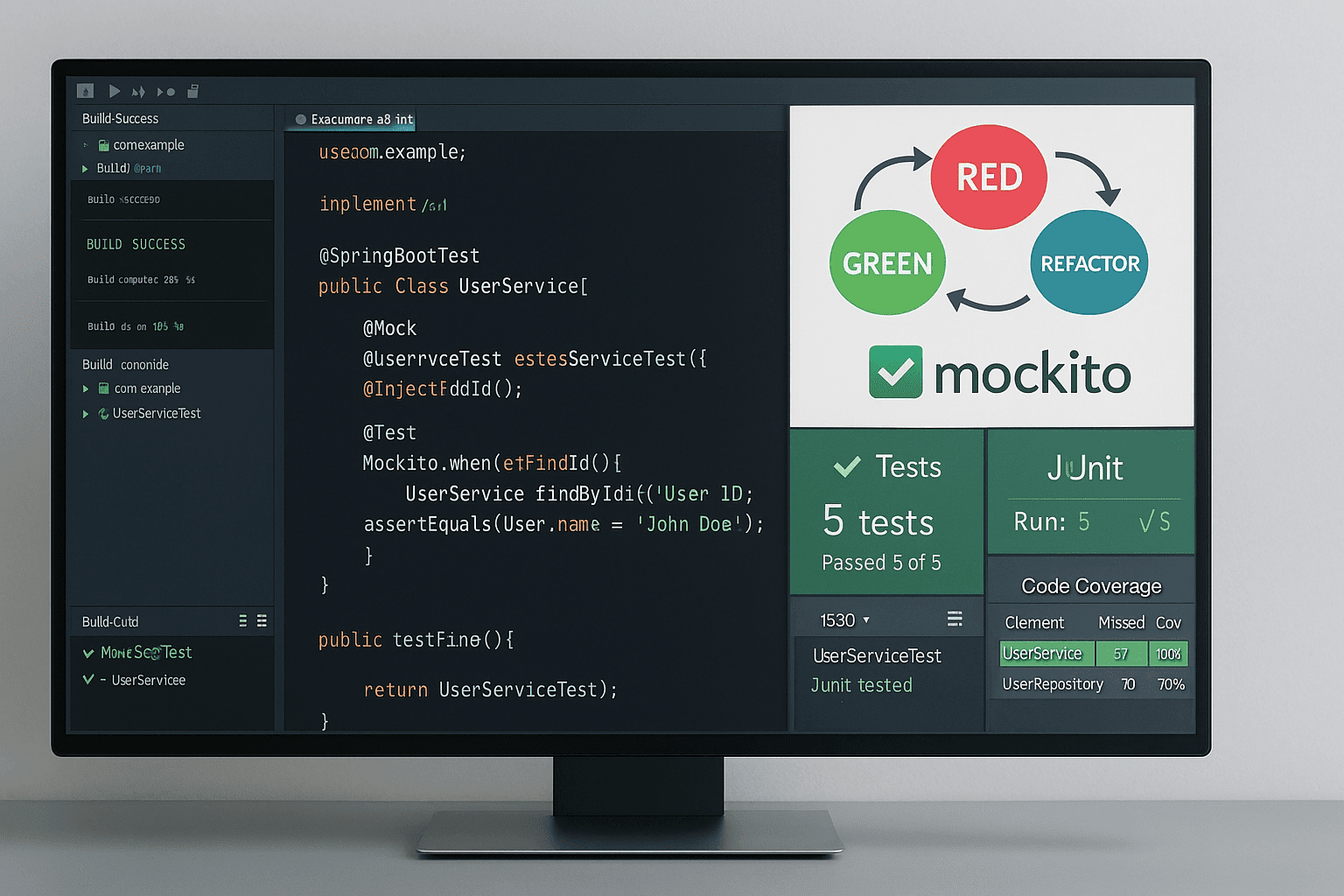
Java Unit Testing is a critical skill for building reliable, maintainable, and professional Java applications. This course is designed to help developers move beyond basic testing knowledge and gain practical expertise in modern Java testing practices used in real-world development teams. It focuses on writing effective tests that improve code quality, reduce bugs, and support confident refactoring.
The course begins by establishing a strong testing mindset, explaining why unit testing matters, how it delivers long-term value, and how it fits into modern development workflows. Learners gain a clear understanding of JUnit 5, including test structure, assertions, lifecycle management, parameterised tests, and best practices for readable and maintainable test code. Emphasis is placed on writing tests that are fast, independent, and meaningful.
As the course progresses, learners explore Test-Driven Development (TDD), learning how to design clean code through tests using the red–green–refactor cycle. Mockito is introduced to help isolate units of code, mock dependencies, and verify interactions, enabling effective testing of complex business logic. These skills are essential for working with layered applications and services.
The course also covers code coverage using JaCoCo, teaching learners how to interpret reports, identify gaps, and avoid misleading metrics. In later stages, learners apply testing techniques to Spring Boot applications, including REST controllers, full-stack tests, security scenarios, and data-layer testing with JPA. This ensures learners can confidently test applications across all layers.
Upon completion, learners receive a free course completion certificate. For those who need formal recognition, multiple premium certificate and transcript options are available for purchase. Learners also benefit from 5-star rated support available 24/7 via email, ensuring expert help is always available throughout the learning journey.
Who is this course for?
Java Unit Testing is a critical skill for building reliable, maintainable, and professional Java applications. This course is designed to help developers move beyond basic testing knowledge and gain practical expertise in modern Java testing practices used in real-world development teams. It focuses on writing effective tests that improve code quality, reduce bugs, and support confident refactoring.
The course begins by establishing a strong testing mindset, explaining why unit testing matters, how it delivers long-term value, and how it fits into modern development workflows. Learners gain a clear understanding of JUnit 5, including test structure, assertions, lifecycle management, parameterised tests, and best practices for readable and maintainable test code. Emphasis is placed on writing tests that are fast, independent, and meaningful.
As the course progresses, learners explore Test-Driven Development (TDD), learning how to design clean code through tests using the red–green–refactor cycle. Mockito is introduced to help isolate units of code, mock dependencies, and verify interactions, enabling effective testing of complex business logic. These skills are essential for working with layered applications and services.
The course also covers code coverage using JaCoCo, teaching learners how to interpret reports, identify gaps, and avoid misleading metrics. In later stages, learners apply testing techniques to Spring Boot applications, including REST controllers, full-stack tests, security scenarios, and data-layer testing with JPA. This ensures learners can confidently test applications across all layers.
Upon completion, learners receive a free course completion certificate. For those who need formal recognition, multiple premium certificate and transcript options are available for purchase. Learners also benefit from 5-star rated support available 24/7 via email, ensuring expert help is always available throughout the learning journey.
Requirements
Java Unit Testing is a critical skill for building reliable, maintainable, and professional Java applications. This course is designed to help developers move beyond basic testing knowledge and gain practical expertise in modern Java testing practices used in real-world development teams. It focuses on writing effective tests that improve code quality, reduce bugs, and support confident refactoring.
The course begins by establishing a strong testing mindset, explaining why unit testing matters, how it delivers long-term value, and how it fits into modern development workflows. Learners gain a clear understanding of JUnit 5, including test structure, assertions, lifecycle management, parameterised tests, and best practices for readable and maintainable test code. Emphasis is placed on writing tests that are fast, independent, and meaningful.
As the course progresses, learners explore Test-Driven Development (TDD), learning how to design clean code through tests using the red–green–refactor cycle. Mockito is introduced to help isolate units of code, mock dependencies, and verify interactions, enabling effective testing of complex business logic. These skills are essential for working with layered applications and services.
The course also covers code coverage using JaCoCo, teaching learners how to interpret reports, identify gaps, and avoid misleading metrics. In later stages, learners apply testing techniques to Spring Boot applications, including REST controllers, full-stack tests, security scenarios, and data-layer testing with JPA. This ensures learners can confidently test applications across all layers.
Upon completion, learners receive a free course completion certificate. For those who need formal recognition, multiple premium certificate and transcript options are available for purchase. Learners also benefit from 5-star rated support available 24/7 via email, ensuring expert help is always available throughout the learning journey.
Career path
Java Unit Testing is a critical skill for building reliable, maintainable, and professional Java applications. This course is designed to help developers move beyond basic testing knowledge and gain practical expertise in modern Java testing practices used in real-world development teams. It focuses on writing effective tests that improve code quality, reduce bugs, and support confident refactoring.
The course begins by establishing a strong testing mindset, explaining why unit testing matters, how it delivers long-term value, and how it fits into modern development workflows. Learners gain a clear understanding of JUnit 5, including test structure, assertions, lifecycle management, parameterised tests, and best practices for readable and maintainable test code. Emphasis is placed on writing tests that are fast, independent, and meaningful.
As the course progresses, learners explore Test-Driven Development (TDD), learning how to design clean code through tests using the red–green–refactor cycle. Mockito is introduced to help isolate units of code, mock dependencies, and verify interactions, enabling effective testing of complex business logic. These skills are essential for working with layered applications and services.
The course also covers code coverage using JaCoCo, teaching learners how to interpret reports, identify gaps, and avoid misleading metrics. In later stages, learners apply testing techniques to Spring Boot applications, including REST controllers, full-stack tests, security scenarios, and data-layer testing with JPA. This ensures learners can confidently test applications across all layers.
Upon completion, learners receive a free course completion certificate. For those who need formal recognition, multiple premium certificate and transcript options are available for purchase. Learners also benefit from 5-star rated support available 24/7 via email, ensuring expert help is always available throughout the learning journey.
-
- Course Orientation & Goals 00:00:00
- What Is a Unit Test? 00:10:00
- Why Write Unit Tests? Value & ROI 00:10:00
- The FIRST Principles Fast, Independent, 00:10:00
- Testing Code in Isolation vs Integration 00:10:00
- The Testing Pyramid (Unit, Service, UI) 00:10:00
- What Is JUnit 5? Architecture & Modules 00:10:00
- Build Tools Overview: Maven, Gradle & IDEs 00:00:00
-
- Create a New Maven Project in IntelliJ IDEA 00:10:00
- Add JUnit 5 Dependencies (Jupiter) 00:10:00
- Configure Maven Surefire Plugin (Test Discovery & Reports) 00:10:00
- Create a New Gradle Project 00:10:00
- Add JUnit 5 Dependencies (build.gradle) 00:10:00
- Executing Tests with Gradle (Tasks & Config) 00:10:00
- Your First Test Method (@Test) 00:10:00
- Core Assertions & Messages (assertEquals, assertTrue, etc.) 00:10:00
- More Assertions (assertAll, assertTimeout, assertIterableEquals) 00:10:00
- Exercise: Write Basic Assertions 00:10:00
- Lazy Assertion Messages (Suppliers for Performance) 00:10:00
- Naming Tests for Clarity (Given/When/Then) 00:10:00
- @DisplayName & Readable Test Output 00:10:00
- Arrange–Act–Assert Structure (AAA) 00:10:00
- JUnit Test Lifecycle (@BeforeEach/@AfterEach/@BeforeAll/@AfterAll) 00:10:00
- Lifecycle Methods Demo 00:10:00
- Disabling Tests (@Disabled) & Tagging 00:10:00
- Asserting Exceptions (assertThrows) 00:10:00
- TDD Overview (Red → Green → Refactor) 00:10:00
- New Project & First Class/Method 00:10:00
- Creating a UserService (Design by Tests) 00:10:00
- Testing createUser() 00:10:00
- Verifying Domain Rules (e.g., first name present) 00:10:00
- Refactoring Tests & Production Code 00:10:00
- Exercise: Extend UserService 00:10:00
- Solution Walkthrough 00:10:00
- Check ID Assignment & Uniqueness 00:10:00
- Asserting Exceptions for Invalid Input 00:10:00
- TDD Mini-Challenge (Practice) 00:10:00
- Code Coverage Concepts & Caveats 00:10:00
- Generating Coverage Reports (Maven) 00:10:00
- Exporting Code Coverage Reports 00:10:00
- Exporting Test Reports 00:10:00
- JaCoCo Maven Plugin (Config & Thresholds) 00:10:00
- HTML Coverage Reports & Interpreting Gaps 00:10:00
- Overview of Full-Stack Tests 00:10:00
- @SpringBootTest & Context Management 00:10:00
- WebEnvironment: MOCK vs DEFINED_PORT vs RANDOM_PORT 00:10:00
- @TestPropertySource & Test Profiles 00:10:00
- Testing on a Defined Port 00:10:00
- Testing on a Random Port 00:10:00
- Prepare TestRestTemplate 00:10:00
- End-to-End Flow: Create User (JSON) 00:10:00
- Security: JWT Required—Negative & Positive Paths 00:10:00
- Testing Login Works (Token Issuance) 00:10:00
- Ordering Test Methods Where Necessary 00:10:00
- GET /users with JWT—Authorisation & Assertions 00:10:00
- Repository Testing Overview (@DataJpaTest) 00:10:00
- Test findByEmail (Happy & Edge Cases) 00:10:00
- Exercise: Additional Finder Methods 00:10:00
- Exercise Solution 00:10:00
- Testing JPQL/Derived Queries—Source & Behaviour 00:10:00
- Premium Certificate 00:15:00

No Reviews found for this course.
Is this certificate recognized?
Yes, our premium certificate and transcript are widely recognized and accepted by embassies worldwide, particularly by the UK embassy. This adds credibility to your qualification and enhances its value for professional and academic purposes.
I am a beginner. Is this course suitable for me?
Yes, this course is designed for learners of all levels, including beginners. The content is structured to provide step-by-step guidance, ensuring that even those with no prior experience can follow along and gain valuable knowledge.
I am a professional. Is this course suitable for me?
Yes, professionals will also benefit from this course. It covers advanced concepts, practical applications, and industry insights that can help enhance existing skills and knowledge. Whether you are looking to refine your expertise or expand your qualifications, this course provides valuable learning.
Does this course have an expiry date?
No, you have lifetime access to the course. Once enrolled, you can revisit the materials at any time as long as the course remains available. Additionally, we regularly update our content to ensure it stays relevant and up to date.
How do I claim my free certificate?
I trust you’re in good health. Your free certificate can be located in the Achievement section. The option to purchase a CPD certificate is available but entirely optional, and you may choose to skip it. Please be aware that it’s crucial to click the “Complete” button to ensure the certificate is generated, as this process is entirely automated.
Does this course have assessments and assignments?
Yes, the course includes both assessments and assignments. Your final marks will be determined by a combination of 20% from assignments and 80% from assessments. These evaluations are designed to test your understanding and ensure you have grasped the key concepts effectively.
Is this course accredited?
We are a recognized course provider with CPD, UKRLP, and AOHT membership. The logos of these accreditation bodies will be featured on your premium certificate and transcript, ensuring credibility and professional recognition.
Will I receive a certificate upon completion?
Yes, you will receive a free digital certificate automatically once you complete the course. If you would like a premium CPD-accredited certificate, either in digital or physical format, you can upgrade for a small fee.
Course Features
Price
Study Method
Online | Self-paced
Course Format
Reading Material - PDF, article
Duration
17 hours, 35 minutes
Qualification
No formal qualification
Certificate
At completion
Additional info
Coming soon
- Share

Certification in Lenormand Card Reading: Techniques, Spreads, and Interpretations
Course Line237$903.14Original price was: $903.14.$27.63Current price is: $27.63.Fitness Instructor
Course Line237$903.14Original price was: $903.14.$27.63Current price is: $27.63.Radiographer Level 3 Advanced Diploma
Course Line237$903.14Original price was: $903.14.$27.63Current price is: $27.63.



Related Courses
Microsoft Excel for Business: Beginner to Advanced Data Analysis
$903.14Original price was: $903.14.$27.63Current price is: $27.63.237C++ Programming for Beginners: From Zero to AI-Ready Developer
$903.14Original price was: $903.14.$27.63Current price is: $27.63.237Microsoft SQL Server & T-SQL Certification Training: Beginner to Advanced
$903.14Original price was: $903.14.$27.63Current price is: $27.63.237



Related Courses
Microsoft Excel for Business: Beginner to Advanced Data Analysis
$903.14Original price was: $903.14.$27.63Current price is: $27.63.237C++ Programming for Beginners: From Zero to AI-Ready Developer
$903.14Original price was: $903.14.$27.63Current price is: $27.63.237Microsoft SQL Server & T-SQL Certification Training: Beginner to Advanced
$903.14Original price was: $903.14.$27.63Current price is: $27.63.237

