
Course Features
Price
Study Method
Online | Self-paced
Course Format
Reading Material - PDF, article
Duration
2 hours, 45 minutes
Qualification
No formal qualification
Certificate
At completion
Additional info
Coming soon
- Share
Overview
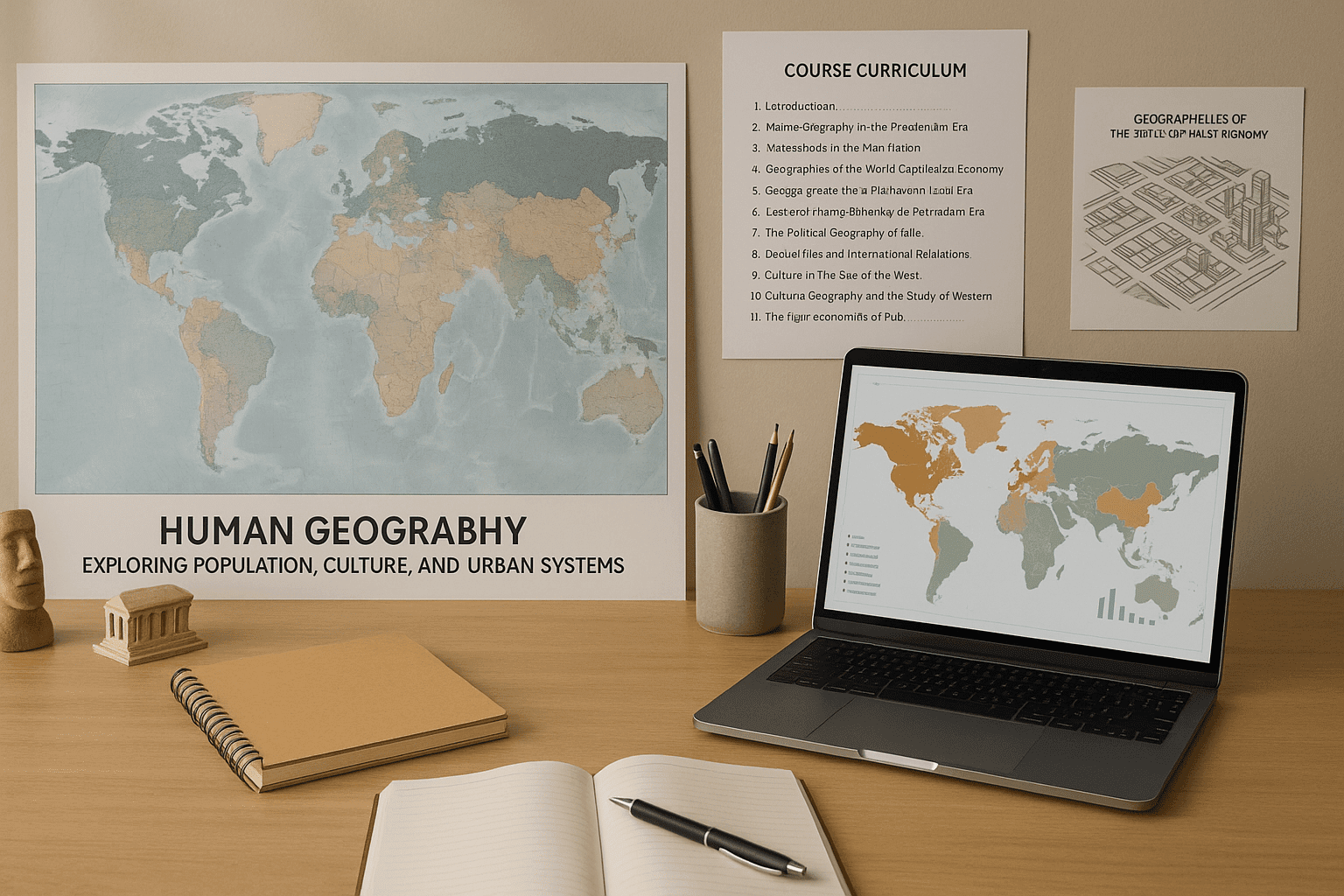
Human geography course content offers a detailed exploration of how people, cultures, economies, and political structures interact with the spaces they occupy. This programme introduces learners to essential geographic concepts, starting with the premodern era and progressing through major transitions in global economic systems, cultural development, and geopolitical change. It provides a clear pathway to understanding how societies evolve and how patterns of population, culture, and urban growth shape the modern world.
The curriculum moves from foundational historical contexts to complex global frameworks such as the Old and New International Division of Labour, enabling learners to see how trade, production, migration, and political power have shifted over time. Through case studies including the rise of the Tiger Economies and the growth of Western cultural influence, students develop the ability to interpret global patterns with clarity and critical thinking.
Urban systems, cultural landscapes, state power, and international relations are all explored through an analytical lens. Learners are guided to understand why certain regions experience rapid development while others remain economically or politically constrained. By the end of the course, participants will have the confidence to discuss globalisation, cultural diffusion, economic restructuring, and geopolitical tensions with accuracy and insight.
This training is ideal for anyone who wants to strengthen their understanding of global systems, cultural diversity, and human responses to economic and political change. It also builds transferable skills in analysis, interpretation, and evidence-based reasoning—valuable across academic, professional, and policy-related fields.
At the end of the course, learners will receive a free course completion certificate, with multiple premium certificate and transcript options available for purchase if they wish. Students also benefit from 5-star rated support available 24/7 through email, ensuring they feel fully supported throughout their learning journey.
Who is this course for?
Human geography course content offers a detailed exploration of how people, cultures, economies, and political structures interact with the spaces they occupy. This programme introduces learners to essential geographic concepts, starting with the premodern era and progressing through major transitions in global economic systems, cultural development, and geopolitical change. It provides a clear pathway to understanding how societies evolve and how patterns of population, culture, and urban growth shape the modern world.
The curriculum moves from foundational historical contexts to complex global frameworks such as the Old and New International Division of Labour, enabling learners to see how trade, production, migration, and political power have shifted over time. Through case studies including the rise of the Tiger Economies and the growth of Western cultural influence, students develop the ability to interpret global patterns with clarity and critical thinking.
Urban systems, cultural landscapes, state power, and international relations are all explored through an analytical lens. Learners are guided to understand why certain regions experience rapid development while others remain economically or politically constrained. By the end of the course, participants will have the confidence to discuss globalisation, cultural diffusion, economic restructuring, and geopolitical tensions with accuracy and insight.
This training is ideal for anyone who wants to strengthen their understanding of global systems, cultural diversity, and human responses to economic and political change. It also builds transferable skills in analysis, interpretation, and evidence-based reasoning—valuable across academic, professional, and policy-related fields.
At the end of the course, learners will receive a free course completion certificate, with multiple premium certificate and transcript options available for purchase if they wish. Students also benefit from 5-star rated support available 24/7 through email, ensuring they feel fully supported throughout their learning journey.
Requirements
Human geography course content offers a detailed exploration of how people, cultures, economies, and political structures interact with the spaces they occupy. This programme introduces learners to essential geographic concepts, starting with the premodern era and progressing through major transitions in global economic systems, cultural development, and geopolitical change. It provides a clear pathway to understanding how societies evolve and how patterns of population, culture, and urban growth shape the modern world.
The curriculum moves from foundational historical contexts to complex global frameworks such as the Old and New International Division of Labour, enabling learners to see how trade, production, migration, and political power have shifted over time. Through case studies including the rise of the Tiger Economies and the growth of Western cultural influence, students develop the ability to interpret global patterns with clarity and critical thinking.
Urban systems, cultural landscapes, state power, and international relations are all explored through an analytical lens. Learners are guided to understand why certain regions experience rapid development while others remain economically or politically constrained. By the end of the course, participants will have the confidence to discuss globalisation, cultural diffusion, economic restructuring, and geopolitical tensions with accuracy and insight.
This training is ideal for anyone who wants to strengthen their understanding of global systems, cultural diversity, and human responses to economic and political change. It also builds transferable skills in analysis, interpretation, and evidence-based reasoning—valuable across academic, professional, and policy-related fields.
At the end of the course, learners will receive a free course completion certificate, with multiple premium certificate and transcript options available for purchase if they wish. Students also benefit from 5-star rated support available 24/7 through email, ensuring they feel fully supported throughout their learning journey.
Career path
Human geography course content offers a detailed exploration of how people, cultures, economies, and political structures interact with the spaces they occupy. This programme introduces learners to essential geographic concepts, starting with the premodern era and progressing through major transitions in global economic systems, cultural development, and geopolitical change. It provides a clear pathway to understanding how societies evolve and how patterns of population, culture, and urban growth shape the modern world.
The curriculum moves from foundational historical contexts to complex global frameworks such as the Old and New International Division of Labour, enabling learners to see how trade, production, migration, and political power have shifted over time. Through case studies including the rise of the Tiger Economies and the growth of Western cultural influence, students develop the ability to interpret global patterns with clarity and critical thinking.
Urban systems, cultural landscapes, state power, and international relations are all explored through an analytical lens. Learners are guided to understand why certain regions experience rapid development while others remain economically or politically constrained. By the end of the course, participants will have the confidence to discuss globalisation, cultural diffusion, economic restructuring, and geopolitical tensions with accuracy and insight.
This training is ideal for anyone who wants to strengthen their understanding of global systems, cultural diversity, and human responses to economic and political change. It also builds transferable skills in analysis, interpretation, and evidence-based reasoning—valuable across academic, professional, and policy-related fields.
At the end of the course, learners will receive a free course completion certificate, with multiple premium certificate and transcript options available for purchase if they wish. Students also benefit from 5-star rated support available 24/7 through email, ensuring they feel fully supported throughout their learning journey.
-
- Human Geography in the Premodern Era 00:10:00
-
- Watersheds in Human History 00:10:00
- Geographies of the World Capitalist Economy 00:10:00
- The New International Division of Labor (NIDL) 00:10:00
- The Political Geography of Rule 00:10:00
- Culture in the Rise of the West 00:10:00
- Exam of Human Geography: Exploring Population, Culture, and Urban Systems 00:50:00

No Reviews found for this course.
Is this certificate recognized?
Yes, our premium certificate and transcript are widely recognized and accepted by embassies worldwide, particularly by the UK embassy. This adds credibility to your qualification and enhances its value for professional and academic purposes.
I am a beginner. Is this course suitable for me?
Yes, this course is designed for learners of all levels, including beginners. The content is structured to provide step-by-step guidance, ensuring that even those with no prior experience can follow along and gain valuable knowledge.
I am a professional. Is this course suitable for me?
Yes, professionals will also benefit from this course. It covers advanced concepts, practical applications, and industry insights that can help enhance existing skills and knowledge. Whether you are looking to refine your expertise or expand your qualifications, this course provides valuable learning.
Does this course have an expiry date?
No, you have lifetime access to the course. Once enrolled, you can revisit the materials at any time as long as the course remains available. Additionally, we regularly update our content to ensure it stays relevant and up to date.
How do I claim my free certificate?
I trust you’re in good health. Your free certificate can be located in the Achievement section. The option to purchase a CPD certificate is available but entirely optional, and you may choose to skip it. Please be aware that it’s crucial to click the “Complete” button to ensure the certificate is generated, as this process is entirely automated.
Does this course have assessments and assignments?
Yes, the course includes both assessments and assignments. Your final marks will be determined by a combination of 20% from assignments and 80% from assessments. These evaluations are designed to test your understanding and ensure you have grasped the key concepts effectively.
Is this course accredited?
We are a recognized course provider with CPD, UKRLP, and AOHT membership. The logos of these accreditation bodies will be featured on your premium certificate and transcript, ensuring credibility and professional recognition.
Will I receive a certificate upon completion?
Yes, you will receive a free digital certificate automatically once you complete the course. If you would like a premium CPD-accredited certificate, either in digital or physical format, you can upgrade for a small fee.
Course Features
Price
Study Method
Online | Self-paced
Course Format
Reading Material - PDF, article
Duration
2 hours, 45 minutes
Qualification
No formal qualification
Certificate
At completion
Additional info
Coming soon
- Share

Hotel Budgeting and Cash Management: A Complete Guide for Hospitality Professionals
Kazi Shofi Uddin Bablu237$903.60Original price was: $903.60.$27.64Current price is: $27.64.Midwifery and Maternity Level 3 Advanced Diploma
Course Line240$903.60Original price was: $903.60.$27.64Current price is: $27.64.Mineral Economics and Project Evaluation Level 3 Advanced Diploma
Course Line239$903.60Original price was: $903.60.$27.64Current price is: $27.64.



Related Courses
Psychology of Addiction: Alcohol, Drugs & Recovery
$903.60Original price was: $903.60.$27.64Current price is: $27.64.237Waste Management Level 8 Advanced Diploma
$903.60Original price was: $903.60.$27.64Current price is: $27.64.238Civil Engineering Building Construction Fundamentals: Site, Codes & Quantity Skills
$903.60Original price was: $903.60.$27.64Current price is: $27.64.237




Related Courses
Psychology of Addiction: Alcohol, Drugs & Recovery
$903.60Original price was: $903.60.$27.64Current price is: $27.64.237Waste Management Level 8 Advanced Diploma
$903.60Original price was: $903.60.$27.64Current price is: $27.64.238Civil Engineering Building Construction Fundamentals: Site, Codes & Quantity Skills
$903.60Original price was: $903.60.$27.64Current price is: $27.64.237

