
Course Features
Price
Study Method
Online | Self-paced
Course Format
Interactive PDFs, Articles & Learning Resources
Duration
9 hours, 5 minutes
Qualification
Professional Skills Development Course
Assessment
Final MCQ Exam (included in price)
Certificate
Verifiable Digital Certificate - Free
Additional info
Lifetime Access | Start Instantly
- Share
Overview
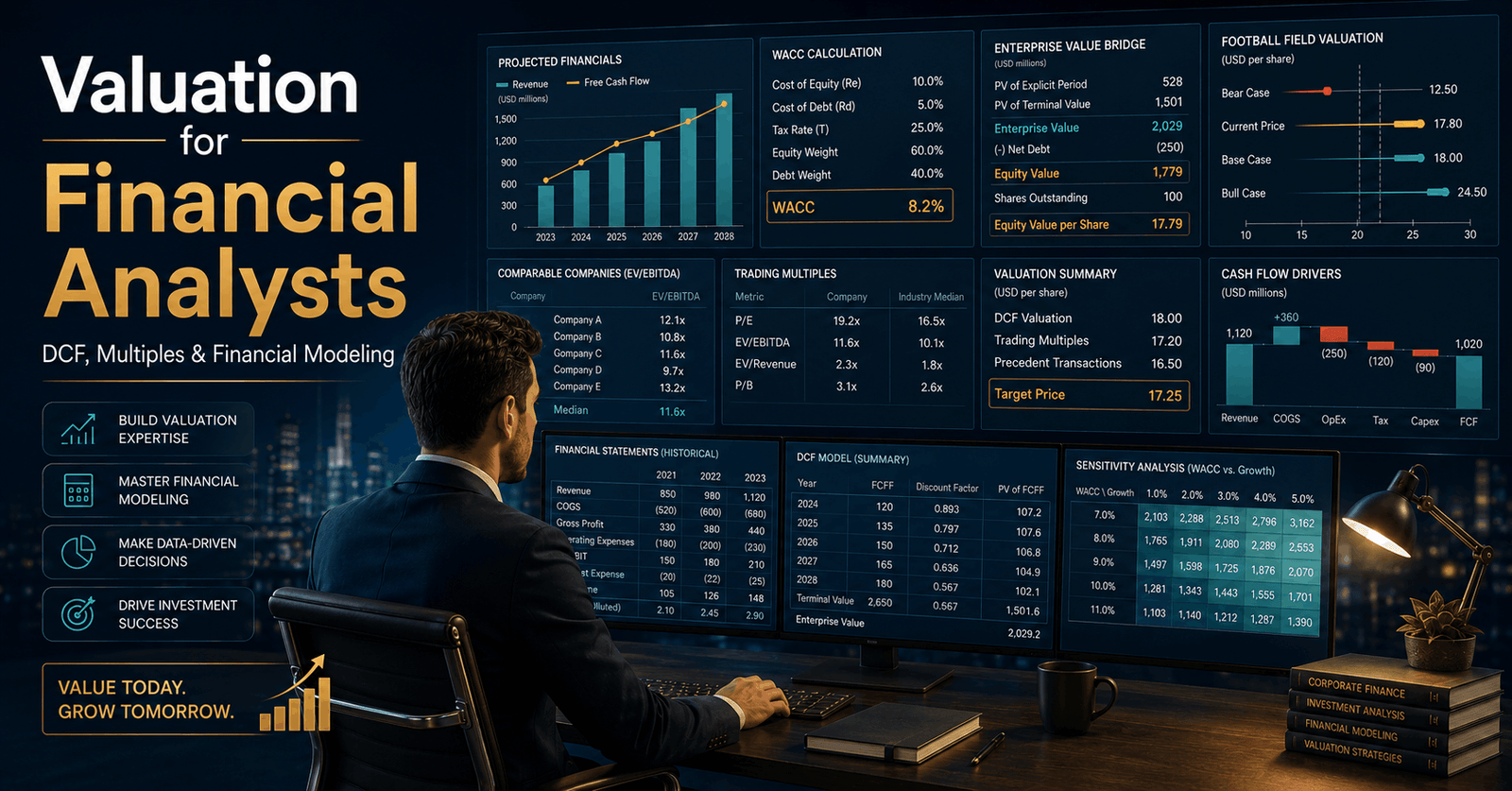
Financial Valuation is a core capability for understanding what a business may be worth and how financial assumptions influence investment and corporate finance decisions. This course provides a structured journey through widely used valuation approaches, combining conceptual knowledge with detailed financial modeling techniques relevant to aspiring analysts and finance professionals.
The course begins by examining where valuation is applied and the assumptions that underpin different methodologies. Learners will consider the strengths and limitations of major approaches before progressing into discounted cash flow analysis. Key concepts include the weighted average cost of capital (WACC), the Capital Asset Pricing Model (CAPM), beta, terminal value and exit multiples, providing the theoretical foundation needed to understand DCF calculations.
A substantial part of the programme focuses on financial modeling. You will explore how historical information and projected estimates can be organised into a structured model, including revenue, costs, depreciation, amortisation, interest and tax. The course also examines balance sheet components, working capital, fixed assets, debt schedules, equity and cash flow statements. Learners will see how financial statements connect and how free cash flow to the firm can contribute to deriving enterprise and equity value.
The programme then introduces market-based valuation through comparable trading multiples. You will examine the process of identifying suitable public companies, gathering financial information, calculating last twelve months figures and applying commonly used multiples such as EV/EBITDA and P/E. Precedent transaction analysis is also covered, helping learners understand how relevant historical deals can provide another perspective on value.
Finally, the course brings multiple methodologies together through valuation synthesis. Learners will explore how a football field chart can present valuation ranges and support comparison across different approaches.
By completing the course, you can develop a stronger understanding of company valuation, financial model construction and the interpretation of valuation outputs. These skills can support further development in investment analysis, corporate finance and related fields.
Students have access to our 5-star rated support team, available 24/7 through email. Upon successful completion, learners will receive a free course completion certificate. Multiple premium certificate and transcript options are also available for purchase for those seeking additional professional documentation.Who is this course for?
Financial Valuation is a core capability for understanding what a business may be worth and how financial assumptions influence investment and corporate finance decisions. This course provides a structured journey through widely used valuation approaches, combining conceptual knowledge with detailed financial modeling techniques relevant to aspiring analysts and finance professionals.
The course begins by examining where valuation is applied and the assumptions that underpin different methodologies. Learners will consider the strengths and limitations of major approaches before progressing into discounted cash flow analysis. Key concepts include the weighted average cost of capital (WACC), the Capital Asset Pricing Model (CAPM), beta, terminal value and exit multiples, providing the theoretical foundation needed to understand DCF calculations.
A substantial part of the programme focuses on financial modeling. You will explore how historical information and projected estimates can be organised into a structured model, including revenue, costs, depreciation, amortisation, interest and tax. The course also examines balance sheet components, working capital, fixed assets, debt schedules, equity and cash flow statements. Learners will see how financial statements connect and how free cash flow to the firm can contribute to deriving enterprise and equity value.
The programme then introduces market-based valuation through comparable trading multiples. You will examine the process of identifying suitable public companies, gathering financial information, calculating last twelve months figures and applying commonly used multiples such as EV/EBITDA and P/E. Precedent transaction analysis is also covered, helping learners understand how relevant historical deals can provide another perspective on value.
Finally, the course brings multiple methodologies together through valuation synthesis. Learners will explore how a football field chart can present valuation ranges and support comparison across different approaches.
By completing the course, you can develop a stronger understanding of company valuation, financial model construction and the interpretation of valuation outputs. These skills can support further development in investment analysis, corporate finance and related fields.
Students have access to our 5-star rated support team, available 24/7 through email. Upon successful completion, learners will receive a free course completion certificate. Multiple premium certificate and transcript options are also available for purchase for those seeking additional professional documentation.Requirements
Financial Valuation is a core capability for understanding what a business may be worth and how financial assumptions influence investment and corporate finance decisions. This course provides a structured journey through widely used valuation approaches, combining conceptual knowledge with detailed financial modeling techniques relevant to aspiring analysts and finance professionals.
The course begins by examining where valuation is applied and the assumptions that underpin different methodologies. Learners will consider the strengths and limitations of major approaches before progressing into discounted cash flow analysis. Key concepts include the weighted average cost of capital (WACC), the Capital Asset Pricing Model (CAPM), beta, terminal value and exit multiples, providing the theoretical foundation needed to understand DCF calculations.
A substantial part of the programme focuses on financial modeling. You will explore how historical information and projected estimates can be organised into a structured model, including revenue, costs, depreciation, amortisation, interest and tax. The course also examines balance sheet components, working capital, fixed assets, debt schedules, equity and cash flow statements. Learners will see how financial statements connect and how free cash flow to the firm can contribute to deriving enterprise and equity value.
The programme then introduces market-based valuation through comparable trading multiples. You will examine the process of identifying suitable public companies, gathering financial information, calculating last twelve months figures and applying commonly used multiples such as EV/EBITDA and P/E. Precedent transaction analysis is also covered, helping learners understand how relevant historical deals can provide another perspective on value.
Finally, the course brings multiple methodologies together through valuation synthesis. Learners will explore how a football field chart can present valuation ranges and support comparison across different approaches.
By completing the course, you can develop a stronger understanding of company valuation, financial model construction and the interpretation of valuation outputs. These skills can support further development in investment analysis, corporate finance and related fields.
Students have access to our 5-star rated support team, available 24/7 through email. Upon successful completion, learners will receive a free course completion certificate. Multiple premium certificate and transcript options are also available for purchase for those seeking additional professional documentation.Career path
Financial Valuation is a core capability for understanding what a business may be worth and how financial assumptions influence investment and corporate finance decisions. This course provides a structured journey through widely used valuation approaches, combining conceptual knowledge with detailed financial modeling techniques relevant to aspiring analysts and finance professionals.
The course begins by examining where valuation is applied and the assumptions that underpin different methodologies. Learners will consider the strengths and limitations of major approaches before progressing into discounted cash flow analysis. Key concepts include the weighted average cost of capital (WACC), the Capital Asset Pricing Model (CAPM), beta, terminal value and exit multiples, providing the theoretical foundation needed to understand DCF calculations.
A substantial part of the programme focuses on financial modeling. You will explore how historical information and projected estimates can be organised into a structured model, including revenue, costs, depreciation, amortisation, interest and tax. The course also examines balance sheet components, working capital, fixed assets, debt schedules, equity and cash flow statements. Learners will see how financial statements connect and how free cash flow to the firm can contribute to deriving enterprise and equity value.
The programme then introduces market-based valuation through comparable trading multiples. You will examine the process of identifying suitable public companies, gathering financial information, calculating last twelve months figures and applying commonly used multiples such as EV/EBITDA and P/E. Precedent transaction analysis is also covered, helping learners understand how relevant historical deals can provide another perspective on value.
Finally, the course brings multiple methodologies together through valuation synthesis. Learners will explore how a football field chart can present valuation ranges and support comparison across different approaches.
By completing the course, you can develop a stronger understanding of company valuation, financial model construction and the interpretation of valuation outputs. These skills can support further development in investment analysis, corporate finance and related fields.
Students have access to our 5-star rated support team, available 24/7 through email. Upon successful completion, learners will receive a free course completion certificate. Multiple premium certificate and transcript options are also available for purchase for those seeking additional professional documentation.-
- Course Introduction and Learning Objectives 00:10:00
-
- Applications of Valuation in Finance 00:10:00
- Key Assumptions Behind Valuation Methods 00:10:00
- Pros and Cons of Valuation Techniques 00:10:00
- Introduction to Trading Multiples 00:10:00
- Identifying Comparable Public Companies 00:10:00
- Gathering Financial Data 00:10:00
- Last Twelve Months (LTM) Figures 00:10:00
- Common Valuation Multiples (EV/EBITDA, P/E, etc.) 00:10:00
- Calculating Enterprise and Equity Value 00:10:00
- Summary of Valuation Methods 00:10:00
- Building and Interpreting the Football Field Chart 00:10:00
- Exam of Valuation for Financial Analysts: DCF, Multiples, and Financial Modeling 00:50:00

No Reviews found for this course.
Is this certificate recognized?
Yes, our premium certificate and transcript are widely recognized and accepted by embassies worldwide, particularly by the UK embassy. This adds credibility to your qualification and enhances its value for professional and academic purposes.
I am a beginner. Is this course suitable for me?
Yes, this course is designed for learners of all levels, including beginners. The content is structured to provide step-by-step guidance, ensuring that even those with no prior experience can follow along and gain valuable knowledge.
I am a professional. Is this course suitable for me?
Yes, professionals will also benefit from this course. It covers advanced concepts, practical applications, and industry insights that can help enhance existing skills and knowledge. Whether you are looking to refine your expertise or expand your qualifications, this course provides valuable learning.
Does this course have an expiry date?
No, you have lifetime access to the course. Once enrolled, you can revisit the materials at any time as long as the course remains available. Additionally, we regularly update our content to ensure it stays relevant and up to date.
How do I claim my free certificate?
I trust you’re in good health. Your free certificate can be located in the Achievement section. The option to purchase a CPD certificate is available but entirely optional, and you may choose to skip it. Please be aware that it’s crucial to click the “Complete” button to ensure the certificate is generated, as this process is entirely automated.
Does this course have assessments and assignments?
Yes, the course includes both assessments and assignments. Your final marks will be determined by a combination of 20% from assignments and 80% from assessments. These evaluations are designed to test your understanding and ensure you have grasped the key concepts effectively.
Is this course accredited?
We are a recognized course provider with CPD, UKRLP, and AOHT membership. The logos of these accreditation bodies will be featured on your premium certificate and transcript, ensuring credibility and professional recognition.
Will I receive a certificate upon completion?
Yes, you will receive a free digital certificate automatically once you complete the course. If you would like a premium CPD-accredited certificate, either in digital or physical format, you can upgrade for a small fee.
Course Features
Price
Study Method
Online | Self-paced
Course Format
Interactive PDFs, Articles & Learning Resources
Duration
9 hours, 5 minutes
Qualification
Professional Skills Development Course
Assessment
Final MCQ Exam (included in price)
Certificate
Verifiable Digital Certificate - Free
Additional info
Lifetime Access | Start Instantly
- Share

CACHE: Child Mental Health & Emotional Wellbeing
Course Line239£490.00Original price was: £490.00.£14.99Current price is: £14.99.Audio Typing Level 8 Advanced Diploma
Course Line237£490.00Original price was: £490.00.£14.99Current price is: £14.99.



Related Courses
Microsoft Excel for Business: Beginner to Advanced Data Analysis
£490.00Original price was: £490.00.£14.99Current price is: £14.99.237Financial Modelling in Excel: Build Forecasting & Budget Models
£490.00Original price was: £490.00.£14.99Current price is: £14.99.237Payroll Processing, PAYE & RTI Training Using BrightPay
£490.00Original price was: £490.00.£14.99Current price is: £14.99.237




Related Courses
Microsoft Excel for Business: Beginner to Advanced Data Analysis
£490.00Original price was: £490.00.£14.99Current price is: £14.99.237Financial Modelling in Excel: Build Forecasting & Budget Models
£490.00Original price was: £490.00.£14.99Current price is: £14.99.237Payroll Processing, PAYE & RTI Training Using BrightPay
£490.00Original price was: £490.00.£14.99Current price is: £14.99.237

