
Course Features
Price
Study Method
Online | Self-paced
Course Format
Interactive PDFs, Articles & Learning Resources
Duration
1 day, 2 hours
Qualification
Professional Skills Development Course
Assessment
Final MCQ Exam (included in price)
Certificate
Verifiable Digital Certificate - Free
Additional info
Lifetime Access | Start Instantly
- Share
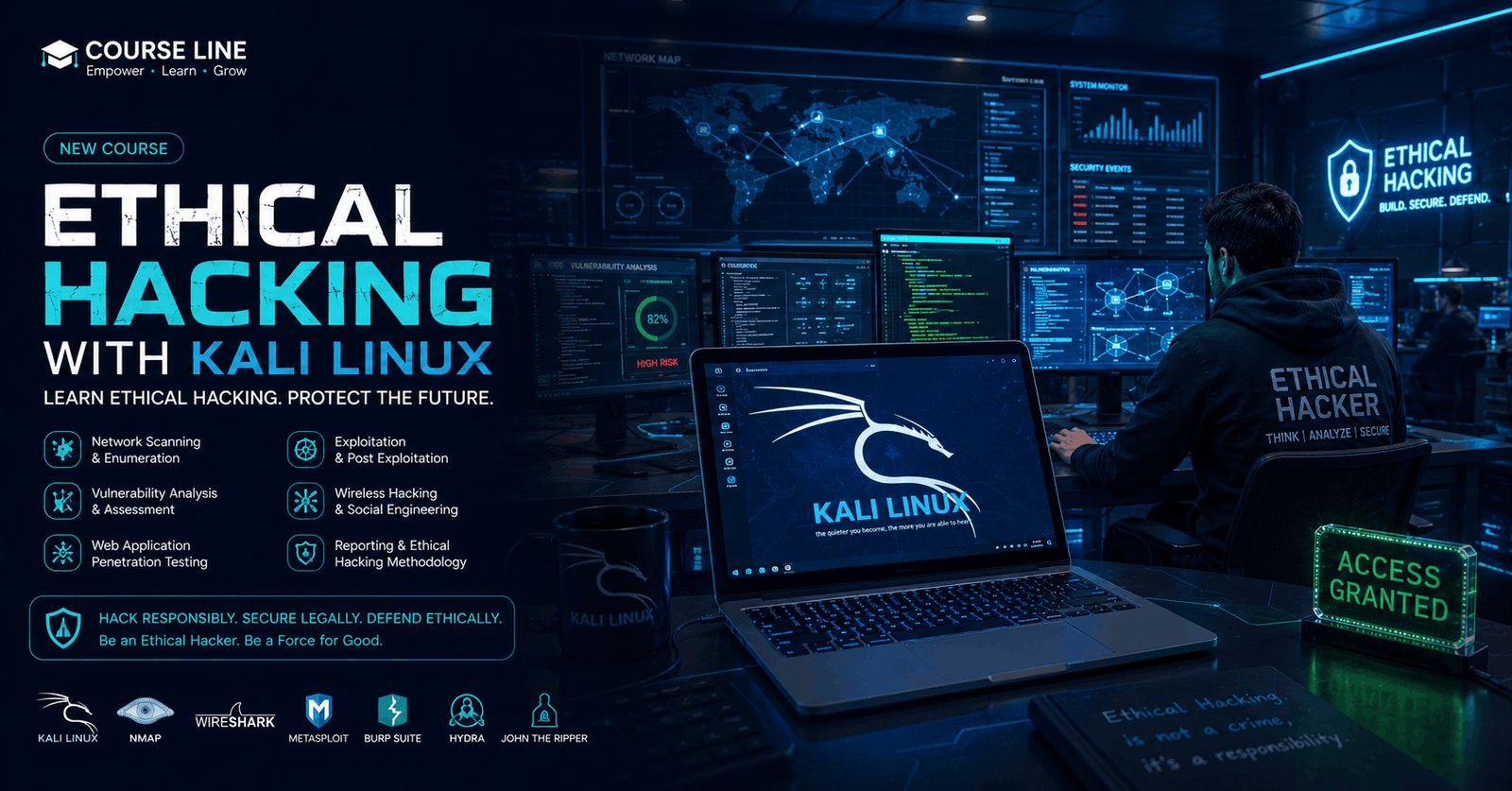
Overview
Ethical Hacking Course provides a comprehensive introduction to cybersecurity concepts, security testing methodologies, and the tools used by professionals to identify and understand digital vulnerabilities. In today’s connected world, organisations require skilled security specialists who can protect systems, networks, websites, and applications from cyber threats. This course is designed to help learners develop practical knowledge of ethical hacking while understanding the importance of responsible and legal security practices.
You will begin by building a strong foundation in ethical hacking, including the role of security professionals, different types of hackers, networking concepts, and the importance of controlled testing environments. The course guides you through setting up a cybersecurity laboratory using virtualisation platforms and security-focused operating systems, allowing you to explore concepts in a safe learning environment.
Throughout the course, you will gain familiarity with essential cybersecurity tools and techniques used for security assessment, information gathering, network analysis, vulnerability identification, and penetration testing documentation. You will explore important areas such as website security, mobile security, Linux fundamentals, wireless security, and the role of Kali Linux in professional cybersecurity workflows.
The course also introduces learners to key concepts related to digital privacy, system protection, security awareness, and modern defence strategies. You will develop an understanding of how cybersecurity experts analyse systems, evaluate risks, and recommend improvements to strengthen security. Practical demonstrations and structured lessons help bridge the gap between theoretical knowledge and real-world security applications.
By completing this course, you will build a strong foundation in ethical hacking principles, cybersecurity tools, and security assessment approaches. The knowledge gained can support further learning in penetration testing, network security, information security, and cybersecurity certifications. It is an excellent starting point for learners who want to explore opportunities in the rapidly growing cybersecurity industry.
Learners who successfully complete the course will receive a free course completion certificate. Those who wish to enhance their professional credentials can also purchase multiple premium certificate and official transcript options. Additionally, all students receive access to 5-star rated support available 24/7 through email, ensuring guidance and assistance throughout their learning journey.Who is this course for?
Ethical Hacking Course provides a comprehensive introduction to cybersecurity concepts, security testing methodologies, and the tools used by professionals to identify and understand digital vulnerabilities. In today’s connected world, organisations require skilled security specialists who can protect systems, networks, websites, and applications from cyber threats. This course is designed to help learners develop practical knowledge of ethical hacking while understanding the importance of responsible and legal security practices.
You will begin by building a strong foundation in ethical hacking, including the role of security professionals, different types of hackers, networking concepts, and the importance of controlled testing environments. The course guides you through setting up a cybersecurity laboratory using virtualisation platforms and security-focused operating systems, allowing you to explore concepts in a safe learning environment.
Throughout the course, you will gain familiarity with essential cybersecurity tools and techniques used for security assessment, information gathering, network analysis, vulnerability identification, and penetration testing documentation. You will explore important areas such as website security, mobile security, Linux fundamentals, wireless security, and the role of Kali Linux in professional cybersecurity workflows.
The course also introduces learners to key concepts related to digital privacy, system protection, security awareness, and modern defence strategies. You will develop an understanding of how cybersecurity experts analyse systems, evaluate risks, and recommend improvements to strengthen security. Practical demonstrations and structured lessons help bridge the gap between theoretical knowledge and real-world security applications.
By completing this course, you will build a strong foundation in ethical hacking principles, cybersecurity tools, and security assessment approaches. The knowledge gained can support further learning in penetration testing, network security, information security, and cybersecurity certifications. It is an excellent starting point for learners who want to explore opportunities in the rapidly growing cybersecurity industry.
Learners who successfully complete the course will receive a free course completion certificate. Those who wish to enhance their professional credentials can also purchase multiple premium certificate and official transcript options. Additionally, all students receive access to 5-star rated support available 24/7 through email, ensuring guidance and assistance throughout their learning journey.Requirements
Ethical Hacking Course provides a comprehensive introduction to cybersecurity concepts, security testing methodologies, and the tools used by professionals to identify and understand digital vulnerabilities. In today’s connected world, organisations require skilled security specialists who can protect systems, networks, websites, and applications from cyber threats. This course is designed to help learners develop practical knowledge of ethical hacking while understanding the importance of responsible and legal security practices.
You will begin by building a strong foundation in ethical hacking, including the role of security professionals, different types of hackers, networking concepts, and the importance of controlled testing environments. The course guides you through setting up a cybersecurity laboratory using virtualisation platforms and security-focused operating systems, allowing you to explore concepts in a safe learning environment.
Throughout the course, you will gain familiarity with essential cybersecurity tools and techniques used for security assessment, information gathering, network analysis, vulnerability identification, and penetration testing documentation. You will explore important areas such as website security, mobile security, Linux fundamentals, wireless security, and the role of Kali Linux in professional cybersecurity workflows.
The course also introduces learners to key concepts related to digital privacy, system protection, security awareness, and modern defence strategies. You will develop an understanding of how cybersecurity experts analyse systems, evaluate risks, and recommend improvements to strengthen security. Practical demonstrations and structured lessons help bridge the gap between theoretical knowledge and real-world security applications.
By completing this course, you will build a strong foundation in ethical hacking principles, cybersecurity tools, and security assessment approaches. The knowledge gained can support further learning in penetration testing, network security, information security, and cybersecurity certifications. It is an excellent starting point for learners who want to explore opportunities in the rapidly growing cybersecurity industry.
Learners who successfully complete the course will receive a free course completion certificate. Those who wish to enhance their professional credentials can also purchase multiple premium certificate and official transcript options. Additionally, all students receive access to 5-star rated support available 24/7 through email, ensuring guidance and assistance throughout their learning journey.Career path
Ethical Hacking Course provides a comprehensive introduction to cybersecurity concepts, security testing methodologies, and the tools used by professionals to identify and understand digital vulnerabilities. In today’s connected world, organisations require skilled security specialists who can protect systems, networks, websites, and applications from cyber threats. This course is designed to help learners develop practical knowledge of ethical hacking while understanding the importance of responsible and legal security practices.
You will begin by building a strong foundation in ethical hacking, including the role of security professionals, different types of hackers, networking concepts, and the importance of controlled testing environments. The course guides you through setting up a cybersecurity laboratory using virtualisation platforms and security-focused operating systems, allowing you to explore concepts in a safe learning environment.
Throughout the course, you will gain familiarity with essential cybersecurity tools and techniques used for security assessment, information gathering, network analysis, vulnerability identification, and penetration testing documentation. You will explore important areas such as website security, mobile security, Linux fundamentals, wireless security, and the role of Kali Linux in professional cybersecurity workflows.
The course also introduces learners to key concepts related to digital privacy, system protection, security awareness, and modern defence strategies. You will develop an understanding of how cybersecurity experts analyse systems, evaluate risks, and recommend improvements to strengthen security. Practical demonstrations and structured lessons help bridge the gap between theoretical knowledge and real-world security applications.
By completing this course, you will build a strong foundation in ethical hacking principles, cybersecurity tools, and security assessment approaches. The knowledge gained can support further learning in penetration testing, network security, information security, and cybersecurity certifications. It is an excellent starting point for learners who want to explore opportunities in the rapidly growing cybersecurity industry.
Learners who successfully complete the course will receive a free course completion certificate. Those who wish to enhance their professional credentials can also purchase multiple premium certificate and official transcript options. Additionally, all students receive access to 5-star rated support available 24/7 through email, ensuring guidance and assistance throughout their learning journey.-
- Quick Hacking (Part 1) 00:10:00
- Quick Hacking (Part 2) 00:10:00
- Quick Hacking (Part 3) 00:10:00
- Course Introduction 00:10:00
-
- Oracle VirtualBox 00:10:00
- Installing Windows 7 00:10:00
- Installing Kali Linux 00:10:00
- Important Lab Information 00:10:00
- Installing Windows 10 00:10:00
- Installing Server 2012 00:10:00
- Setting Up Metasploitable 00:10:00
- Working with Snapshots 00:10:00
- Hacking Overview 00:10:00
- Types of Hackers 00:10:00
- Network Configuration in VirtualBox 00:10:00
- Understanding Networks 00:10:00
- Checking Target Reachability 00:10:00
- Using NSLOOKUP 00:10:00
- Extracting Data from Targets 00:10:00
- Website Mirroring 00:10:00
- Email Tracing 00:10:00
- Using The Harvester 00:10:00
- Hacker’s Search Engines 00:10:00
- Google Hacking Techniques 00:10:00
- Nmap & Hping3 (Part 1) 00:10:00
- Nmap & Hping3 (Part 2) 00:10:00
- Nmap & Hping3 (Part 3) 00:10:00
- Nmap & Hping3 (Part 4) 00:10:00
- Nmap & Hping3 (Part 5) 00:10:00
- Zenmap GUI for Nmap 00:10:00
- Detecting Target OS 00:10:00
- Detecting Network Topology 00:10:00
- Installing Veil Framework 00:10:00
- Generating Undetectable Backdoors 00:10:00
- Modifying and Testing Backdoors 00:10:00
- Using Backdoors to Gain Access 00:10:00
- Email Spoofing 00:10:00
- Steganography (Part 1) 00:10:00
- Steganography (Part 2) 00:10:00
- Steganography (Part 3) 00:10:00
- Steganography (Part 4) 00:10:00
- Finding Hidden Files Using ADS Spy 00:10:00
- Best Keylogger Practices 00:10:00
- System Hacking Techniques 00:10:00
- Gaining Remote Access 00:10:00
- Trojan Creation and Hacking 00:10:00
- ARP Spoofing 00:10:00
- ARP Poisoning 00:10:00
- Breaking Windows 10 Passwords 00:10:00
- Social Engineering (Part 1) 00:10:00
- Social Engineering (Part 2) 00:10:00
- Social Engineering (Part 3) 00:10:00
- Social Engineering (Part 4) 00:10:00
- Netcraft Toolbar 00:10:00
- PhishTank 00:10:00
- Clearing Your Tracks 00:10:00
- Writing Pentesting Reports (Part 1) 00:10:00
- Writing Pentesting Reports (Part 2) 00:10:00
- Overview of Website Hacking 00:10:00
- Understanding Websites 00:10:00
- Accessing Websites 00:10:00
- Website Footprinting (Part 1) 00:10:00
- Website Footprinting (Part 2) 00:10:00
- Website Footprinting (Part 3) 00:10:00
- Introduction to SQL 00:10:00
- SQL Injection (Low Security) 00:10:00
- SQL Injection (Medium Security) 00:10:00
- SQL Injection (Advanced Security) 00:10:00
- Live Website Hacking using SQL Injection 00:10:00
- Finding Other Websites on the Same Server 00:10:00
- Automating SQL Injection with SQLMap 00:10:00
- Denial of Service Attacks 00:10:00
- DoS Attack Practical 00:10:00
- DDoS Attack Practical 00:10:00
- What is XSS 00:10:00
- XSS Practical 00:10:00
- XSS on Live Websites 00:10:00
- XSS Live Challenges 00:10:00
- Bug Bounty Websites 00:10:00
- Automating Website Attacks 00:10:00
- Summary of Website Hacking 00:10:00
- Linux Overview 00:10:00
- Installing RHEL 00:10:00
- RHEL Basics 00:10:00
- Basic Linux Commands (Part 1) 00:10:00
- Basic Linux Commands (Part 2) 00:10:00
- Users, Groups and Group Memberships 00:10:00
- Permissions in Linux 00:10:00
- Directory Structure Explained 00:10:00
- Linux Partitions (Part 1) 00:10:00
- Linux Partitions (Part 2) 00:10:00
- Linux Partitions (Part 3) 00:10:00
- Linux Partitions (Part 4) 00:10:00
- Breaking Super User Passwords 00:10:00
- Linux Processes (Part 1) 00:10:00
- Linux Processes (Part 2) 00:10:00
- Apache Introduction 00:10:00
- Apache Installation 00:10:00
- Database Assessment with Kali 00:10:00
- JSQL 00:10:00
- SQLsus 00:10:00
- Password Attack Basics 00:10:00
- Understanding Hashes 00:10:00
- Password Cracking 00:10:00
- Hash Cracking 00:10:00
- CEWL (Wordlist Generator) 00:10:00
- Crunch (Custom Wordlists) 00:10:00
- John The Ripper 00:10:00
- Cracking Hashes 00:10:00
- Cracking Hashes in RAR Files 00:10:00
- THC Hydra 00:10:00
- Premium Certificate 00:15:00

No Reviews found for this course.
Is this certificate recognized?
Yes, our premium certificate and transcript are widely recognized and accepted by embassies worldwide, particularly by the UK embassy. This adds credibility to your qualification and enhances its value for professional and academic purposes.
I am a beginner. Is this course suitable for me?
Yes, this course is designed for learners of all levels, including beginners. The content is structured to provide step-by-step guidance, ensuring that even those with no prior experience can follow along and gain valuable knowledge.
I am a professional. Is this course suitable for me?
Yes, professionals will also benefit from this course. It covers advanced concepts, practical applications, and industry insights that can help enhance existing skills and knowledge. Whether you are looking to refine your expertise or expand your qualifications, this course provides valuable learning.
Does this course have an expiry date?
No, you have lifetime access to the course. Once enrolled, you can revisit the materials at any time as long as the course remains available. Additionally, we regularly update our content to ensure it stays relevant and up to date.
How do I claim my free certificate?
I trust you’re in good health. Your free certificate can be located in the Achievement section. The option to purchase a CPD certificate is available but entirely optional, and you may choose to skip it. Please be aware that it’s crucial to click the “Complete” button to ensure the certificate is generated, as this process is entirely automated.
Does this course have assessments and assignments?
Yes, the course includes both assessments and assignments. Your final marks will be determined by a combination of 20% from assignments and 80% from assessments. These evaluations are designed to test your understanding and ensure you have grasped the key concepts effectively.
Is this course accredited?
We are a recognized course provider with CPD, UKRLP, and AOHT membership. The logos of these accreditation bodies will be featured on your premium certificate and transcript, ensuring credibility and professional recognition.
Will I receive a certificate upon completion?
Yes, you will receive a free digital certificate automatically once you complete the course. If you would like a premium CPD-accredited certificate, either in digital or physical format, you can upgrade for a small fee.
Course Features
Price
Study Method
Online | Self-paced
Course Format
Interactive PDFs, Articles & Learning Resources
Duration
1 day, 2 hours
Qualification
Professional Skills Development Course
Assessment
Final MCQ Exam (included in price)
Certificate
Verifiable Digital Certificate - Free
Additional info
Lifetime Access | Start Instantly
- Share

QCF Level 3 Diploma in Hospitality Supervision and Leadership
Course Line237$652.75Original price was: $652.75.$19.97Current price is: $19.97.Advanced Pest Control
Course Line250$652.75Original price was: $652.75.$19.97Current price is: $19.97.Master Excel VLOOKUP: From Basics to Advanced Techniques
Course Line237$652.75Original price was: $652.75.$19.97Current price is: $19.97.



Related Courses
PRINCE2 in Practice: Simulated Projects & Case Studies
$652.75Original price was: $652.75.$19.97Current price is: $19.97.237PRINCE2 Risk Management: Identifying, Assessing & Controlling Risk
$652.75Original price was: $652.75.$19.97Current price is: $19.97.237PRINCE2 Roles & Responsibilities: Managing Teams in a PRINCE2 Environment
$652.75Original price was: $652.75.$19.97Current price is: $19.97.237




Related Courses
PRINCE2 in Practice: Simulated Projects & Case Studies
$652.75Original price was: $652.75.$19.97Current price is: $19.97.237PRINCE2 Risk Management: Identifying, Assessing & Controlling Risk
$652.75Original price was: $652.75.$19.97Current price is: $19.97.237PRINCE2 Roles & Responsibilities: Managing Teams in a PRINCE2 Environment
$652.75Original price was: $652.75.$19.97Current price is: $19.97.237

