
Course Features
Price
Study Method
Online | Self-paced
Course Format
Interactive PDFs, Articles & Learning Resources
Duration
8 hours, 45 minutes
Qualification
Professional Skills Development Course
Assessment
Final MCQ Exam (included in price)
Certificate
Verifiable Digital Certificate - Free
Additional info
Lifetime Access | Start Instantly
- Share
Overview
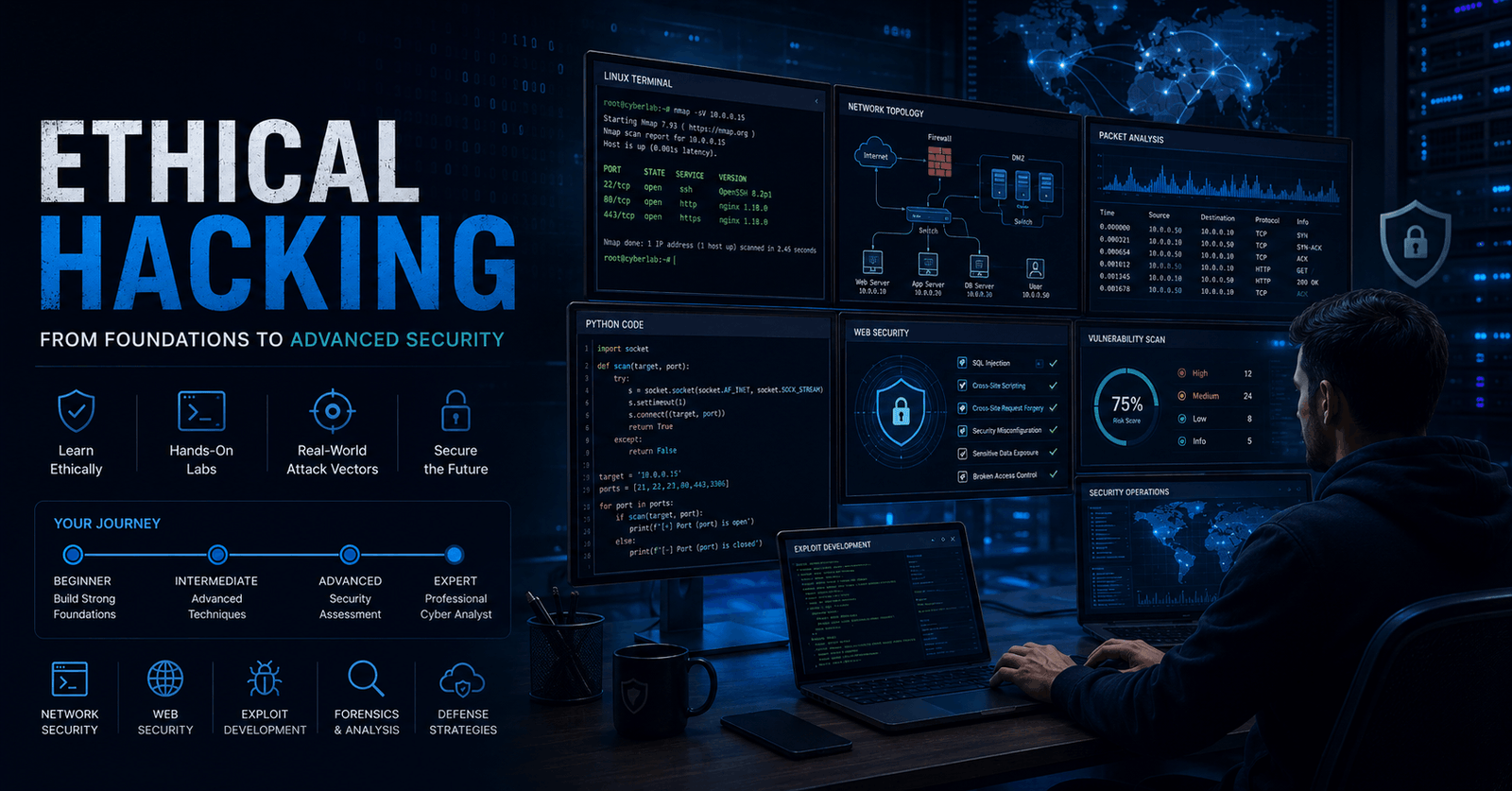
Ethical Hacking Course training provides a structured route into cybersecurity, taking learners from essential security concepts to more advanced technical skills used in authorised security assessment. Designed to build knowledge progressively, the course combines foundational theory with practical exposure to Linux, networking, web applications, security tools and Python programming.
You will begin by exploring ethical hacking principles, common assessment processes and the role of responsible security testing. The course then develops your command-line confidence through Kali Linux, covering the Linux filesystem, essential commands, service management, environment variables, text processing, Bash scripting and Netcat. These skills provide a strong technical foundation for working with security-focused operating environments.
As you progress, you will examine how web applications function, including HTTP, DNS and common web security risks. You will also become familiar with widely used assessment tools such as Burp Suite, DIRB and Nikto. Networking modules introduce the OSI model, packet capture, traffic filtering and network analysis with Wireshark, helping you understand how data moves across networks and how insecure communications may be identified during authorised investigations.
The course also introduces Nmap for port scanning, service discovery, operating system detection and security assessment. Python programming is included to help you understand automation, data structures, control flow, functions, error handling and the development of simple security-testing tools in controlled environments. Later lessons explore realistic cybersecurity scenarios, privacy technologies, traffic analysis, denial-of-service concepts and defensive approaches, with an emphasis on understanding threats responsibly and legally.
By completing this course, you can develop broader technical awareness, improve your problem-solving abilities and gain a clearer understanding of how security professionals identify weaknesses and strengthen digital systems. The content is suitable for independent learners who want a structured progression from introductory concepts towards more technical cybersecurity topics.
Learners will receive a free course completion certificate after completing the course. Multiple premium certificate and transcript options are also available for purchase for those who wish to obtain additional documentation. Students also have access to our 5-star rated support, available 24/7 through email, for assistance throughout their learning journey.Who is this course for?
Ethical Hacking Course training provides a structured route into cybersecurity, taking learners from essential security concepts to more advanced technical skills used in authorised security assessment. Designed to build knowledge progressively, the course combines foundational theory with practical exposure to Linux, networking, web applications, security tools and Python programming.
You will begin by exploring ethical hacking principles, common assessment processes and the role of responsible security testing. The course then develops your command-line confidence through Kali Linux, covering the Linux filesystem, essential commands, service management, environment variables, text processing, Bash scripting and Netcat. These skills provide a strong technical foundation for working with security-focused operating environments.
As you progress, you will examine how web applications function, including HTTP, DNS and common web security risks. You will also become familiar with widely used assessment tools such as Burp Suite, DIRB and Nikto. Networking modules introduce the OSI model, packet capture, traffic filtering and network analysis with Wireshark, helping you understand how data moves across networks and how insecure communications may be identified during authorised investigations.
The course also introduces Nmap for port scanning, service discovery, operating system detection and security assessment. Python programming is included to help you understand automation, data structures, control flow, functions, error handling and the development of simple security-testing tools in controlled environments. Later lessons explore realistic cybersecurity scenarios, privacy technologies, traffic analysis, denial-of-service concepts and defensive approaches, with an emphasis on understanding threats responsibly and legally.
By completing this course, you can develop broader technical awareness, improve your problem-solving abilities and gain a clearer understanding of how security professionals identify weaknesses and strengthen digital systems. The content is suitable for independent learners who want a structured progression from introductory concepts towards more technical cybersecurity topics.
Learners will receive a free course completion certificate after completing the course. Multiple premium certificate and transcript options are also available for purchase for those who wish to obtain additional documentation. Students also have access to our 5-star rated support, available 24/7 through email, for assistance throughout their learning journey.Requirements
Ethical Hacking Course training provides a structured route into cybersecurity, taking learners from essential security concepts to more advanced technical skills used in authorised security assessment. Designed to build knowledge progressively, the course combines foundational theory with practical exposure to Linux, networking, web applications, security tools and Python programming.
You will begin by exploring ethical hacking principles, common assessment processes and the role of responsible security testing. The course then develops your command-line confidence through Kali Linux, covering the Linux filesystem, essential commands, service management, environment variables, text processing, Bash scripting and Netcat. These skills provide a strong technical foundation for working with security-focused operating environments.
As you progress, you will examine how web applications function, including HTTP, DNS and common web security risks. You will also become familiar with widely used assessment tools such as Burp Suite, DIRB and Nikto. Networking modules introduce the OSI model, packet capture, traffic filtering and network analysis with Wireshark, helping you understand how data moves across networks and how insecure communications may be identified during authorised investigations.
The course also introduces Nmap for port scanning, service discovery, operating system detection and security assessment. Python programming is included to help you understand automation, data structures, control flow, functions, error handling and the development of simple security-testing tools in controlled environments. Later lessons explore realistic cybersecurity scenarios, privacy technologies, traffic analysis, denial-of-service concepts and defensive approaches, with an emphasis on understanding threats responsibly and legally.
By completing this course, you can develop broader technical awareness, improve your problem-solving abilities and gain a clearer understanding of how security professionals identify weaknesses and strengthen digital systems. The content is suitable for independent learners who want a structured progression from introductory concepts towards more technical cybersecurity topics.
Learners will receive a free course completion certificate after completing the course. Multiple premium certificate and transcript options are also available for purchase for those who wish to obtain additional documentation. Students also have access to our 5-star rated support, available 24/7 through email, for assistance throughout their learning journey.Career path
Ethical Hacking Course training provides a structured route into cybersecurity, taking learners from essential security concepts to more advanced technical skills used in authorised security assessment. Designed to build knowledge progressively, the course combines foundational theory with practical exposure to Linux, networking, web applications, security tools and Python programming.
You will begin by exploring ethical hacking principles, common assessment processes and the role of responsible security testing. The course then develops your command-line confidence through Kali Linux, covering the Linux filesystem, essential commands, service management, environment variables, text processing, Bash scripting and Netcat. These skills provide a strong technical foundation for working with security-focused operating environments.
As you progress, you will examine how web applications function, including HTTP, DNS and common web security risks. You will also become familiar with widely used assessment tools such as Burp Suite, DIRB and Nikto. Networking modules introduce the OSI model, packet capture, traffic filtering and network analysis with Wireshark, helping you understand how data moves across networks and how insecure communications may be identified during authorised investigations.
The course also introduces Nmap for port scanning, service discovery, operating system detection and security assessment. Python programming is included to help you understand automation, data structures, control flow, functions, error handling and the development of simple security-testing tools in controlled environments. Later lessons explore realistic cybersecurity scenarios, privacy technologies, traffic analysis, denial-of-service concepts and defensive approaches, with an emphasis on understanding threats responsibly and legally.
By completing this course, you can develop broader technical awareness, improve your problem-solving abilities and gain a clearer understanding of how security professionals identify weaknesses and strengthen digital systems. The content is suitable for independent learners who want a structured progression from introductory concepts towards more technical cybersecurity topics.
Learners will receive a free course completion certificate after completing the course. Multiple premium certificate and transcript options are also available for purchase for those who wish to obtain additional documentation. Students also have access to our 5-star rated support, available 24/7 through email, for assistance throughout their learning journey.-
- Ethical Hacking Essentials 00:10:00
- The Ethical Hacking Process 00:10:00
- Benefits of Becoming an Ethical Hacker 00:10:00
-
- Why Choose Kali Linux? 00:10:00
- Booting Kali Linux 00:10:00
- Linux Filesystem Overview 00:10:00
- Essential Linux Commands 00:10:00
- Managing Services in Kali Linux 00:10:00
- Installing and Removing Tools 00:10:00
- Environment Variables and CLI Customization 00:10:00
- Bash History, Piping, and Redirection 00:10:00
- Text Searching, Manipulation, and File Editing 00:10:00
- File Comparison and Process Management 00:10:00
- Monitoring Files and Commands 00:10:00
- Downloading Files from CLI 00:10:00
- Bash Scripting Basics: Scripts, Variables, Conditionals 00:10:00
- Netcat Essentials 00:10:00
- Web Application Security Essentials 00:10:00
- How Web Apps Work 00:10:00
- HTTP Protocol Deep Dive 00:10:00
- DNS Fundamentals 00:10:00
- OWASP Top 10 Vulnerabilities 00:10:00
- Web App Assessment Tools: DIRB, Burp Suite, Nikto 00:10:00
- Introduction to Port Scanning 00:10:00
- Nmap Overview and Environment Setup 00:10:00
- Nmap Scanning Techniques 00:10:00
- Advanced Scanning: OS Detection, Service Versions, CVEs 00:10:00
- Nmap for DOS and Brute Force Attacks 00:10:00
- Firewall and IDS Evasion 00:10:00
- Overview of Mr. Robot’s Ethical Hacking Scenario 00:10:00
- Deep Web vs Dark Web 00:10:00
- TOR Network Setup and Usage 00:10:00
- MITM and Packet Sniffing Attacks 00:10:00
- Building Hacking Environment 00:10:00
- Understanding and Executing DDoS Attacks (SYN Flood 00:10:00
- Famous DDoS Attacks and Defense Techniques 00:10:00
- Premium Certificate 00:15:00

No Reviews found for this course.
Is this certificate recognized?
Yes, our premium certificate and transcript are widely recognized and accepted by embassies worldwide, particularly by the UK embassy. This adds credibility to your qualification and enhances its value for professional and academic purposes.
I am a beginner. Is this course suitable for me?
Yes, this course is designed for learners of all levels, including beginners. The content is structured to provide step-by-step guidance, ensuring that even those with no prior experience can follow along and gain valuable knowledge.
I am a professional. Is this course suitable for me?
Yes, professionals will also benefit from this course. It covers advanced concepts, practical applications, and industry insights that can help enhance existing skills and knowledge. Whether you are looking to refine your expertise or expand your qualifications, this course provides valuable learning.
Does this course have an expiry date?
No, you have lifetime access to the course. Once enrolled, you can revisit the materials at any time as long as the course remains available. Additionally, we regularly update our content to ensure it stays relevant and up to date.
How do I claim my free certificate?
I trust you’re in good health. Your free certificate can be located in the Achievement section. The option to purchase a CPD certificate is available but entirely optional, and you may choose to skip it. Please be aware that it’s crucial to click the “Complete” button to ensure the certificate is generated, as this process is entirely automated.
Does this course have assessments and assignments?
Yes, the course includes both assessments and assignments. Your final marks will be determined by a combination of 20% from assignments and 80% from assessments. These evaluations are designed to test your understanding and ensure you have grasped the key concepts effectively.
Is this course accredited?
We are a recognized course provider with CPD, UKRLP, and AOHT membership. The logos of these accreditation bodies will be featured on your premium certificate and transcript, ensuring credibility and professional recognition.
Will I receive a certificate upon completion?
Yes, you will receive a free digital certificate automatically once you complete the course. If you would like a premium CPD-accredited certificate, either in digital or physical format, you can upgrade for a small fee.
Course Features
Price
Study Method
Online | Self-paced
Course Format
Interactive PDFs, Articles & Learning Resources
Duration
8 hours, 45 minutes
Qualification
Professional Skills Development Course
Assessment
Final MCQ Exam (included in price)
Certificate
Verifiable Digital Certificate - Free
Additional info
Lifetime Access | Start Instantly
- Share

Diary Management Level 3 Advanced Diploma
Course Line249₩970,401.39Original price was: ₩970,401.39.₩29,686.36Current price is: ₩29,686.36.LPC Level 3 Advanced Diploma
Course Line238₩970,401.39Original price was: ₩970,401.39.₩29,686.36Current price is: ₩29,686.36.Level 3 Certificate in Law and Practice
Course Line239₩970,401.39Original price was: ₩970,401.39.₩29,686.36Current price is: ₩29,686.36.



Related Courses
PRINCE2 in Practice: Simulated Projects & Case Studies
₩970,401.39Original price was: ₩970,401.39.₩29,686.36Current price is: ₩29,686.36.237PRINCE2 Risk Management: Identifying, Assessing & Controlling Risk
₩970,401.39Original price was: ₩970,401.39.₩29,686.36Current price is: ₩29,686.36.237PRINCE2 Roles & Responsibilities: Managing Teams in a PRINCE2 Environment
₩970,401.39Original price was: ₩970,401.39.₩29,686.36Current price is: ₩29,686.36.237




Related Courses
PRINCE2 in Practice: Simulated Projects & Case Studies
₩970,401.39Original price was: ₩970,401.39.₩29,686.36Current price is: ₩29,686.36.237PRINCE2 Risk Management: Identifying, Assessing & Controlling Risk
₩970,401.39Original price was: ₩970,401.39.₩29,686.36Current price is: ₩29,686.36.237PRINCE2 Roles & Responsibilities: Managing Teams in a PRINCE2 Environment
₩970,401.39Original price was: ₩970,401.39.₩29,686.36Current price is: ₩29,686.36.237

