
Course Features
Price
Study Method
Online | Self-paced
Course Format
Interactive PDFs, Articles & Learning Resources
Duration
9 hours, 25 minutes
Qualification
Professional Skills Development Course
Assessment
Final MCQ Exam (included in price)
Certificate
Verifiable Digital Certificate - Free
Additional info
Lifetime Access | Start Instantly
- Share
Overview
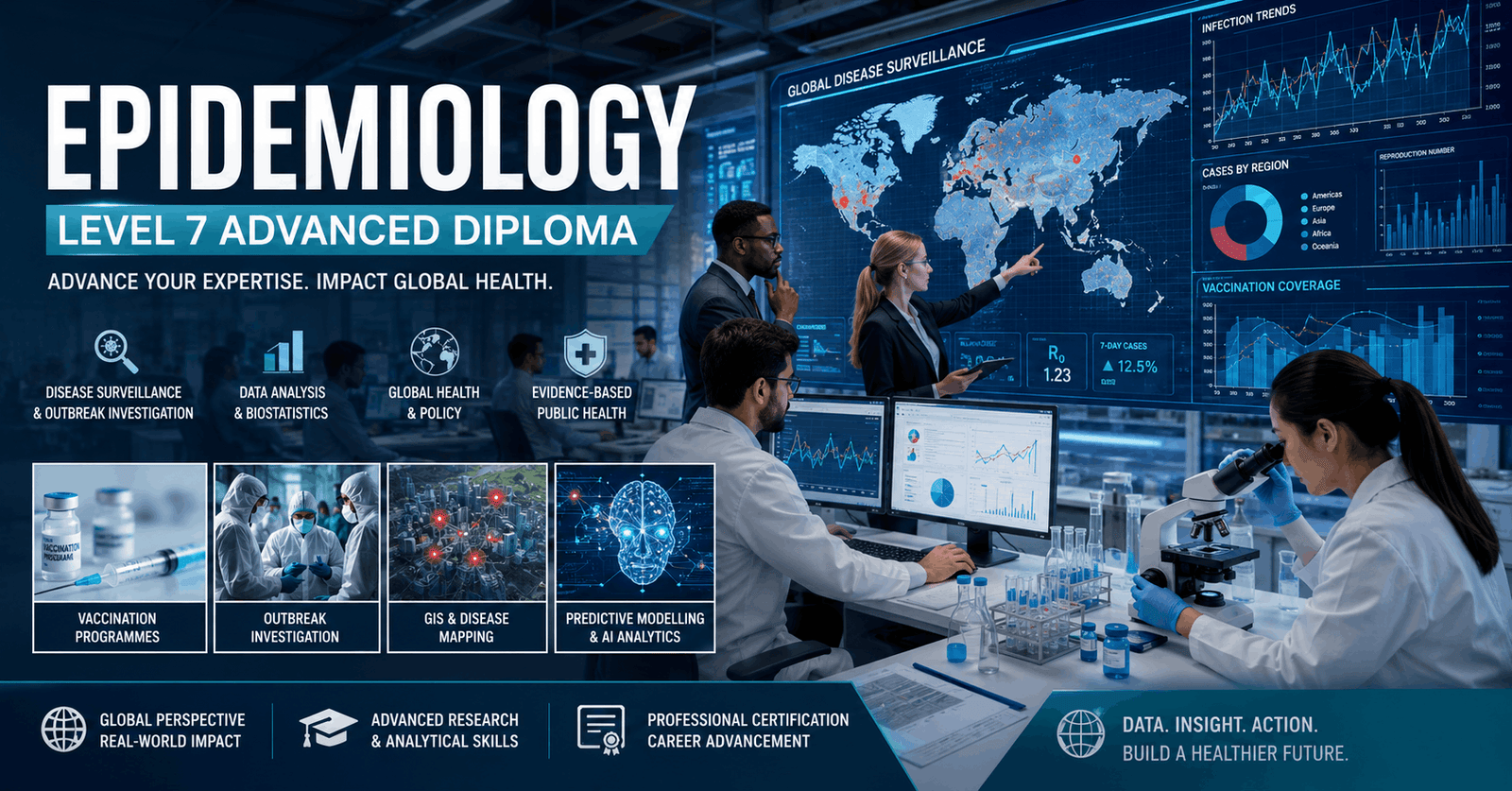
Epidemiology Diploma programmes are essential for professionals and learners who want to understand how diseases spread, how public health decisions are made, and how data-driven research helps protect global populations. This Epidemiology Level 7 Advanced Diploma provides advanced knowledge of epidemiological research, disease surveillance, public health analytics, and evidence-based decision-making used across healthcare, research, and policy environments.
The course is designed to help learners develop a strong understanding of epidemiological principles, study designs, statistical analysis, infectious disease monitoring, and chronic disease investigation. Students will explore how researchers collect, interpret, and apply health data to identify disease patterns, assess risks, and support public health interventions. The programme also introduces modern epidemiological technologies, including predictive modelling, GIS disease mapping, machine learning applications, and big data analytics used in contemporary healthcare systems.
Learners will gain insight into global health challenges such as pandemics, health inequalities, environmental health risks, and occupational disease patterns. The course also examines surveillance systems, vaccination strategies, outbreak investigation techniques, and public health policy development, helping students understand how epidemiology influences national and international healthcare planning. Advanced modules focus on research methodologies, systematic reviews, meta-analyses, and scientific communication skills required for professional and academic progression.
This flexible online diploma is suitable for individuals seeking to strengthen their analytical, research, and public health knowledge without disrupting existing work or personal commitments. The self-paced learning format allows learners to study from anywhere while building practical understanding of modern epidemiological practices and healthcare research systems.
Upon successful completion of the course, learners will receive a free course completion certificate. Multiple premium certificate and transcript options are also available for purchase for learners seeking enhanced professional recognition. Students will additionally benefit from 5-star rated support available 24/7 through email, ensuring continuous guidance and assistance throughout the learning experience.
This course is ideal for healthcare professionals, public health practitioners, medical researchers, policy analysts, postgraduate learners, and individuals interested in disease prevention and health research. It is also suitable for those looking to strengthen their understanding of epidemiological methods, global health issues, public health surveillance, and advanced healthcare data analysis.
Learners should have a basic understanding of healthcare, biology, research, or public health concepts, although prior epidemiology experience is not mandatory. A willingness to engage with analytical thinking, research methods, and data interpretation is recommended. Students will also need an internet-connected device and good English communication skills.
Who is this course for?
Epidemiology Diploma programmes are essential for professionals and learners who want to understand how diseases spread, how public health decisions are made, and how data-driven research helps protect global populations. This Epidemiology Level 7 Advanced Diploma provides advanced knowledge of epidemiological research, disease surveillance, public health analytics, and evidence-based decision-making used across healthcare, research, and policy environments.
The course is designed to help learners develop a strong understanding of epidemiological principles, study designs, statistical analysis, infectious disease monitoring, and chronic disease investigation. Students will explore how researchers collect, interpret, and apply health data to identify disease patterns, assess risks, and support public health interventions. The programme also introduces modern epidemiological technologies, including predictive modelling, GIS disease mapping, machine learning applications, and big data analytics used in contemporary healthcare systems.
Learners will gain insight into global health challenges such as pandemics, health inequalities, environmental health risks, and occupational disease patterns. The course also examines surveillance systems, vaccination strategies, outbreak investigation techniques, and public health policy development, helping students understand how epidemiology influences national and international healthcare planning. Advanced modules focus on research methodologies, systematic reviews, meta-analyses, and scientific communication skills required for professional and academic progression.
This flexible online diploma is suitable for individuals seeking to strengthen their analytical, research, and public health knowledge without disrupting existing work or personal commitments. The self-paced learning format allows learners to study from anywhere while building practical understanding of modern epidemiological practices and healthcare research systems.
Upon successful completion of the course, learners will receive a free course completion certificate. Multiple premium certificate and transcript options are also available for purchase for learners seeking enhanced professional recognition. Students will additionally benefit from 5-star rated support available 24/7 through email, ensuring continuous guidance and assistance throughout the learning experience.
This course is ideal for healthcare professionals, public health practitioners, medical researchers, policy analysts, postgraduate learners, and individuals interested in disease prevention and health research. It is also suitable for those looking to strengthen their understanding of epidemiological methods, global health issues, public health surveillance, and advanced healthcare data analysis.
Learners should have a basic understanding of healthcare, biology, research, or public health concepts, although prior epidemiology experience is not mandatory. A willingness to engage with analytical thinking, research methods, and data interpretation is recommended. Students will also need an internet-connected device and good English communication skills.
Requirements
Epidemiology Diploma programmes are essential for professionals and learners who want to understand how diseases spread, how public health decisions are made, and how data-driven research helps protect global populations. This Epidemiology Level 7 Advanced Diploma provides advanced knowledge of epidemiological research, disease surveillance, public health analytics, and evidence-based decision-making used across healthcare, research, and policy environments.
The course is designed to help learners develop a strong understanding of epidemiological principles, study designs, statistical analysis, infectious disease monitoring, and chronic disease investigation. Students will explore how researchers collect, interpret, and apply health data to identify disease patterns, assess risks, and support public health interventions. The programme also introduces modern epidemiological technologies, including predictive modelling, GIS disease mapping, machine learning applications, and big data analytics used in contemporary healthcare systems.
Learners will gain insight into global health challenges such as pandemics, health inequalities, environmental health risks, and occupational disease patterns. The course also examines surveillance systems, vaccination strategies, outbreak investigation techniques, and public health policy development, helping students understand how epidemiology influences national and international healthcare planning. Advanced modules focus on research methodologies, systematic reviews, meta-analyses, and scientific communication skills required for professional and academic progression.
This flexible online diploma is suitable for individuals seeking to strengthen their analytical, research, and public health knowledge without disrupting existing work or personal commitments. The self-paced learning format allows learners to study from anywhere while building practical understanding of modern epidemiological practices and healthcare research systems.
Upon successful completion of the course, learners will receive a free course completion certificate. Multiple premium certificate and transcript options are also available for purchase for learners seeking enhanced professional recognition. Students will additionally benefit from 5-star rated support available 24/7 through email, ensuring continuous guidance and assistance throughout the learning experience.
This course is ideal for healthcare professionals, public health practitioners, medical researchers, policy analysts, postgraduate learners, and individuals interested in disease prevention and health research. It is also suitable for those looking to strengthen their understanding of epidemiological methods, global health issues, public health surveillance, and advanced healthcare data analysis.
Learners should have a basic understanding of healthcare, biology, research, or public health concepts, although prior epidemiology experience is not mandatory. A willingness to engage with analytical thinking, research methods, and data interpretation is recommended. Students will also need an internet-connected device and good English communication skills.
Career path
Epidemiology Diploma programmes are essential for professionals and learners who want to understand how diseases spread, how public health decisions are made, and how data-driven research helps protect global populations. This Epidemiology Level 7 Advanced Diploma provides advanced knowledge of epidemiological research, disease surveillance, public health analytics, and evidence-based decision-making used across healthcare, research, and policy environments.
The course is designed to help learners develop a strong understanding of epidemiological principles, study designs, statistical analysis, infectious disease monitoring, and chronic disease investigation. Students will explore how researchers collect, interpret, and apply health data to identify disease patterns, assess risks, and support public health interventions. The programme also introduces modern epidemiological technologies, including predictive modelling, GIS disease mapping, machine learning applications, and big data analytics used in contemporary healthcare systems.
Learners will gain insight into global health challenges such as pandemics, health inequalities, environmental health risks, and occupational disease patterns. The course also examines surveillance systems, vaccination strategies, outbreak investigation techniques, and public health policy development, helping students understand how epidemiology influences national and international healthcare planning. Advanced modules focus on research methodologies, systematic reviews, meta-analyses, and scientific communication skills required for professional and academic progression.
This flexible online diploma is suitable for individuals seeking to strengthen their analytical, research, and public health knowledge without disrupting existing work or personal commitments. The self-paced learning format allows learners to study from anywhere while building practical understanding of modern epidemiological practices and healthcare research systems.
Upon successful completion of the course, learners will receive a free course completion certificate. Multiple premium certificate and transcript options are also available for purchase for learners seeking enhanced professional recognition. Students will additionally benefit from 5-star rated support available 24/7 through email, ensuring continuous guidance and assistance throughout the learning experience.
This course is ideal for healthcare professionals, public health practitioners, medical researchers, policy analysts, postgraduate learners, and individuals interested in disease prevention and health research. It is also suitable for those looking to strengthen their understanding of epidemiological methods, global health issues, public health surveillance, and advanced healthcare data analysis.
Learners should have a basic understanding of healthcare, biology, research, or public health concepts, although prior epidemiology experience is not mandatory. A willingness to engage with analytical thinking, research methods, and data interpretation is recommended. Students will also need an internet-connected device and good English communication skills.
-
- Introduction to Epidemiology 00:10:00
- Historical Development of Epidemiology 00:10:00
- Key Epidemiological Concepts and Measures 00:10:00
- Types of Epidemiological Studies 00:10:00
- Ethical Considerations in Epidemiological Research 00:10:00
-
- Observational vs. Experimental Studies 00:10:00
- Descriptive Epidemiology: Case Reports, Case Series & Surveys 00:10:00
- Analytical Epidemiology: Cohort, Case-Control, and Cross-Sectional 00:10:00
- Randomized Controlled Trials (RCTs) in Epidemiology 00:10:00
- Bias, Confounding & Causation in Epidemiological Studies 00:10:00
- Data Sources in Epidemiology (Primary & Secondary Data) 00:10:00
- Measures of Disease Frequency (Incidence, Prevalence, Mortality Rates) 00:10:00
- Measures of Association (Relative Risk, Odds Ratio) 00:10:00
- Statistical Tools & Software in Epidemiology 00:10:00
- Interpreting Epidemiological Data 00:10:00
- Epidemiology of Cardiovascular Diseases 00:10:00
- Epidemiology of Cancer 00:10:00
- Epidemiology of Diabetes and Metabolic Disorders 00:10:00
- Mental Health and Epidemiology 00:10:00
- Lifestyle and Behavioral Risk Factors 00:10:00
- Principles of Public Health Surveillance 00:10:00
- National and International Surveillance Systems 00:10:00
- Epidemiological Data in Public Health Decision-Making 00:10:00
- Disease Prevention Strategies and Health Promotion 00:10:00
- Public Health Policy and Regulations 00:10:00
- Systematic Reviews and Meta-Analyses 00:10:00
- Machine Learning and AI in Epidemiology 00:10:00
- Geographic Information Systems (GIS) in Disease Mapping 00:10:00
- Predictive Modelling in Public Health 00:10:00
- Translational Epidemiology 00:10:00
- Exam of Epidemiology Level 7 Advanced Diploma 00:50:00

Is this certificate recognized?
Yes, our premium certificate and transcript are widely recognized and accepted by embassies worldwide, particularly by the UK embassy. This adds credibility to your qualification and enhances its value for professional and academic purposes.
I am a beginner. Is this course suitable for me?
Yes, this course is designed for learners of all levels, including beginners. The content is structured to provide step-by-step guidance, ensuring that even those with no prior experience can follow along and gain valuable knowledge.
I am a professional. Is this course suitable for me?
Yes, professionals will also benefit from this course. It covers advanced concepts, practical applications, and industry insights that can help enhance existing skills and knowledge. Whether you are looking to refine your expertise or expand your qualifications, this course provides valuable learning.
Does this course have an expiry date?
No, you have lifetime access to the course. Once enrolled, you can revisit the materials at any time as long as the course remains available. Additionally, we regularly update our content to ensure it stays relevant and up to date.
How do I claim my free certificate?
I trust you’re in good health. Your free certificate can be located in the Achievement section. The option to purchase a CPD certificate is available but entirely optional, and you may choose to skip it. Please be aware that it’s crucial to click the “Complete” button to ensure the certificate is generated, as this process is entirely automated.
Does this course have assessments and assignments?
Yes, the course includes both assessments and assignments. Your final marks will be determined by a combination of 20% from assignments and 80% from assessments. These evaluations are designed to test your understanding and ensure you have grasped the key concepts effectively.
Is this course accredited?
We are a recognized course provider with CPD, UKRLP, and AOHT membership. The logos of these accreditation bodies will be featured on your premium certificate and transcript, ensuring credibility and professional recognition.
Will I receive a certificate upon completion?
Yes, you will receive a free digital certificate automatically once you complete the course. If you would like a premium CPD-accredited certificate, either in digital or physical format, you can upgrade for a small fee.
Course Features
Price
Study Method
Online | Self-paced
Course Format
Interactive PDFs, Articles & Learning Resources
Duration
9 hours, 25 minutes
Qualification
Professional Skills Development Course
Assessment
Final MCQ Exam (included in price)
Certificate
Verifiable Digital Certificate - Free
Additional info
Lifetime Access | Start Instantly
- Share

ACCA LW: Corporate & Business Law Essentials
Course Line237৳ 80,515.97Original price was: ৳ 80,515.97.৳ 2,463.13Current price is: ৳ 2,463.13.Learning How To Be A Software Developer: From Industry Insights to Career Success
Course Line237৳ 80,515.97Original price was: ৳ 80,515.97.৳ 2,463.13Current price is: ৳ 2,463.13.Genealogy Level 8 Advanced Diploma
Course Line240৳ 80,515.97Original price was: ৳ 80,515.97.৳ 2,463.13Current price is: ৳ 2,463.13.



Related Courses
Workplace Stress Management: Build Resilience & Reduce Daily Pressure
৳ 80,515.97Original price was: ৳ 80,515.97.৳ 2,463.13Current price is: ৳ 2,463.13.237Psychology of Addiction: Alcohol, Drugs & Recovery
৳ 80,515.97Original price was: ৳ 80,515.97.৳ 2,463.13Current price is: ৳ 2,463.13.237Clinical Coding level 8 advanced Diploma
৳ 80,515.97Original price was: ৳ 80,515.97.৳ 2,463.13Current price is: ৳ 2,463.13.237




Related Courses
Workplace Stress Management: Build Resilience & Reduce Daily Pressure
৳ 80,515.97Original price was: ৳ 80,515.97.৳ 2,463.13Current price is: ৳ 2,463.13.237Psychology of Addiction: Alcohol, Drugs & Recovery
৳ 80,515.97Original price was: ৳ 80,515.97.৳ 2,463.13Current price is: ৳ 2,463.13.237Clinical Coding level 8 advanced Diploma
৳ 80,515.97Original price was: ৳ 80,515.97.৳ 2,463.13Current price is: ৳ 2,463.13.237


VERY INFORMATIVE AND EASILY ACCESSIBLE