
Course Features
Price
Study Method
Online | Self-paced
Course Format
Interactive PDFs, Articles & Learning Resources
Duration
23 hours, 5 minutes
Qualification
Professional Skills Development Course
Assessment
Final MCQ Exam (included in price)
Certificate
Verifiable Digital Certificate - Free
Additional info
Lifetime Access | Start Instantly
- Share
Overview
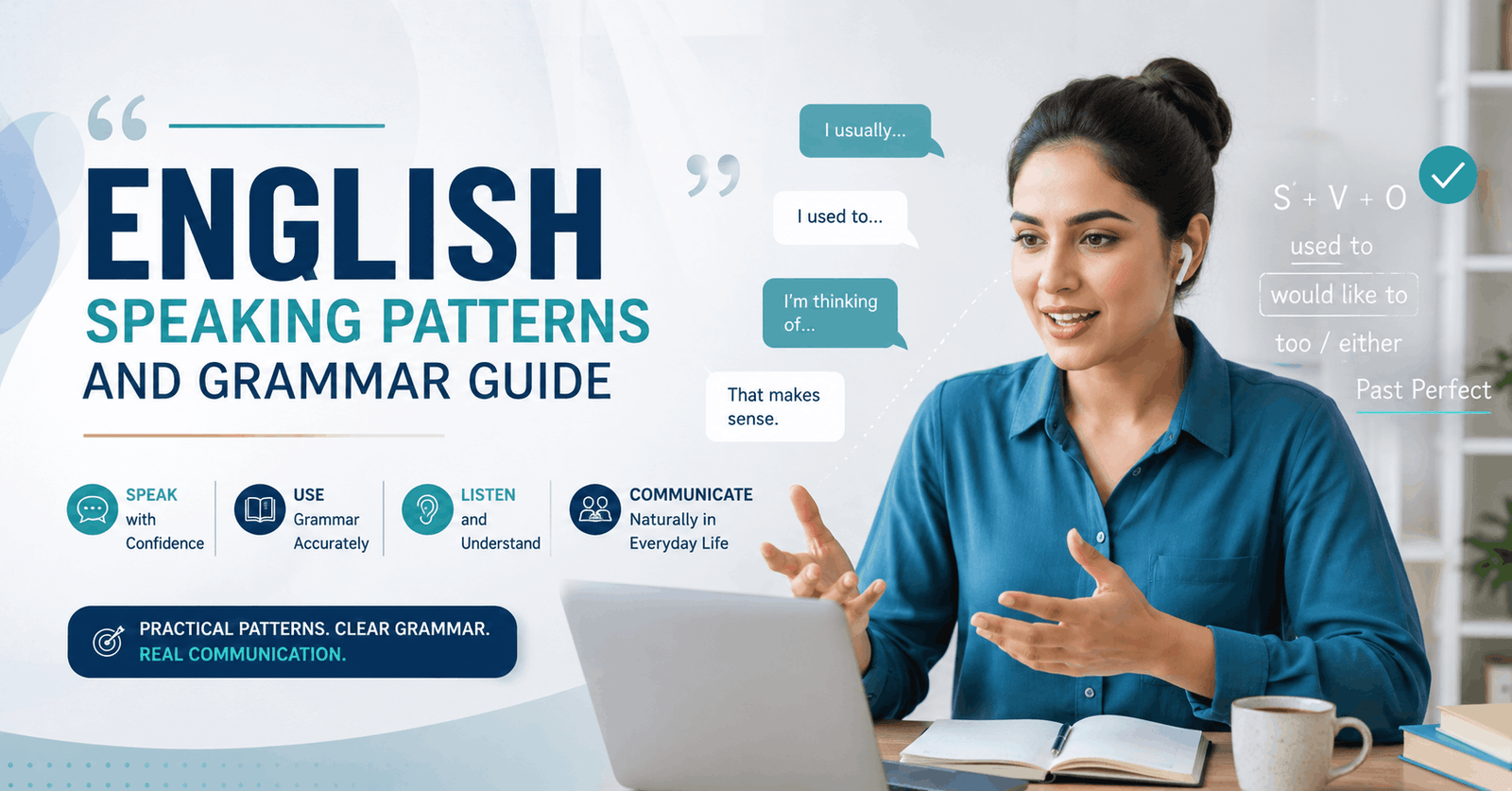
English Speaking Patterns provide a practical framework for understanding how everyday English sentences are formed, used and understood in real communication. This course is designed to help learners strengthen their grammar knowledge while developing greater accuracy and confidence in spoken English. Rather than focusing only on isolated grammar rules, the course follows a structured learning approach that combines pattern recognition, brain training, mastery activities and listening practice.
Learners begin with essential patterns using “to” and “for” before progressing through the core structures that shape everyday English. The course explores the verb “to be” in present and past forms, including active and passive structures, followed by the correct use of “do”, “does”, “did” and past-tense verb forms. Present-tense patterns are also covered in detail, helping learners understand when verbs require an “-s” ending and how these structures function in natural sentences.
As the course progresses, students explore “have” and “has” structures, perfect forms and frequently used modal verbs such as “can”, “will”, “should”, “would” and “could”. Dedicated lessons on “enjoy” and “like” help learners build natural expressions for preferences and activities. Articles, including “a”, “an” and “the”, are introduced alongside the practical differences between “some” and “any”.
The course also develops accuracy with high-frequency words and prepositions, including “by”, “every”, “with”, “in” and “on”, as well as possessive adjectives. A dedicated section on common mistakes helps learners recognise frequent errors and develop more reliable speaking habits.
With its progressive learning, practice, mastery and listening stages, the course supports learners who want to understand grammar as a usable communication skill rather than a collection of rules. Students can study at their own pace and revisit key patterns whenever additional practice is needed.
Upon successful completion, learners will receive a free course completion certificate. Multiple premium certificate and transcript options are also available for purchase for those who wish to obtain additional documentation. Students also have access to our 5-star rated support team, available 24/7 through email, whenever assistance is needed.Improved English communication can support progression across many professional and academic environments. Learners may use their skills when preparing for customer service, administration, hospitality, sales, business support or other communication-focused roles. The course can also provide a useful foundation for further study in English grammar, speaking, writing, workplace communication or broader language development programmes.
Who is this course for?
English Speaking Patterns provide a practical framework for understanding how everyday English sentences are formed, used and understood in real communication. This course is designed to help learners strengthen their grammar knowledge while developing greater accuracy and confidence in spoken English. Rather than focusing only on isolated grammar rules, the course follows a structured learning approach that combines pattern recognition, brain training, mastery activities and listening practice.
Learners begin with essential patterns using “to” and “for” before progressing through the core structures that shape everyday English. The course explores the verb “to be” in present and past forms, including active and passive structures, followed by the correct use of “do”, “does”, “did” and past-tense verb forms. Present-tense patterns are also covered in detail, helping learners understand when verbs require an “-s” ending and how these structures function in natural sentences.
As the course progresses, students explore “have” and “has” structures, perfect forms and frequently used modal verbs such as “can”, “will”, “should”, “would” and “could”. Dedicated lessons on “enjoy” and “like” help learners build natural expressions for preferences and activities. Articles, including “a”, “an” and “the”, are introduced alongside the practical differences between “some” and “any”.
The course also develops accuracy with high-frequency words and prepositions, including “by”, “every”, “with”, “in” and “on”, as well as possessive adjectives. A dedicated section on common mistakes helps learners recognise frequent errors and develop more reliable speaking habits.
With its progressive learning, practice, mastery and listening stages, the course supports learners who want to understand grammar as a usable communication skill rather than a collection of rules. Students can study at their own pace and revisit key patterns whenever additional practice is needed.
Upon successful completion, learners will receive a free course completion certificate. Multiple premium certificate and transcript options are also available for purchase for those who wish to obtain additional documentation. Students also have access to our 5-star rated support team, available 24/7 through email, whenever assistance is needed.Improved English communication can support progression across many professional and academic environments. Learners may use their skills when preparing for customer service, administration, hospitality, sales, business support or other communication-focused roles. The course can also provide a useful foundation for further study in English grammar, speaking, writing, workplace communication or broader language development programmes.
Requirements
English Speaking Patterns provide a practical framework for understanding how everyday English sentences are formed, used and understood in real communication. This course is designed to help learners strengthen their grammar knowledge while developing greater accuracy and confidence in spoken English. Rather than focusing only on isolated grammar rules, the course follows a structured learning approach that combines pattern recognition, brain training, mastery activities and listening practice.
Learners begin with essential patterns using “to” and “for” before progressing through the core structures that shape everyday English. The course explores the verb “to be” in present and past forms, including active and passive structures, followed by the correct use of “do”, “does”, “did” and past-tense verb forms. Present-tense patterns are also covered in detail, helping learners understand when verbs require an “-s” ending and how these structures function in natural sentences.
As the course progresses, students explore “have” and “has” structures, perfect forms and frequently used modal verbs such as “can”, “will”, “should”, “would” and “could”. Dedicated lessons on “enjoy” and “like” help learners build natural expressions for preferences and activities. Articles, including “a”, “an” and “the”, are introduced alongside the practical differences between “some” and “any”.
The course also develops accuracy with high-frequency words and prepositions, including “by”, “every”, “with”, “in” and “on”, as well as possessive adjectives. A dedicated section on common mistakes helps learners recognise frequent errors and develop more reliable speaking habits.
With its progressive learning, practice, mastery and listening stages, the course supports learners who want to understand grammar as a usable communication skill rather than a collection of rules. Students can study at their own pace and revisit key patterns whenever additional practice is needed.
Upon successful completion, learners will receive a free course completion certificate. Multiple premium certificate and transcript options are also available for purchase for those who wish to obtain additional documentation. Students also have access to our 5-star rated support team, available 24/7 through email, whenever assistance is needed.Improved English communication can support progression across many professional and academic environments. Learners may use their skills when preparing for customer service, administration, hospitality, sales, business support or other communication-focused roles. The course can also provide a useful foundation for further study in English grammar, speaking, writing, workplace communication or broader language development programmes.
Career path
English Speaking Patterns provide a practical framework for understanding how everyday English sentences are formed, used and understood in real communication. This course is designed to help learners strengthen their grammar knowledge while developing greater accuracy and confidence in spoken English. Rather than focusing only on isolated grammar rules, the course follows a structured learning approach that combines pattern recognition, brain training, mastery activities and listening practice.
Learners begin with essential patterns using “to” and “for” before progressing through the core structures that shape everyday English. The course explores the verb “to be” in present and past forms, including active and passive structures, followed by the correct use of “do”, “does”, “did” and past-tense verb forms. Present-tense patterns are also covered in detail, helping learners understand when verbs require an “-s” ending and how these structures function in natural sentences.
As the course progresses, students explore “have” and “has” structures, perfect forms and frequently used modal verbs such as “can”, “will”, “should”, “would” and “could”. Dedicated lessons on “enjoy” and “like” help learners build natural expressions for preferences and activities. Articles, including “a”, “an” and “the”, are introduced alongside the practical differences between “some” and “any”.
The course also develops accuracy with high-frequency words and prepositions, including “by”, “every”, “with”, “in” and “on”, as well as possessive adjectives. A dedicated section on common mistakes helps learners recognise frequent errors and develop more reliable speaking habits.
With its progressive learning, practice, mastery and listening stages, the course supports learners who want to understand grammar as a usable communication skill rather than a collection of rules. Students can study at their own pace and revisit key patterns whenever additional practice is needed.
Upon successful completion, learners will receive a free course completion certificate. Multiple premium certificate and transcript options are also available for purchase for those who wish to obtain additional documentation. Students also have access to our 5-star rated support team, available 24/7 through email, whenever assistance is needed.Improved English communication can support progression across many professional and academic environments. Learners may use their skills when preparing for customer service, administration, hospitality, sales, business support or other communication-focused roles. The course can also provide a useful foundation for further study in English grammar, speaking, writing, workplace communication or broader language development programmes.
-
- Welcome to the Course! 00:10:00
- WATCH BEFORE STARTING 00:10:00
-
- Pattern: “To” (Learning Stage) 00:10:00
- Pattern: “To” (Brain Training Stage) 00:10:00
- Pattern: “To” (Mastery Stage) 00:10:00
- Pattern: “To” (Listening Stage) 00:10:00
- Pattern: “For” (Learning Stage) 00:10:00
- Pattern: “For” (Brain Training Stage) 00:10:00
- Pattern: “For” (Mastery Stage) 00:10:00
- Pattern: “For” (Listening Stage) 00:10:00
- (Learning Stage) 00:10:00
- “Is” (Brain Training Stage) 00:10:00
- “Is” (Mastery Stage) 00:10:00
- “Is” (Listening Stage) 00:10:00
- “Am” (Learning Stage) 00:10:00
- “Am” (Brain Training Stage) 00:10:00
- “Are” (Learning Stage) 00:10:00
- “Are” (Brain Training Stage) 00:10:00
- “Are” (Mastery Stage) 00:10:00
- “Are” (Listening Stage) 00:10:00
- “Was” (Learning Stage) 00:10:00
- “Was” (Brain Training Stage) 00:10:00
- “Was” (Mastery Stage) 00:10:00
- “Was” (Listening Stage) 00:10:00
- “Were” (Learning Stage) 00:10:00
- “Were” (Brain Training Stage) 00:10:00
- “Were” (Mastery Stage) 00:10:00
- “Were” (Listening Stage) 00:10:00
- “To Be” Active (Learning Stage) 00:10:00
- “To Be” Active (Brain Training Stage) 00:10:00
- “To Be” Active (Mastery Stage) 00:10:00
- “To Be” Active (Listening Stage) 00:10:00
- “To Be” Passive (Learning Stage) 00:10:00
- “To Be” Passive (Brain Training Stage) 00:10:00
- “To Be” Passive (Mastery Stage) 00:10:00
- “To Be” Passive (Listening Stage) 00:10:00
- Verb 1 (No -S) (Learning Stage) 00:10:00
- Verb 1 (No -S) (Brain Training Stage) 00:10:00
- Verb 1 (No -S) (Mastery Stage) 00:10:00
- Verb 1 (No -S) (Listening Stage) 00:10:00
- Verb 1 (With -S) (Listening Stage) 00:10:00
- Verb 1 (With -S) (Brain Training Stage) 00:10:00
- Verb 1 (With -S) (Mastery Stage) 00:10:00
- Verb 1 (With -S) (Listening Stage) 00:10:00
- “Can” (Learning Stage) 00:10:00
- “Can” (Brain Training Stage) 00:10:00
- “Can” (Mastery Stage) 00:10:00
- “Can” (Listening Stage) 00:10:00
- “Will” (Learning Stage) 00:10:00
- “Will” (Brain Training Stage) 00:10:00
- “Will + Verb” (Learning Stage) 00:10:00
- “Will + Verb” (Brain Training Stage) 00:10:00
- “Will + Verb” (Mastery Stage) 00:10:00
- “Will + Verb” (Listening Stage) 00:10:00
- “Should/Would/Could” (Learning Stage) 00:10:00
- “Should/Would/Could” (Brain Training Stage) 00:10:00
- “Should/Would/Could” (Mastery Stage) 00:10:00
- “Should/Would/Could” (Listening Stage) 00:10:00
- “A / An” (Learning Stage) 00:10:00
- “A / An” (Brain Training Stage) 00:10:00
- “A / An” (Mastery Stage) 00:10:00
- “A / An” (Listening Stage) 00:10:00
- “Some / Any” (Learning Stage) 00:10:00
- “Some / Any” (Brain Training Stage) 00:10:00
- “Some / Any” (Mastery Stage) 00:10:00
- “Some / Any” (Listening Stage) 00:10:00
- “The” (Learning Stage) 00:10:00
- “The” (Brain Training Stage) 00:10:00
- Common Mistake #1 00:10:00
- Common Mistake #2 00:10:00
- Common Mistake #3 00:10:00
- Common Mistake #4 00:10:00
- Common Mistake #5 00:10:00
- Common Mistake #6 00:10:00
- Common Mistake #7 00:10:00
- Common Mistake #8 00:10:00
- Common Mistake #9 00:10:00
- Common Mistake #10 00:10:00
- Common Mistake #11 00:10:00
- Premium Certificate 00:15:00

No Reviews found for this course.
Is this certificate recognized?
Yes, our premium certificate and transcript are widely recognized and accepted by embassies worldwide, particularly by the UK embassy. This adds credibility to your qualification and enhances its value for professional and academic purposes.
I am a beginner. Is this course suitable for me?
Yes, this course is designed for learners of all levels, including beginners. The content is structured to provide step-by-step guidance, ensuring that even those with no prior experience can follow along and gain valuable knowledge.
I am a professional. Is this course suitable for me?
Yes, professionals will also benefit from this course. It covers advanced concepts, practical applications, and industry insights that can help enhance existing skills and knowledge. Whether you are looking to refine your expertise or expand your qualifications, this course provides valuable learning.
Does this course have an expiry date?
No, you have lifetime access to the course. Once enrolled, you can revisit the materials at any time as long as the course remains available. Additionally, we regularly update our content to ensure it stays relevant and up to date.
How do I claim my free certificate?
I trust you’re in good health. Your free certificate can be located in the Achievement section. The option to purchase a CPD certificate is available but entirely optional, and you may choose to skip it. Please be aware that it’s crucial to click the “Complete” button to ensure the certificate is generated, as this process is entirely automated.
Does this course have assessments and assignments?
Yes, the course includes both assessments and assignments. Your final marks will be determined by a combination of 20% from assignments and 80% from assessments. These evaluations are designed to test your understanding and ensure you have grasped the key concepts effectively.
Is this course accredited?
We are a recognized course provider with CPD, UKRLP, and AOHT membership. The logos of these accreditation bodies will be featured on your premium certificate and transcript, ensuring credibility and professional recognition.
Will I receive a certificate upon completion?
Yes, you will receive a free digital certificate automatically once you complete the course. If you would like a premium CPD-accredited certificate, either in digital or physical format, you can upgrade for a small fee.
Course Features
Price
Study Method
Online | Self-paced
Course Format
Interactive PDFs, Articles & Learning Resources
Duration
23 hours, 5 minutes
Qualification
Professional Skills Development Course
Assessment
Final MCQ Exam (included in price)
Certificate
Verifiable Digital Certificate - Free
Additional info
Lifetime Access | Start Instantly
- Share

Network Fundamentals for Absolute Beginners: Your First Step to Networking
Course Line237£490.00Original price was: £490.00.£14.99Current price is: £14.99.Credit Control Level 7 Advanced Diploma
Course Line240£490.00Original price was: £490.00.£14.99Current price is: £14.99.Medical Illustration Level 8 Advanced Diploma
Course Line240£490.00Original price was: £490.00.£14.99Current price is: £14.99.



Related Courses
Professional Proofreading & Editing Skills: Grammar, Style & Error-Free Writing
£490.00Original price was: £490.00.£14.99Current price is: £14.99.237Practical TEFL Training: How to Teach English with Confidence, Structure & Classroom Control
£490.00Original price was: £490.00.£14.99Current price is: £14.99.237Communicating with Children: Theory to Practice
£490.00Original price was: £490.00.£14.99Current price is: £14.99.237




Related Courses
Professional Proofreading & Editing Skills: Grammar, Style & Error-Free Writing
£490.00Original price was: £490.00.£14.99Current price is: £14.99.237Practical TEFL Training: How to Teach English with Confidence, Structure & Classroom Control
£490.00Original price was: £490.00.£14.99Current price is: £14.99.237Communicating with Children: Theory to Practice
£490.00Original price was: £490.00.£14.99Current price is: £14.99.237

