
Course Features
Price
Study Method
Online | Self-paced
Course Format
Interactive PDFs, Articles & Learning Resources
Duration
4 hours, 35 minutes
Qualification
Professional Skills Development Course
Assessment
Final MCQ Exam (included in price)
Certificate
Verifiable Digital Certificate - Free
Additional info
Lifetime Access | Start Instantly
- Share
Overview
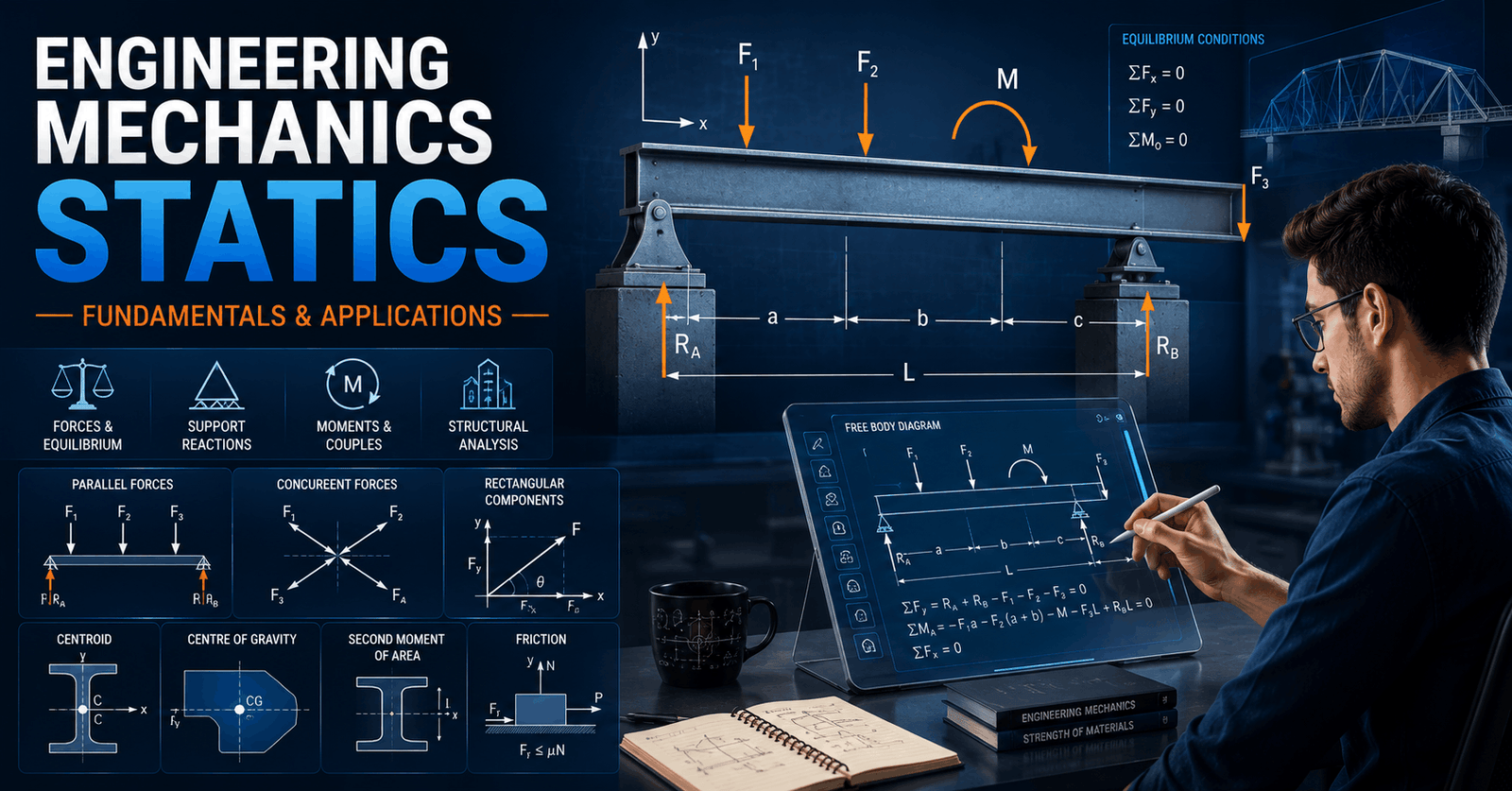
Engineering Mechanics Statics provides a structured introduction to the principles used to analyse forces, equilibrium, rigid bodies, beams, centroids, moments of area, and friction. Designed to build a reliable foundation in engineering mechanics, the course combines conceptual explanations with numerical examples to help learners understand how fundamental statics principles are applied to engineering problems.
The course begins with force systems and essential terminology, including resultants, equilibrium, equilibrants, parallel forces, and rectangular components of a force. Learners then examine the composition and resolution of forces, the parallelogram law, and Lami’s theorem. These topics establish the mathematical and physical foundations needed to analyse particles subjected to multiple forces.
Attention then moves to rigid bodies, where learners explore internal and external forces, the principle of transmissibility, and the moment of a force. Numerical examples reinforce the analytical process and help students develop a more systematic approach to solving mechanics problems.
The course also introduces beams, common support conditions, and support reactions. Understanding these concepts is essential for analysing how structures respond to applied loads. Further lessons examine centroids and centres of gravity, including methods for determining the geometric centre of plane figures. Learners are also introduced to the second moment of area and its significance for simple configurations.
The final section explores friction, its classifications, and the fundamental laws that describe frictional behaviour. Together, these topics provide a broad foundation for further study in structural mechanics, strength of materials, machine design, civil engineering, and related technical disciplines.
By combining theory with worked numerical examples, the course helps learners strengthen analytical thinking, interpret force systems, and approach engineering calculations with greater confidence. It is particularly valuable for students who want to reinforce classroom learning or prepare for more advanced mechanics subjects.
After completing the course, learners will receive a free course completion certificate. Those who want additional documentation may also purchase from multiple premium certificate and transcript options. Students also have access to our 5-star rated support, available 24/7 through email, providing reliable assistance throughout their learning journey.Who is this course for?
Engineering Mechanics Statics provides a structured introduction to the principles used to analyse forces, equilibrium, rigid bodies, beams, centroids, moments of area, and friction. Designed to build a reliable foundation in engineering mechanics, the course combines conceptual explanations with numerical examples to help learners understand how fundamental statics principles are applied to engineering problems.
The course begins with force systems and essential terminology, including resultants, equilibrium, equilibrants, parallel forces, and rectangular components of a force. Learners then examine the composition and resolution of forces, the parallelogram law, and Lami’s theorem. These topics establish the mathematical and physical foundations needed to analyse particles subjected to multiple forces.
Attention then moves to rigid bodies, where learners explore internal and external forces, the principle of transmissibility, and the moment of a force. Numerical examples reinforce the analytical process and help students develop a more systematic approach to solving mechanics problems.
The course also introduces beams, common support conditions, and support reactions. Understanding these concepts is essential for analysing how structures respond to applied loads. Further lessons examine centroids and centres of gravity, including methods for determining the geometric centre of plane figures. Learners are also introduced to the second moment of area and its significance for simple configurations.
The final section explores friction, its classifications, and the fundamental laws that describe frictional behaviour. Together, these topics provide a broad foundation for further study in structural mechanics, strength of materials, machine design, civil engineering, and related technical disciplines.
By combining theory with worked numerical examples, the course helps learners strengthen analytical thinking, interpret force systems, and approach engineering calculations with greater confidence. It is particularly valuable for students who want to reinforce classroom learning or prepare for more advanced mechanics subjects.
After completing the course, learners will receive a free course completion certificate. Those who want additional documentation may also purchase from multiple premium certificate and transcript options. Students also have access to our 5-star rated support, available 24/7 through email, providing reliable assistance throughout their learning journey.Requirements
Engineering Mechanics Statics provides a structured introduction to the principles used to analyse forces, equilibrium, rigid bodies, beams, centroids, moments of area, and friction. Designed to build a reliable foundation in engineering mechanics, the course combines conceptual explanations with numerical examples to help learners understand how fundamental statics principles are applied to engineering problems.
The course begins with force systems and essential terminology, including resultants, equilibrium, equilibrants, parallel forces, and rectangular components of a force. Learners then examine the composition and resolution of forces, the parallelogram law, and Lami’s theorem. These topics establish the mathematical and physical foundations needed to analyse particles subjected to multiple forces.
Attention then moves to rigid bodies, where learners explore internal and external forces, the principle of transmissibility, and the moment of a force. Numerical examples reinforce the analytical process and help students develop a more systematic approach to solving mechanics problems.
The course also introduces beams, common support conditions, and support reactions. Understanding these concepts is essential for analysing how structures respond to applied loads. Further lessons examine centroids and centres of gravity, including methods for determining the geometric centre of plane figures. Learners are also introduced to the second moment of area and its significance for simple configurations.
The final section explores friction, its classifications, and the fundamental laws that describe frictional behaviour. Together, these topics provide a broad foundation for further study in structural mechanics, strength of materials, machine design, civil engineering, and related technical disciplines.
By combining theory with worked numerical examples, the course helps learners strengthen analytical thinking, interpret force systems, and approach engineering calculations with greater confidence. It is particularly valuable for students who want to reinforce classroom learning or prepare for more advanced mechanics subjects.
After completing the course, learners will receive a free course completion certificate. Those who want additional documentation may also purchase from multiple premium certificate and transcript options. Students also have access to our 5-star rated support, available 24/7 through email, providing reliable assistance throughout their learning journey.Career path
Engineering Mechanics Statics provides a structured introduction to the principles used to analyse forces, equilibrium, rigid bodies, beams, centroids, moments of area, and friction. Designed to build a reliable foundation in engineering mechanics, the course combines conceptual explanations with numerical examples to help learners understand how fundamental statics principles are applied to engineering problems.
The course begins with force systems and essential terminology, including resultants, equilibrium, equilibrants, parallel forces, and rectangular components of a force. Learners then examine the composition and resolution of forces, the parallelogram law, and Lami’s theorem. These topics establish the mathematical and physical foundations needed to analyse particles subjected to multiple forces.
Attention then moves to rigid bodies, where learners explore internal and external forces, the principle of transmissibility, and the moment of a force. Numerical examples reinforce the analytical process and help students develop a more systematic approach to solving mechanics problems.
The course also introduces beams, common support conditions, and support reactions. Understanding these concepts is essential for analysing how structures respond to applied loads. Further lessons examine centroids and centres of gravity, including methods for determining the geometric centre of plane figures. Learners are also introduced to the second moment of area and its significance for simple configurations.
The final section explores friction, its classifications, and the fundamental laws that describe frictional behaviour. Together, these topics provide a broad foundation for further study in structural mechanics, strength of materials, machine design, civil engineering, and related technical disciplines.
By combining theory with worked numerical examples, the course helps learners strengthen analytical thinking, interpret force systems, and approach engineering calculations with greater confidence. It is particularly valuable for students who want to reinforce classroom learning or prepare for more advanced mechanics subjects.
After completing the course, learners will receive a free course completion certificate. Those who want additional documentation may also purchase from multiple premium certificate and transcript options. Students also have access to our 5-star rated support, available 24/7 through email, providing reliable assistance throughout their learning journey.-
- Course Welcome 00:10:00
-
- Introduction to Engineering Mechanics 00:10:00
- System of Forces 00:10:00
- Resultant, Equilibrium and Equilibrant 00:10:00
- Numerical Example on Parallel Forces-1 00:10:00
- Rectangular Components of a Force 00:10:00
- Composition and Resolution of Forces 00:10:00
- Parallelogram Law of Forces 00:10:00
- Numerical Example on Parallelogram Law of Forces 00:10:00
- Lami’s Theorem 00:10:00
- Beams, Supports and Reactions 00:10:00
- Numerical Example on Support Reactions-4 00:10:00
- Second Moment of Area – Introduction and MOI for 00:10:00
- Exam of Engineering Mechanics Statics: Fundamentals and Applications 00:50:00

No Reviews found for this course.
Is this certificate recognized?
Yes, our premium certificate and transcript are widely recognized and accepted by embassies worldwide, particularly by the UK embassy. This adds credibility to your qualification and enhances its value for professional and academic purposes.
I am a beginner. Is this course suitable for me?
Yes, this course is designed for learners of all levels, including beginners. The content is structured to provide step-by-step guidance, ensuring that even those with no prior experience can follow along and gain valuable knowledge.
I am a professional. Is this course suitable for me?
Yes, professionals will also benefit from this course. It covers advanced concepts, practical applications, and industry insights that can help enhance existing skills and knowledge. Whether you are looking to refine your expertise or expand your qualifications, this course provides valuable learning.
Does this course have an expiry date?
No, you have lifetime access to the course. Once enrolled, you can revisit the materials at any time as long as the course remains available. Additionally, we regularly update our content to ensure it stays relevant and up to date.
How do I claim my free certificate?
I trust you’re in good health. Your free certificate can be located in the Achievement section. The option to purchase a CPD certificate is available but entirely optional, and you may choose to skip it. Please be aware that it’s crucial to click the “Complete” button to ensure the certificate is generated, as this process is entirely automated.
Does this course have assessments and assignments?
Yes, the course includes both assessments and assignments. Your final marks will be determined by a combination of 20% from assignments and 80% from assessments. These evaluations are designed to test your understanding and ensure you have grasped the key concepts effectively.
Is this course accredited?
We are a recognized course provider with CPD, UKRLP, and AOHT membership. The logos of these accreditation bodies will be featured on your premium certificate and transcript, ensuring credibility and professional recognition.
Will I receive a certificate upon completion?
Yes, you will receive a free digital certificate automatically once you complete the course. If you would like a premium CPD-accredited certificate, either in digital or physical format, you can upgrade for a small fee.
Course Features
Price
Study Method
Online | Self-paced
Course Format
Interactive PDFs, Articles & Learning Resources
Duration
4 hours, 35 minutes
Qualification
Professional Skills Development Course
Assessment
Final MCQ Exam (included in price)
Certificate
Verifiable Digital Certificate - Free
Additional info
Lifetime Access | Start Instantly
- Share

Public Speaking Mastery: Start Strong, Engage & Leave a Lasting Impact
Course Line237£490.00Original price was: £490.00.£14.99Current price is: £14.99.International Marketing Strategies
Course Line237£490.00Original price was: £490.00.£14.99Current price is: £14.99.ABRSM Sight Reading Bootcamp: Piano, Voice & Strings
Course Line237£490.00Original price was: £490.00.£14.99Current price is: £14.99.



Related Courses
AutoCAD Floor Plan Rendering in Photoshop: Architectural Visualisation Professional Training
£490.00Original price was: £490.00.£14.99Current price is: £14.99.237Practical TEFL Training: How to Teach English with Confidence, Structure & Classroom Control
£490.00Original price was: £490.00.£14.99Current price is: £14.99.237Communicating with Children: Theory to Practice
£490.00Original price was: £490.00.£14.99Current price is: £14.99.237




Related Courses
AutoCAD Floor Plan Rendering in Photoshop: Architectural Visualisation Professional Training
£490.00Original price was: £490.00.£14.99Current price is: £14.99.237Practical TEFL Training: How to Teach English with Confidence, Structure & Classroom Control
£490.00Original price was: £490.00.£14.99Current price is: £14.99.237Communicating with Children: Theory to Practice
£490.00Original price was: £490.00.£14.99Current price is: £14.99.237

