
Course Features
Price
Study Method
Online | Self-paced
Course Format
Interactive PDFs, Articles & Learning Resources
Duration
7 hours, 55 minutes
Qualification
Professional Skills Development Course
Assessment
Final MCQ Exam (included in price)
Certificate
Verifiable Digital Certificate - Free
Additional info
Lifetime Access | Start Instantly
- Share
Overview
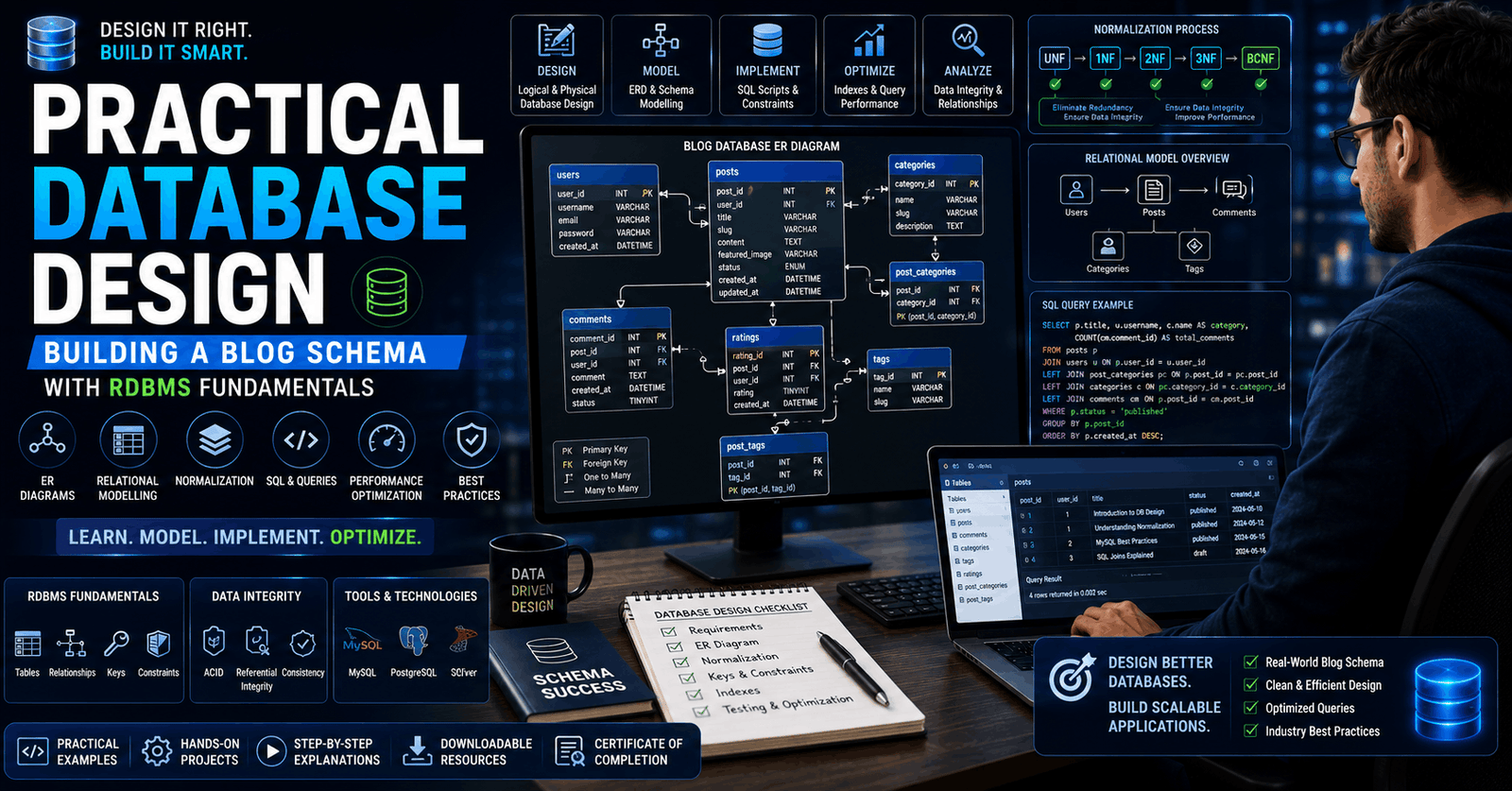
Database Design Course is a practical and structured programme designed to help learners build a strong foundation in relational database design, schema planning, and data modelling. In today’s digital environment, well-designed databases are essential for efficient software systems, scalable applications, and reliable data management. Strong database design skills are highly valuable for software developers, database administrators, data engineers, and technology professionals.
This course provides a hands-on learning experience focused on designing a real-world blog database using core RDBMS principles. Learners will develop a deep understanding of how databases are structured and how effective design improves data quality, performance, scalability, and maintainability.
Throughout the course, you will explore key database concepts including databases, entities, tables, attributes, fields, and data lifecycle management. The training helps learners understand how raw business requirements are transformed into structured database designs that support efficient application development.
You will gain practical knowledge in building Entity Relationship Diagrams (ERDs), identifying entities and attributes, defining naming conventions, and designing relational schemas. The course also provides detailed coverage of normalization concepts including First Normal Form (1NF), Second Normal Form (2NF), and Third Normal Form (3NF). Understanding normalization helps reduce redundancy, improve consistency, and strengthen database performance.
In addition, learners will explore table relationships, primary keys, candidate keys, functional dependencies, and schema optimization techniques. By applying these concepts to a blog database project, learners develop practical design skills relevant to real-world software development and database architecture.
This course is ideal for beginners and professionals seeking stronger database design expertise. Whether your goal is software development, data engineering, or system architecture, this training delivers practical skills with long-term technical value.
Upon successful completion, learners will receive a free course completion certificate. Multiple premium certificate and transcript options are also available for purchase if desired. Students also benefit from 5-star rated 24/7 email support, ensuring expert assistance is always available throughout the learning journey.Who is this course for?
Database Design Course is a practical and structured programme designed to help learners build a strong foundation in relational database design, schema planning, and data modelling. In today’s digital environment, well-designed databases are essential for efficient software systems, scalable applications, and reliable data management. Strong database design skills are highly valuable for software developers, database administrators, data engineers, and technology professionals.
This course provides a hands-on learning experience focused on designing a real-world blog database using core RDBMS principles. Learners will develop a deep understanding of how databases are structured and how effective design improves data quality, performance, scalability, and maintainability.
Throughout the course, you will explore key database concepts including databases, entities, tables, attributes, fields, and data lifecycle management. The training helps learners understand how raw business requirements are transformed into structured database designs that support efficient application development.
You will gain practical knowledge in building Entity Relationship Diagrams (ERDs), identifying entities and attributes, defining naming conventions, and designing relational schemas. The course also provides detailed coverage of normalization concepts including First Normal Form (1NF), Second Normal Form (2NF), and Third Normal Form (3NF). Understanding normalization helps reduce redundancy, improve consistency, and strengthen database performance.
In addition, learners will explore table relationships, primary keys, candidate keys, functional dependencies, and schema optimization techniques. By applying these concepts to a blog database project, learners develop practical design skills relevant to real-world software development and database architecture.
This course is ideal for beginners and professionals seeking stronger database design expertise. Whether your goal is software development, data engineering, or system architecture, this training delivers practical skills with long-term technical value.
Upon successful completion, learners will receive a free course completion certificate. Multiple premium certificate and transcript options are also available for purchase if desired. Students also benefit from 5-star rated 24/7 email support, ensuring expert assistance is always available throughout the learning journey.Requirements
Database Design Course is a practical and structured programme designed to help learners build a strong foundation in relational database design, schema planning, and data modelling. In today’s digital environment, well-designed databases are essential for efficient software systems, scalable applications, and reliable data management. Strong database design skills are highly valuable for software developers, database administrators, data engineers, and technology professionals.
This course provides a hands-on learning experience focused on designing a real-world blog database using core RDBMS principles. Learners will develop a deep understanding of how databases are structured and how effective design improves data quality, performance, scalability, and maintainability.
Throughout the course, you will explore key database concepts including databases, entities, tables, attributes, fields, and data lifecycle management. The training helps learners understand how raw business requirements are transformed into structured database designs that support efficient application development.
You will gain practical knowledge in building Entity Relationship Diagrams (ERDs), identifying entities and attributes, defining naming conventions, and designing relational schemas. The course also provides detailed coverage of normalization concepts including First Normal Form (1NF), Second Normal Form (2NF), and Third Normal Form (3NF). Understanding normalization helps reduce redundancy, improve consistency, and strengthen database performance.
In addition, learners will explore table relationships, primary keys, candidate keys, functional dependencies, and schema optimization techniques. By applying these concepts to a blog database project, learners develop practical design skills relevant to real-world software development and database architecture.
This course is ideal for beginners and professionals seeking stronger database design expertise. Whether your goal is software development, data engineering, or system architecture, this training delivers practical skills with long-term technical value.
Upon successful completion, learners will receive a free course completion certificate. Multiple premium certificate and transcript options are also available for purchase if desired. Students also benefit from 5-star rated 24/7 email support, ensuring expert assistance is always available throughout the learning journey.Career path
Database Design Course is a practical and structured programme designed to help learners build a strong foundation in relational database design, schema planning, and data modelling. In today’s digital environment, well-designed databases are essential for efficient software systems, scalable applications, and reliable data management. Strong database design skills are highly valuable for software developers, database administrators, data engineers, and technology professionals.
This course provides a hands-on learning experience focused on designing a real-world blog database using core RDBMS principles. Learners will develop a deep understanding of how databases are structured and how effective design improves data quality, performance, scalability, and maintainability.
Throughout the course, you will explore key database concepts including databases, entities, tables, attributes, fields, and data lifecycle management. The training helps learners understand how raw business requirements are transformed into structured database designs that support efficient application development.
You will gain practical knowledge in building Entity Relationship Diagrams (ERDs), identifying entities and attributes, defining naming conventions, and designing relational schemas. The course also provides detailed coverage of normalization concepts including First Normal Form (1NF), Second Normal Form (2NF), and Third Normal Form (3NF). Understanding normalization helps reduce redundancy, improve consistency, and strengthen database performance.
In addition, learners will explore table relationships, primary keys, candidate keys, functional dependencies, and schema optimization techniques. By applying these concepts to a blog database project, learners develop practical design skills relevant to real-world software development and database architecture.
This course is ideal for beginners and professionals seeking stronger database design expertise. Whether your goal is software development, data engineering, or system architecture, this training delivers practical skills with long-term technical value.
Upon successful completion, learners will receive a free course completion certificate. Multiple premium certificate and transcript options are also available for purchase if desired. Students also benefit from 5-star rated 24/7 email support, ensuring expert assistance is always available throughout the learning journey.-
- Course Introduction 00:10:00
- Key Terminology: Databases, RDBMS, and Data Lifecycle 00:10:00
- Key Terminology: Entities and Tables 00:10:00
- Key Terminology: Attributes and Fields 00:10:00
- Objectives of Database Design 00:10:00
-
- Project Introduction: Blog Database Design 00:10:00
- Introducing Entities in the Blog Schema 00:10:00
- Identifying Significant Entities 00:10:00
- Project Approach 1: Formulating the Preliminary Entity List 00:10:00
- Using Lucidchart for Database Design 00:10:00
- Project Approach 1: Associating Attributes with Entities 00:10:00
- Project Approach 2: Identifying Entities from Attributes List 00:10:00
- Illustrating Database Design: Entity Relationship Diagram (ERD) 00:10:00
- Table and Field Naming Conventions 00:10:00
- Understanding Table Keys 00:10:00
- Candidate Keys 00:10:00
- Primary Keys 00:10:00
- Project: Establishing Table Keys 00:10:00
- Functional Dependencies 00:10:00
- Second Normal Form (2NF) 00:10:00
- Partial Key Dependencies 00:10:00
- Project: Identifying and Resolving Partial Key Dependencies 00:10:00
- Third Normal Form (3NF) 00:10:00
- Transitive Dependencies 00:10:00
- Project: Identifying and Resolving Transitive Dependencies 00:10:00
- Exam of Practical Database Design: Building a Blog Schema with RDBMS Fundamental 00:50:00

No Reviews found for this course.
Is this certificate recognized?
Yes, our premium certificate and transcript are widely recognized and accepted by embassies worldwide, particularly by the UK embassy. This adds credibility to your qualification and enhances its value for professional and academic purposes.
I am a beginner. Is this course suitable for me?
Yes, this course is designed for learners of all levels, including beginners. The content is structured to provide step-by-step guidance, ensuring that even those with no prior experience can follow along and gain valuable knowledge.
I am a professional. Is this course suitable for me?
Yes, professionals will also benefit from this course. It covers advanced concepts, practical applications, and industry insights that can help enhance existing skills and knowledge. Whether you are looking to refine your expertise or expand your qualifications, this course provides valuable learning.
Does this course have an expiry date?
No, you have lifetime access to the course. Once enrolled, you can revisit the materials at any time as long as the course remains available. Additionally, we regularly update our content to ensure it stays relevant and up to date.
How do I claim my free certificate?
I trust you’re in good health. Your free certificate can be located in the Achievement section. The option to purchase a CPD certificate is available but entirely optional, and you may choose to skip it. Please be aware that it’s crucial to click the “Complete” button to ensure the certificate is generated, as this process is entirely automated.
Does this course have assessments and assignments?
Yes, the course includes both assessments and assignments. Your final marks will be determined by a combination of 20% from assignments and 80% from assessments. These evaluations are designed to test your understanding and ensure you have grasped the key concepts effectively.
Is this course accredited?
We are a recognized course provider with CPD, UKRLP, and AOHT membership. The logos of these accreditation bodies will be featured on your premium certificate and transcript, ensuring credibility and professional recognition.
Will I receive a certificate upon completion?
Yes, you will receive a free digital certificate automatically once you complete the course. If you would like a premium CPD-accredited certificate, either in digital or physical format, you can upgrade for a small fee.
Course Features
Price
Study Method
Online | Self-paced
Course Format
Interactive PDFs, Articles & Learning Resources
Duration
7 hours, 55 minutes
Qualification
Professional Skills Development Course
Assessment
Final MCQ Exam (included in price)
Certificate
Verifiable Digital Certificate - Free
Additional info
Lifetime Access | Start Instantly
- Share

Solar Thermal Energy Systems: Design & Applications Masterclass
Course Line237د.إ2,390.56Original price was: د.إ2,390.56.د.إ73.13Current price is: د.إ73.13.Crane Operator Essentials: Safety, Skills, and Efficiency
Course Line238د.إ2,390.56Original price was: د.إ2,390.56.د.إ73.13Current price is: د.إ73.13.Level 7 Advanced Diploma in Big Data Analytics
Course Line238د.إ2,390.56Original price was: د.إ2,390.56.د.إ73.13Current price is: د.إ73.13.



Related Courses
PRINCE2 in Practice: Simulated Projects & Case Studies
د.إ2,390.56Original price was: د.إ2,390.56.د.إ73.13Current price is: د.إ73.13.237PRINCE2 Risk Management: Identifying, Assessing & Controlling Risk
د.إ2,390.56Original price was: د.إ2,390.56.د.إ73.13Current price is: د.إ73.13.237PRINCE2 Roles & Responsibilities: Managing Teams in a PRINCE2 Environment
د.إ2,390.56Original price was: د.إ2,390.56.د.إ73.13Current price is: د.إ73.13.237


Related Courses
PRINCE2 in Practice: Simulated Projects & Case Studies
د.إ2,390.56Original price was: د.إ2,390.56.د.إ73.13Current price is: د.إ73.13.237PRINCE2 Risk Management: Identifying, Assessing & Controlling Risk
د.إ2,390.56Original price was: د.إ2,390.56.د.إ73.13Current price is: د.إ73.13.237PRINCE2 Roles & Responsibilities: Managing Teams in a PRINCE2 Environment
د.إ2,390.56Original price was: د.إ2,390.56.د.إ73.13Current price is: د.إ73.13.237

