
Course Features
Price
Study Method
Online | Self-paced
Course Format
Interactive PDFs, Articles & Learning Resources
Duration
6 hours, 45 minutes
Qualification
Professional Skills Development Course
Assessment
Final MCQ Exam (included in price)
Certificate
Verifiable Digital Certificate - Free
Additional info
Lifetime Access | Start Instantly
- Share
Overview
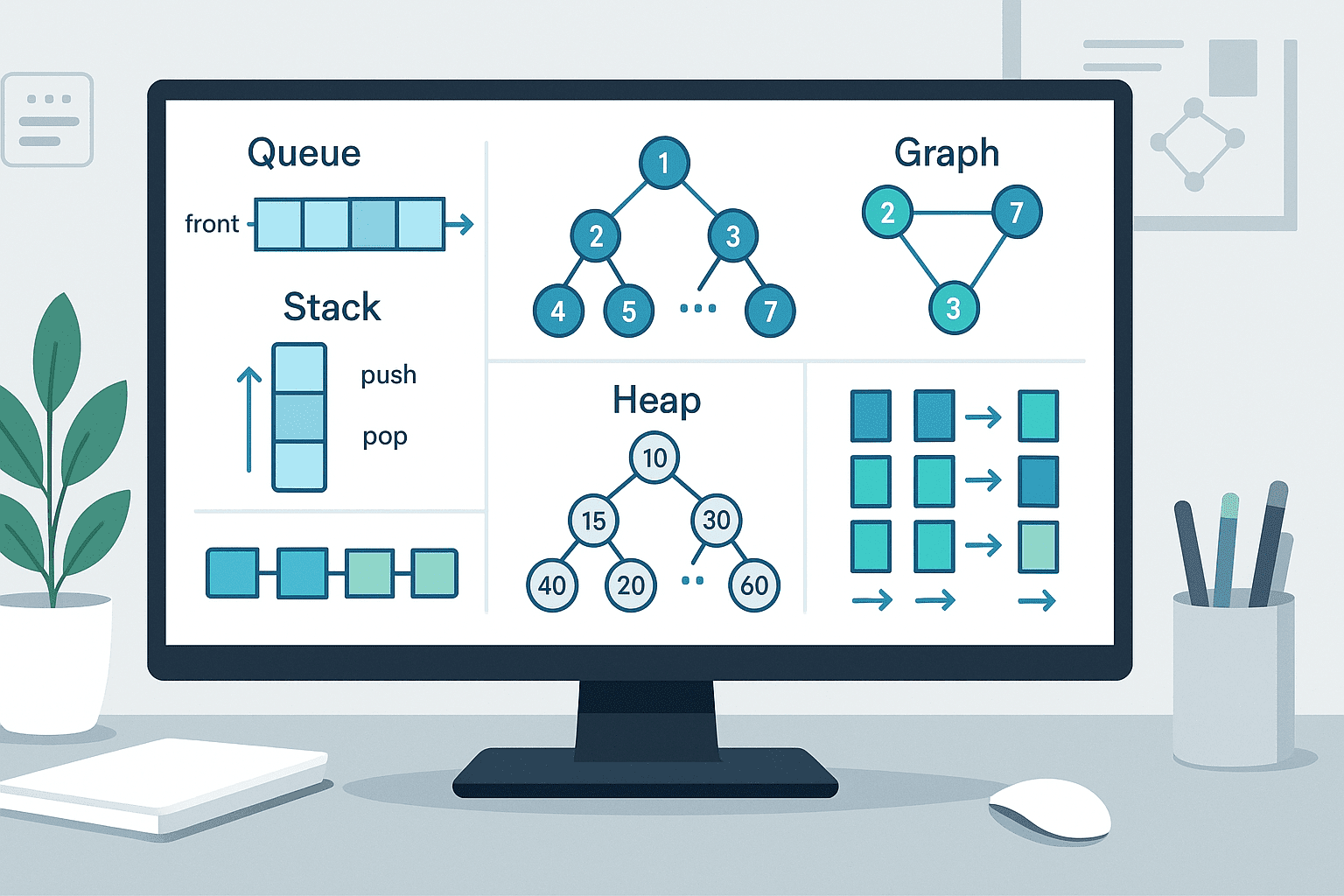
Data Structures Algorithms form the backbone of efficient software development and problem-solving in computer science. This masterclass is designed to help learners understand how data is organised, processed, and optimised using clear visuals and intuitive explanations. Rather than relying on abstract theory alone, the course focuses on conceptual clarity and visual learning to make complex ideas easier to grasp.
You will begin by exploring fundamental linear data structures such as queues, stacks, and linked lists, learning how they operate and where they are used in real-world systems. The course then moves into more advanced structures, including trees, heaps, and graphs, explaining how data relationships are modelled and traversed efficiently. Concepts like graph traversal, spanning trees, and priority-based processing are presented in a structured, learner-friendly way.
A key strength of this course is its emphasis on algorithms. Searching and sorting techniques are explained step by step, with visual demonstrations that show how algorithms behave internally. From basic linear and binary search to advanced sorting methods such as merge sort, quick sort, heap sort, and radix sort, you will understand not only how algorithms work, but why certain approaches are more efficient than others.
This course is ideal for building strong analytical and problem-solving skills. By visualising data flow, comparisons, and traversal paths, learners develop deeper intuition and confidence when approaching algorithmic challenges. The knowledge gained here supports academic study, technical interviews, and practical programming tasks across a wide range of computing fields.
At the end of the course, learners will receive a free course completion certificate. For those who wish to strengthen their academic or professional profile, multiple premium certificate and transcript options are also available for purchase. Students also benefit from 5-star rated learner support available 24/7 via email, ensuring guidance and assistance whenever needed.
Who is this course for?
Data Structures Algorithms form the backbone of efficient software development and problem-solving in computer science. This masterclass is designed to help learners understand how data is organised, processed, and optimised using clear visuals and intuitive explanations. Rather than relying on abstract theory alone, the course focuses on conceptual clarity and visual learning to make complex ideas easier to grasp.
You will begin by exploring fundamental linear data structures such as queues, stacks, and linked lists, learning how they operate and where they are used in real-world systems. The course then moves into more advanced structures, including trees, heaps, and graphs, explaining how data relationships are modelled and traversed efficiently. Concepts like graph traversal, spanning trees, and priority-based processing are presented in a structured, learner-friendly way.
A key strength of this course is its emphasis on algorithms. Searching and sorting techniques are explained step by step, with visual demonstrations that show how algorithms behave internally. From basic linear and binary search to advanced sorting methods such as merge sort, quick sort, heap sort, and radix sort, you will understand not only how algorithms work, but why certain approaches are more efficient than others.
This course is ideal for building strong analytical and problem-solving skills. By visualising data flow, comparisons, and traversal paths, learners develop deeper intuition and confidence when approaching algorithmic challenges. The knowledge gained here supports academic study, technical interviews, and practical programming tasks across a wide range of computing fields.
At the end of the course, learners will receive a free course completion certificate. For those who wish to strengthen their academic or professional profile, multiple premium certificate and transcript options are also available for purchase. Students also benefit from 5-star rated learner support available 24/7 via email, ensuring guidance and assistance whenever needed.
Requirements
Data Structures Algorithms form the backbone of efficient software development and problem-solving in computer science. This masterclass is designed to help learners understand how data is organised, processed, and optimised using clear visuals and intuitive explanations. Rather than relying on abstract theory alone, the course focuses on conceptual clarity and visual learning to make complex ideas easier to grasp.
You will begin by exploring fundamental linear data structures such as queues, stacks, and linked lists, learning how they operate and where they are used in real-world systems. The course then moves into more advanced structures, including trees, heaps, and graphs, explaining how data relationships are modelled and traversed efficiently. Concepts like graph traversal, spanning trees, and priority-based processing are presented in a structured, learner-friendly way.
A key strength of this course is its emphasis on algorithms. Searching and sorting techniques are explained step by step, with visual demonstrations that show how algorithms behave internally. From basic linear and binary search to advanced sorting methods such as merge sort, quick sort, heap sort, and radix sort, you will understand not only how algorithms work, but why certain approaches are more efficient than others.
This course is ideal for building strong analytical and problem-solving skills. By visualising data flow, comparisons, and traversal paths, learners develop deeper intuition and confidence when approaching algorithmic challenges. The knowledge gained here supports academic study, technical interviews, and practical programming tasks across a wide range of computing fields.
At the end of the course, learners will receive a free course completion certificate. For those who wish to strengthen their academic or professional profile, multiple premium certificate and transcript options are also available for purchase. Students also benefit from 5-star rated learner support available 24/7 via email, ensuring guidance and assistance whenever needed.
Career path
Data Structures Algorithms form the backbone of efficient software development and problem-solving in computer science. This masterclass is designed to help learners understand how data is organised, processed, and optimised using clear visuals and intuitive explanations. Rather than relying on abstract theory alone, the course focuses on conceptual clarity and visual learning to make complex ideas easier to grasp.
You will begin by exploring fundamental linear data structures such as queues, stacks, and linked lists, learning how they operate and where they are used in real-world systems. The course then moves into more advanced structures, including trees, heaps, and graphs, explaining how data relationships are modelled and traversed efficiently. Concepts like graph traversal, spanning trees, and priority-based processing are presented in a structured, learner-friendly way.
A key strength of this course is its emphasis on algorithms. Searching and sorting techniques are explained step by step, with visual demonstrations that show how algorithms behave internally. From basic linear and binary search to advanced sorting methods such as merge sort, quick sort, heap sort, and radix sort, you will understand not only how algorithms work, but why certain approaches are more efficient than others.
This course is ideal for building strong analytical and problem-solving skills. By visualising data flow, comparisons, and traversal paths, learners develop deeper intuition and confidence when approaching algorithmic challenges. The knowledge gained here supports academic study, technical interviews, and practical programming tasks across a wide range of computing fields.
At the end of the course, learners will receive a free course completion certificate. For those who wish to strengthen their academic or professional profile, multiple premium certificate and transcript options are also available for purchase. Students also benefit from 5-star rated learner support available 24/7 via email, ensuring guidance and assistance whenever needed.
-
- Understanding Queues: Concepts & Real-World Examples 00:10:00
- Types of Queues – Simple, Circular, Priority & Deque 00:10:00
- Introduction to Stacks & Core Operations (Push, Pop, Peek) 00:10:00
- Linked List Essentials – Types, Insertion & Deletion Operations 00:10:00
-
- Introduction to Graphs – Concepts & Types 00:10:00
- Graph Representation – Adjacency Matrix & List 00:10:00
- Understanding Spanning Trees & Minimum Spanning Trees 00:10:00
- Kruskal’s Algorithm – Building a Minimum Spanning Tree 00:10:00
- Prim’s Algorithm – Finding the Minimum Spanning Tree 00:10:00
- Graph Traversal Techniques 00:10:00
- Introduction to Trees – Structure & Terminology 00:10:00
- Tree Traversals – Preorder, Inorder & Postorder 00:10:00
- Binary Trees – Concept & Implementation 00:10:00
- Binary Search Trees (BST) – Operations & Applications 00:10:00
- Binary Search – Concept & Working Principle 00:10:00
- Binary Search – Example & Implementation 00:10:00
- Linear Search – Concept & Working Principle 00:10:00
- Linear Search – Example & Implementation 00:10:00
- Exam of Data Structures & Algorithms Masterclass: Learn with Visuals and Animations 00:50:00

No Reviews found for this course.
Is this certificate recognized?
Yes, our premium certificate and transcript are widely recognized and accepted by embassies worldwide, particularly by the UK embassy. This adds credibility to your qualification and enhances its value for professional and academic purposes.
I am a beginner. Is this course suitable for me?
Yes, this course is designed for learners of all levels, including beginners. The content is structured to provide step-by-step guidance, ensuring that even those with no prior experience can follow along and gain valuable knowledge.
I am a professional. Is this course suitable for me?
Yes, professionals will also benefit from this course. It covers advanced concepts, practical applications, and industry insights that can help enhance existing skills and knowledge. Whether you are looking to refine your expertise or expand your qualifications, this course provides valuable learning.
Does this course have an expiry date?
No, you have lifetime access to the course. Once enrolled, you can revisit the materials at any time as long as the course remains available. Additionally, we regularly update our content to ensure it stays relevant and up to date.
How do I claim my free certificate?
I trust you’re in good health. Your free certificate can be located in the Achievement section. The option to purchase a CPD certificate is available but entirely optional, and you may choose to skip it. Please be aware that it’s crucial to click the “Complete” button to ensure the certificate is generated, as this process is entirely automated.
Does this course have assessments and assignments?
Yes, the course includes both assessments and assignments. Your final marks will be determined by a combination of 20% from assignments and 80% from assessments. These evaluations are designed to test your understanding and ensure you have grasped the key concepts effectively.
Is this course accredited?
We are a recognized course provider with CPD, UKRLP, and AOHT membership. The logos of these accreditation bodies will be featured on your premium certificate and transcript, ensuring credibility and professional recognition.
Will I receive a certificate upon completion?
Yes, you will receive a free digital certificate automatically once you complete the course. If you would like a premium CPD-accredited certificate, either in digital or physical format, you can upgrade for a small fee.
Course Features
Price
Study Method
Online | Self-paced
Course Format
Interactive PDFs, Articles & Learning Resources
Duration
6 hours, 45 minutes
Qualification
Professional Skills Development Course
Assessment
Final MCQ Exam (included in price)
Certificate
Verifiable Digital Certificate - Free
Additional info
Lifetime Access | Start Instantly
- Share

Canine First Aid
Course Line238₽50,156.30Original price was: ₽50,156.30.₽1,534.37Current price is: ₽1,534.37.School Welfare Officer
Course Line239₽50,156.30Original price was: ₽50,156.30.₽1,534.37Current price is: ₽1,534.37.Disability Awareness Level 3 Advanced Diploma
Course Line242₽50,156.30Original price was: ₽50,156.30.₽1,534.37Current price is: ₽1,534.37.



Related Courses
PRINCE2 in Practice: Simulated Projects & Case Studies
₽50,156.30Original price was: ₽50,156.30.₽1,534.37Current price is: ₽1,534.37.237PRINCE2 Risk Management: Identifying, Assessing & Controlling Risk
₽50,156.30Original price was: ₽50,156.30.₽1,534.37Current price is: ₽1,534.37.237PRINCE2 Roles & Responsibilities: Managing Teams in a PRINCE2 Environment
₽50,156.30Original price was: ₽50,156.30.₽1,534.37Current price is: ₽1,534.37.237


Related Courses
PRINCE2 in Practice: Simulated Projects & Case Studies
₽50,156.30Original price was: ₽50,156.30.₽1,534.37Current price is: ₽1,534.37.237PRINCE2 Risk Management: Identifying, Assessing & Controlling Risk
₽50,156.30Original price was: ₽50,156.30.₽1,534.37Current price is: ₽1,534.37.237PRINCE2 Roles & Responsibilities: Managing Teams in a PRINCE2 Environment
₽50,156.30Original price was: ₽50,156.30.₽1,534.37Current price is: ₽1,534.37.237

