
Course Features
Price
Study Method
Online | Self-paced
Course Format
Reading Material - PDF, article
Duration
8 hours, 45 minutes
Qualification
No formal qualification
Certificate
At completion
Additional info
Coming soon
- Share
Overview
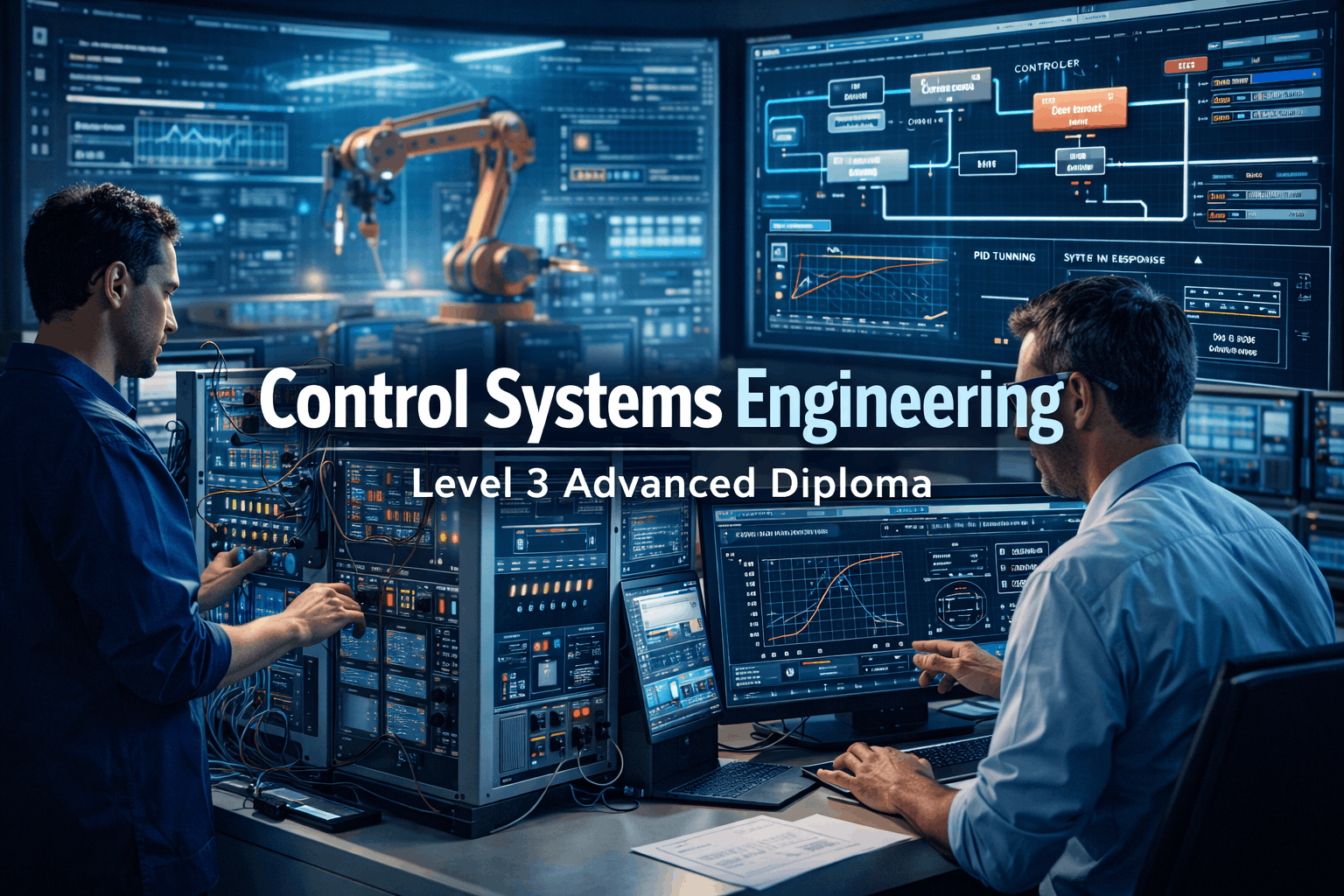
Control Systems Engineering is a highly practical Level 3 Advanced Diploma designed for learners who want to understand how modern machines, processes, and automated systems are controlled with precision and reliability. This course introduces the principles behind how industrial equipment, robotics, and digital systems respond to inputs, maintain stability, and achieve desired performance in real-world environments.
Learners develop a strong foundation in how control systems are modelled, analysed, and tuned to meet performance targets. Through guided study of dynamic systems, feedback loops, and stability concepts, students gain the skills needed to predict how systems behave over time. The programme also explores how controllers such as PID systems are used to regulate temperature, speed, pressure, and motion in industrial and technological applications.
The course bridges theory with practical engineering tools by introducing digital control, programmable logic controllers, and simulation software. These tools allow learners to visualise system behaviour, test control strategies, and troubleshoot performance issues in a safe and efficient way. By understanding how real control systems are implemented, students become better prepared to work in technical roles that demand accuracy, safety, and reliability.
Advanced topics such as adaptive control, system compensation, and state-space design help learners think like engineers, enabling them to design and optimise complex systems. The emphasis on problem-solving and analytical thinking makes this diploma valuable for anyone aiming to enter automation, manufacturing, robotics, aerospace, or process control industries.
This flexible online programme supports both academic growth and career progression by offering structured learning combined with practical insight into modern control technologies. By the end of the course, learners are equipped with skills that apply across many engineering sectors.
At completion, students receive a free course completion certificate, with multiple premium certificate and transcript options available for purchase. Learners also benefit from 5-star rated student support available 24/7 via email, ensuring help is always available throughout their studies.
Graduates can pursue roles in industrial automation, robotics, process control, manufacturing, and aerospace engineering. The diploma also provides a strong foundation for higher-level study in electrical engineering, mechatronics, and control systems design and analysis.
Who is this course for?
Control Systems Engineering is a highly practical Level 3 Advanced Diploma designed for learners who want to understand how modern machines, processes, and automated systems are controlled with precision and reliability. This course introduces the principles behind how industrial equipment, robotics, and digital systems respond to inputs, maintain stability, and achieve desired performance in real-world environments.
Learners develop a strong foundation in how control systems are modelled, analysed, and tuned to meet performance targets. Through guided study of dynamic systems, feedback loops, and stability concepts, students gain the skills needed to predict how systems behave over time. The programme also explores how controllers such as PID systems are used to regulate temperature, speed, pressure, and motion in industrial and technological applications.
The course bridges theory with practical engineering tools by introducing digital control, programmable logic controllers, and simulation software. These tools allow learners to visualise system behaviour, test control strategies, and troubleshoot performance issues in a safe and efficient way. By understanding how real control systems are implemented, students become better prepared to work in technical roles that demand accuracy, safety, and reliability.
Advanced topics such as adaptive control, system compensation, and state-space design help learners think like engineers, enabling them to design and optimise complex systems. The emphasis on problem-solving and analytical thinking makes this diploma valuable for anyone aiming to enter automation, manufacturing, robotics, aerospace, or process control industries.
This flexible online programme supports both academic growth and career progression by offering structured learning combined with practical insight into modern control technologies. By the end of the course, learners are equipped with skills that apply across many engineering sectors.
At completion, students receive a free course completion certificate, with multiple premium certificate and transcript options available for purchase. Learners also benefit from 5-star rated student support available 24/7 via email, ensuring help is always available throughout their studies.
Graduates can pursue roles in industrial automation, robotics, process control, manufacturing, and aerospace engineering. The diploma also provides a strong foundation for higher-level study in electrical engineering, mechatronics, and control systems design and analysis.
Requirements
Control Systems Engineering is a highly practical Level 3 Advanced Diploma designed for learners who want to understand how modern machines, processes, and automated systems are controlled with precision and reliability. This course introduces the principles behind how industrial equipment, robotics, and digital systems respond to inputs, maintain stability, and achieve desired performance in real-world environments.
Learners develop a strong foundation in how control systems are modelled, analysed, and tuned to meet performance targets. Through guided study of dynamic systems, feedback loops, and stability concepts, students gain the skills needed to predict how systems behave over time. The programme also explores how controllers such as PID systems are used to regulate temperature, speed, pressure, and motion in industrial and technological applications.
The course bridges theory with practical engineering tools by introducing digital control, programmable logic controllers, and simulation software. These tools allow learners to visualise system behaviour, test control strategies, and troubleshoot performance issues in a safe and efficient way. By understanding how real control systems are implemented, students become better prepared to work in technical roles that demand accuracy, safety, and reliability.
Advanced topics such as adaptive control, system compensation, and state-space design help learners think like engineers, enabling them to design and optimise complex systems. The emphasis on problem-solving and analytical thinking makes this diploma valuable for anyone aiming to enter automation, manufacturing, robotics, aerospace, or process control industries.
This flexible online programme supports both academic growth and career progression by offering structured learning combined with practical insight into modern control technologies. By the end of the course, learners are equipped with skills that apply across many engineering sectors.
At completion, students receive a free course completion certificate, with multiple premium certificate and transcript options available for purchase. Learners also benefit from 5-star rated student support available 24/7 via email, ensuring help is always available throughout their studies.
Graduates can pursue roles in industrial automation, robotics, process control, manufacturing, and aerospace engineering. The diploma also provides a strong foundation for higher-level study in electrical engineering, mechatronics, and control systems design and analysis.
Career path
Control Systems Engineering is a highly practical Level 3 Advanced Diploma designed for learners who want to understand how modern machines, processes, and automated systems are controlled with precision and reliability. This course introduces the principles behind how industrial equipment, robotics, and digital systems respond to inputs, maintain stability, and achieve desired performance in real-world environments.
Learners develop a strong foundation in how control systems are modelled, analysed, and tuned to meet performance targets. Through guided study of dynamic systems, feedback loops, and stability concepts, students gain the skills needed to predict how systems behave over time. The programme also explores how controllers such as PID systems are used to regulate temperature, speed, pressure, and motion in industrial and technological applications.
The course bridges theory with practical engineering tools by introducing digital control, programmable logic controllers, and simulation software. These tools allow learners to visualise system behaviour, test control strategies, and troubleshoot performance issues in a safe and efficient way. By understanding how real control systems are implemented, students become better prepared to work in technical roles that demand accuracy, safety, and reliability.
Advanced topics such as adaptive control, system compensation, and state-space design help learners think like engineers, enabling them to design and optimise complex systems. The emphasis on problem-solving and analytical thinking makes this diploma valuable for anyone aiming to enter automation, manufacturing, robotics, aerospace, or process control industries.
This flexible online programme supports both academic growth and career progression by offering structured learning combined with practical insight into modern control technologies. By the end of the course, learners are equipped with skills that apply across many engineering sectors.
At completion, students receive a free course completion certificate, with multiple premium certificate and transcript options available for purchase. Learners also benefit from 5-star rated student support available 24/7 via email, ensuring help is always available throughout their studies.
Graduates can pursue roles in industrial automation, robotics, process control, manufacturing, and aerospace engineering. The diploma also provides a strong foundation for higher-level study in electrical engineering, mechatronics, and control systems design and analysis.
-
- Overview of Control Systems and their applications 00:10:00
- Types of Control Systems: Open-loop and Closed-loop 00:10:00
- Control System Components and Terminology 00:10:00
- Control System Design Process 00:10:00
-
- Transfer Functions and Block Diagrams 00:10:00
- Laplace Transform and Time Domain Analysis 00:10:00
- State-Space Representation of Control Systems 00:10:00
- System Stability and Routh-Hurwitz Criterion 00:10:00
- Time Response Analysis: First Order and Second Order Systems 00:10:00
- Performance Specifications: Rise Time, Settling Time, Overshoot, etc. 00:10:00
- Frequency Response Analysis: Bode Plots, Nyquist Plots 00:10:00
- Stability Analysis: Root Locus Technique 00:10:00
- Feedforward Control 00:10:00
- Cascade Control 00:10:00
- Ratio Control 00:10:00
- Gain Scheduling 00:10:00
- Adaptive Control 00:10:00
- Introduction to Digital Control Systems 00:10:00
- Z-Transform and Sampled Data Systems 00:10:00
- Discrete PID Controllers 00:10:00
- Stability Analysis of Digital Control Systems 00:10:00
- PLC (Programmable Logic Controller) Basics 00:10:00
- PLC Programming for Control Systems 00:10:00
- Hardware Interface and Integration 00:10:00
- Case Studies on Real-world Control System Implementation 00:10:00
- MATLAB/Simulink for Control System Simulation 00:10:00
- Control System Design Software 00:10:00
- Hands-on Projects and Simulations 00:10:00
- Exam of Control Systems Level 3 Advanced Diploma 00:50:00

No Reviews found for this course.
Is this certificate recognized?
Yes, our premium certificate and transcript are widely recognized and accepted by embassies worldwide, particularly by the UK embassy. This adds credibility to your qualification and enhances its value for professional and academic purposes.
I am a beginner. Is this course suitable for me?
Yes, this course is designed for learners of all levels, including beginners. The content is structured to provide step-by-step guidance, ensuring that even those with no prior experience can follow along and gain valuable knowledge.
I am a professional. Is this course suitable for me?
Yes, professionals will also benefit from this course. It covers advanced concepts, practical applications, and industry insights that can help enhance existing skills and knowledge. Whether you are looking to refine your expertise or expand your qualifications, this course provides valuable learning.
Does this course have an expiry date?
No, you have lifetime access to the course. Once enrolled, you can revisit the materials at any time as long as the course remains available. Additionally, we regularly update our content to ensure it stays relevant and up to date.
How do I claim my free certificate?
I trust you’re in good health. Your free certificate can be located in the Achievement section. The option to purchase a CPD certificate is available but entirely optional, and you may choose to skip it. Please be aware that it’s crucial to click the “Complete” button to ensure the certificate is generated, as this process is entirely automated.
Does this course have assessments and assignments?
Yes, the course includes both assessments and assignments. Your final marks will be determined by a combination of 20% from assignments and 80% from assessments. These evaluations are designed to test your understanding and ensure you have grasped the key concepts effectively.
Is this course accredited?
We are a recognized course provider with CPD, UKRLP, and AOHT membership. The logos of these accreditation bodies will be featured on your premium certificate and transcript, ensuring credibility and professional recognition.
Will I receive a certificate upon completion?
Yes, you will receive a free digital certificate automatically once you complete the course. If you would like a premium CPD-accredited certificate, either in digital or physical format, you can upgrade for a small fee.
Course Features
Price
Study Method
Online | Self-paced
Course Format
Reading Material - PDF, article
Duration
8 hours, 45 minutes
Qualification
No formal qualification
Certificate
At completion
Additional info
Coming soon
- Share

Bread Making Level 3 Advanced Diploma
Course Line238ر.س2,482.72Original price was: ر.س2,482.72.ر.س75.95Current price is: ر.س75.95.Astronomy Level 3 Advanced Diploma
Course Line240ر.س2,482.72Original price was: ر.س2,482.72.ر.س75.95Current price is: ر.س75.95.Executive Compensation Level 3 Advanced Diploma
Course Line237ر.س2,482.72Original price was: ر.س2,482.72.ر.س75.95Current price is: ر.س75.95.



Related Courses
PRINCE2 in Practice: Simulated Projects & Case Studies
ر.س2,482.72Original price was: ر.س2,482.72.ر.س75.95Current price is: ر.س75.95.237PRINCE2 Risk Management: Identifying, Assessing & Controlling Risk
ر.س2,482.72Original price was: ر.س2,482.72.ر.س75.95Current price is: ر.س75.95.237PRINCE2 Roles & Responsibilities: Managing Teams in a PRINCE2 Environment
ر.س2,482.72Original price was: ر.س2,482.72.ر.س75.95Current price is: ر.س75.95.237


Related Courses
PRINCE2 in Practice: Simulated Projects & Case Studies
ر.س2,482.72Original price was: ر.س2,482.72.ر.س75.95Current price is: ر.س75.95.237PRINCE2 Risk Management: Identifying, Assessing & Controlling Risk
ر.س2,482.72Original price was: ر.س2,482.72.ر.س75.95Current price is: ر.س75.95.237PRINCE2 Roles & Responsibilities: Managing Teams in a PRINCE2 Environment
ر.س2,482.72Original price was: ر.س2,482.72.ر.س75.95Current price is: ر.س75.95.237

