
Course Features
Price
Study Method
Online | Self-paced
Course Format
Interactive PDFs, Articles & Learning Resources
Duration
11 hours, 25 minutes
Qualification
Professional Skills Development Course
Assessment
Final MCQ Exam (included in price)
Certificate
Verifiable Digital Certificate - Free
Additional info
Lifetime Access | Start Instantly
- Share
Overview
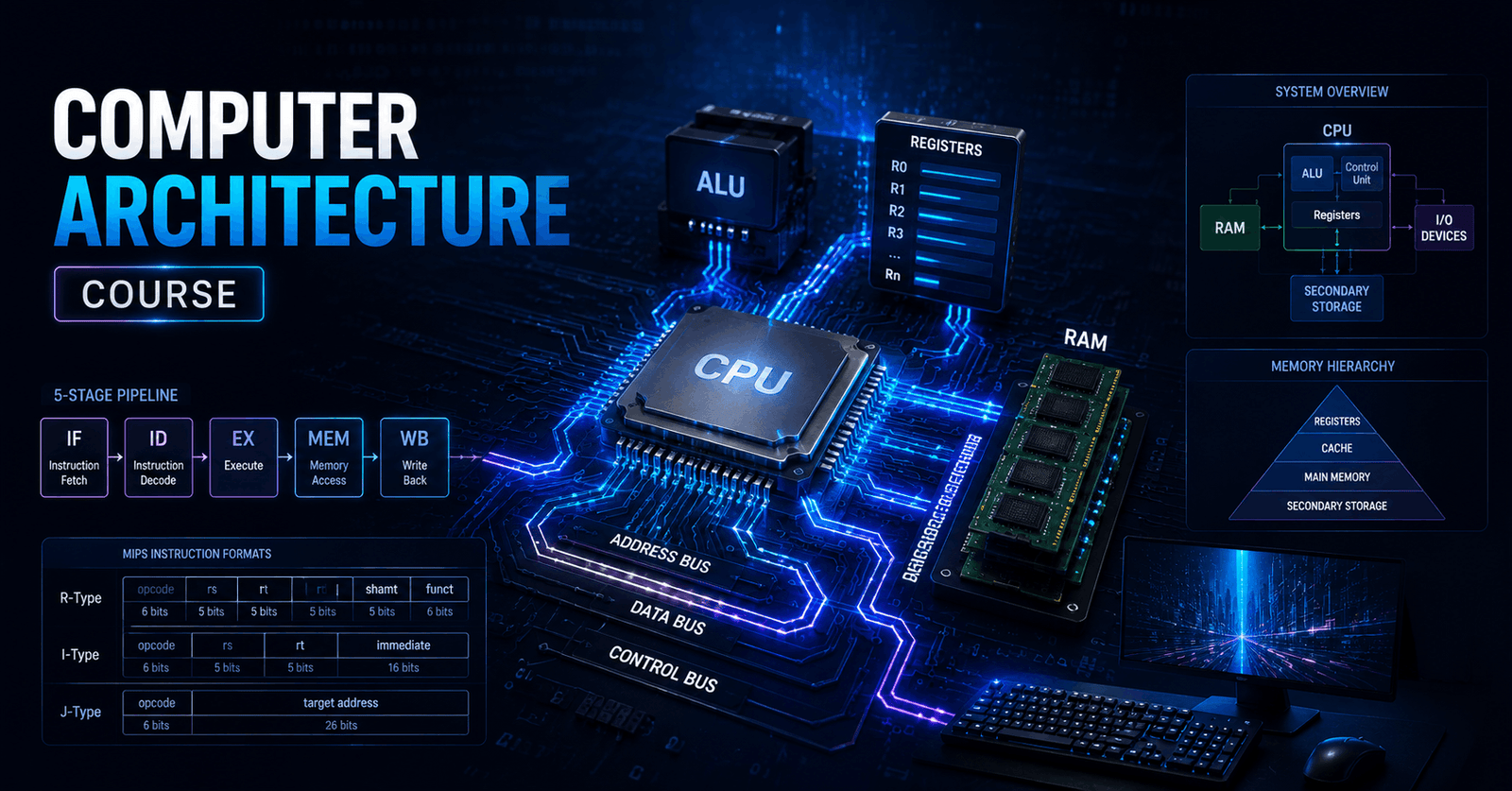
Computer Architecture Course provides a comprehensive introduction to the fundamental concepts behind how computer systems are designed, organised and operated. This course is designed to help learners understand the relationship between hardware components, software instructions and the internal processes that allow computers to execute tasks efficiently.
Beginning with essential concepts, the course introduces computer architecture fundamentals, including hardware, software, number systems and binary-decimal conversions. Learners develop a strong foundation in understanding how information is represented and processed inside a computer system. The training then moves into computer organisation, exploring CPU operations, registers, arithmetic logic units (ALU), memory configurations and system buses.
A major focus of this course is understanding how processors execute instructions. Learners are introduced to Instruction Set Architecture (ISA), including the MIPS R3000 architecture, instruction formats and practical examples. Through guided exercises and programming examples, students gain insight into load/store operations, R-type, I-type and J-type instructions, along with methods for analysing and writing basic MIPS programs.
The course also explores computer pipeline concepts and performance improvement techniques. Learners discover how pipelining works, how processor speed can be enhanced and how challenges such as data hazards affect execution. Practical examples and problem-solving exercises help build confidence in analysing processor performance and architectural decisions.
In addition, the course covers memory systems and peripheral devices, including RAM, DRAM, ROM, display systems, keyboard and mouse interfaces. These topics provide a broader understanding of how different computer components communicate and contribute to the overall functionality of modern computing devices.
By completing this training, learners can develop a deeper technical understanding of computer systems, which can support further study in computer science, software engineering, embedded systems and related technology fields. The knowledge gained can also improve problem-solving abilities when working with low-level programming, hardware design and system optimisation.
Upon successful completion, learners will receive a free course completion certificate. Multiple premium certificate and transcript options are also available for purchase if learners require additional documentation. Students also receive access to 5-star-rated support available 24/7 through email to assist them throughout their learning experience.Who is this course for?
Computer Architecture Course provides a comprehensive introduction to the fundamental concepts behind how computer systems are designed, organised and operated. This course is designed to help learners understand the relationship between hardware components, software instructions and the internal processes that allow computers to execute tasks efficiently.
Beginning with essential concepts, the course introduces computer architecture fundamentals, including hardware, software, number systems and binary-decimal conversions. Learners develop a strong foundation in understanding how information is represented and processed inside a computer system. The training then moves into computer organisation, exploring CPU operations, registers, arithmetic logic units (ALU), memory configurations and system buses.
A major focus of this course is understanding how processors execute instructions. Learners are introduced to Instruction Set Architecture (ISA), including the MIPS R3000 architecture, instruction formats and practical examples. Through guided exercises and programming examples, students gain insight into load/store operations, R-type, I-type and J-type instructions, along with methods for analysing and writing basic MIPS programs.
The course also explores computer pipeline concepts and performance improvement techniques. Learners discover how pipelining works, how processor speed can be enhanced and how challenges such as data hazards affect execution. Practical examples and problem-solving exercises help build confidence in analysing processor performance and architectural decisions.
In addition, the course covers memory systems and peripheral devices, including RAM, DRAM, ROM, display systems, keyboard and mouse interfaces. These topics provide a broader understanding of how different computer components communicate and contribute to the overall functionality of modern computing devices.
By completing this training, learners can develop a deeper technical understanding of computer systems, which can support further study in computer science, software engineering, embedded systems and related technology fields. The knowledge gained can also improve problem-solving abilities when working with low-level programming, hardware design and system optimisation.
Upon successful completion, learners will receive a free course completion certificate. Multiple premium certificate and transcript options are also available for purchase if learners require additional documentation. Students also receive access to 5-star-rated support available 24/7 through email to assist them throughout their learning experience.Requirements
Computer Architecture Course provides a comprehensive introduction to the fundamental concepts behind how computer systems are designed, organised and operated. This course is designed to help learners understand the relationship between hardware components, software instructions and the internal processes that allow computers to execute tasks efficiently.
Beginning with essential concepts, the course introduces computer architecture fundamentals, including hardware, software, number systems and binary-decimal conversions. Learners develop a strong foundation in understanding how information is represented and processed inside a computer system. The training then moves into computer organisation, exploring CPU operations, registers, arithmetic logic units (ALU), memory configurations and system buses.
A major focus of this course is understanding how processors execute instructions. Learners are introduced to Instruction Set Architecture (ISA), including the MIPS R3000 architecture, instruction formats and practical examples. Through guided exercises and programming examples, students gain insight into load/store operations, R-type, I-type and J-type instructions, along with methods for analysing and writing basic MIPS programs.
The course also explores computer pipeline concepts and performance improvement techniques. Learners discover how pipelining works, how processor speed can be enhanced and how challenges such as data hazards affect execution. Practical examples and problem-solving exercises help build confidence in analysing processor performance and architectural decisions.
In addition, the course covers memory systems and peripheral devices, including RAM, DRAM, ROM, display systems, keyboard and mouse interfaces. These topics provide a broader understanding of how different computer components communicate and contribute to the overall functionality of modern computing devices.
By completing this training, learners can develop a deeper technical understanding of computer systems, which can support further study in computer science, software engineering, embedded systems and related technology fields. The knowledge gained can also improve problem-solving abilities when working with low-level programming, hardware design and system optimisation.
Upon successful completion, learners will receive a free course completion certificate. Multiple premium certificate and transcript options are also available for purchase if learners require additional documentation. Students also receive access to 5-star-rated support available 24/7 through email to assist them throughout their learning experience.Career path
Computer Architecture Course provides a comprehensive introduction to the fundamental concepts behind how computer systems are designed, organised and operated. This course is designed to help learners understand the relationship between hardware components, software instructions and the internal processes that allow computers to execute tasks efficiently.
Beginning with essential concepts, the course introduces computer architecture fundamentals, including hardware, software, number systems and binary-decimal conversions. Learners develop a strong foundation in understanding how information is represented and processed inside a computer system. The training then moves into computer organisation, exploring CPU operations, registers, arithmetic logic units (ALU), memory configurations and system buses.
A major focus of this course is understanding how processors execute instructions. Learners are introduced to Instruction Set Architecture (ISA), including the MIPS R3000 architecture, instruction formats and practical examples. Through guided exercises and programming examples, students gain insight into load/store operations, R-type, I-type and J-type instructions, along with methods for analysing and writing basic MIPS programs.
The course also explores computer pipeline concepts and performance improvement techniques. Learners discover how pipelining works, how processor speed can be enhanced and how challenges such as data hazards affect execution. Practical examples and problem-solving exercises help build confidence in analysing processor performance and architectural decisions.
In addition, the course covers memory systems and peripheral devices, including RAM, DRAM, ROM, display systems, keyboard and mouse interfaces. These topics provide a broader understanding of how different computer components communicate and contribute to the overall functionality of modern computing devices.
By completing this training, learners can develop a deeper technical understanding of computer systems, which can support further study in computer science, software engineering, embedded systems and related technology fields. The knowledge gained can also improve problem-solving abilities when working with low-level programming, hardware design and system optimisation.
Upon successful completion, learners will receive a free course completion certificate. Multiple premium certificate and transcript options are also available for purchase if learners require additional documentation. Students also receive access to 5-star-rated support available 24/7 through email to assist them throughout their learning experience.-
- Introduction to Computer Architecture 00:10:00
- Computer Hardware 00:10:00
- Computer Software 00:10:00
- Binary to Decimal 00:10:00
- Decimal to Binary 00:10:00
-
- Computer Organization (Block Diagram) 00:10:00
- CPU Computation Part 00:10:00
- Special Purpose Registers 00:10:00
- ALU 00:10:00
- ALU (Examples) 00:10:00
- ALU (Design Example) 00:10:00
- Computer Registers 00:10:00
- Register and Memory Configuration 00:10:00
- Register and Memory Configuration Example 00:10:00
- Register and Memory Configuration Example 2 00:10:00
- Register and Memory Configuration Example 3 00:10:00
- Computer BUS 00:10:00
- Computer BUS (Continued) 00:10:00
- Chapter 2 Quiz Solved 00:10:00
- Instruction Set Architecture Definition 00:10:00
- MIPS R3000 ISA 00:10:00
- MIPS R3000 Load and Store 00:10:00
- MIPS R3000 R Type Instruction 00:10:00
- MIPS R3000 I Type Instruction 00:10:00
- MIPS R3000 J Type Instruction 00:10:00
- MIPS Architecture Brief History 00:10:00
- MIPS Practice Questions 00:10:00
- MIPS Practice Question 1 00:10:00
- MIPS Practice Question 2 00:10:00
- MIPS Practice Question 3 00:10:00
- MIPS Practice Question 4 00:10:00
- Integer and Binary Conversion Practice Question 00:10:00
- MIPS Instructions 00:10:00
- MIPS Instructions 2 00:10:00
- MIPS Instructions 3 00:10:00
- MIPS Program 1 00:10:00
- MIPS Program 2 00:10:00
- MIPS Program 3 00:10:00
- MIPS Program 4 00:10:00
- MIPS Program 5 00:10:00
- Chapter 3 Quiz SolvedLesson 23: Chapter 3 Quiz Solved 00:10:00
- Computer RAM 00:10:00
- DRAM Types 00:10:00
- Functionality of RAM 00:10:00
- Practice Questions 00:10:00
- Practice Questions 2 00:10:00
- Practice Questions 3 00:10:00
- RAM and ROM 00:10:00
- Display 00:10:00
- Mouse and Keyboard 00:10:00
- Chapter 5 Quiz Solved 00:10:00
- Premium Certificate 00:15:00

No Reviews found for this course.
Is this certificate recognized?
Yes, our premium certificate and transcript are widely recognized and accepted by embassies worldwide, particularly by the UK embassy. This adds credibility to your qualification and enhances its value for professional and academic purposes.
I am a beginner. Is this course suitable for me?
Yes, this course is designed for learners of all levels, including beginners. The content is structured to provide step-by-step guidance, ensuring that even those with no prior experience can follow along and gain valuable knowledge.
I am a professional. Is this course suitable for me?
Yes, professionals will also benefit from this course. It covers advanced concepts, practical applications, and industry insights that can help enhance existing skills and knowledge. Whether you are looking to refine your expertise or expand your qualifications, this course provides valuable learning.
Does this course have an expiry date?
No, you have lifetime access to the course. Once enrolled, you can revisit the materials at any time as long as the course remains available. Additionally, we regularly update our content to ensure it stays relevant and up to date.
How do I claim my free certificate?
I trust you’re in good health. Your free certificate can be located in the Achievement section. The option to purchase a CPD certificate is available but entirely optional, and you may choose to skip it. Please be aware that it’s crucial to click the “Complete” button to ensure the certificate is generated, as this process is entirely automated.
Does this course have assessments and assignments?
Yes, the course includes both assessments and assignments. Your final marks will be determined by a combination of 20% from assignments and 80% from assessments. These evaluations are designed to test your understanding and ensure you have grasped the key concepts effectively.
Is this course accredited?
We are a recognized course provider with CPD, UKRLP, and AOHT membership. The logos of these accreditation bodies will be featured on your premium certificate and transcript, ensuring credibility and professional recognition.
Will I receive a certificate upon completion?
Yes, you will receive a free digital certificate automatically once you complete the course. If you would like a premium CPD-accredited certificate, either in digital or physical format, you can upgrade for a small fee.
Course Features
Price
Study Method
Online | Self-paced
Course Format
Interactive PDFs, Articles & Learning Resources
Duration
11 hours, 25 minutes
Qualification
Professional Skills Development Course
Assessment
Final MCQ Exam (included in price)
Certificate
Verifiable Digital Certificate - Free
Additional info
Lifetime Access | Start Instantly
- Share

Vegetarian Cookery Level 3 Advanced Diploma
Course Line237$923.21Original price was: $923.21.$28.24Current price is: $28.24.Financial Accounting
Course Line240$923.21Original price was: $923.21.$28.24Current price is: $28.24.Clinical Psychologist Level 3 Advanced Diploma
Course Line237$923.21Original price was: $923.21.$28.24Current price is: $28.24.



Related Courses
PRINCE2 in Practice: Simulated Projects & Case Studies
$923.21Original price was: $923.21.$28.24Current price is: $28.24.237PRINCE2 for Beginners: An Introduction to Project Governance
$923.21Original price was: $923.21.$28.24Current price is: $28.24.237PRINCE2 Project Documentation: Templates & Best Practice
$923.21Original price was: $923.21.$28.24Current price is: $28.24.237



Related Courses
PRINCE2 in Practice: Simulated Projects & Case Studies
$923.21Original price was: $923.21.$28.24Current price is: $28.24.237PRINCE2 for Beginners: An Introduction to Project Governance
$923.21Original price was: $923.21.$28.24Current price is: $28.24.237PRINCE2 Project Documentation: Templates & Best Practice
$923.21Original price was: $923.21.$28.24Current price is: $28.24.237

