
Course Features
Price
Study Method
Online | Self-paced
Course Format
Interactive PDFs, Articles & Learning Resources
Duration
19 hours, 25 minutes
Qualification
Professional Skills Development Course
Assessment
Final MCQ Exam (included in price)
Certificate
Verifiable Digital Certificate - Free
Additional info
Lifetime Access | Start Instantly
- Share
Overview
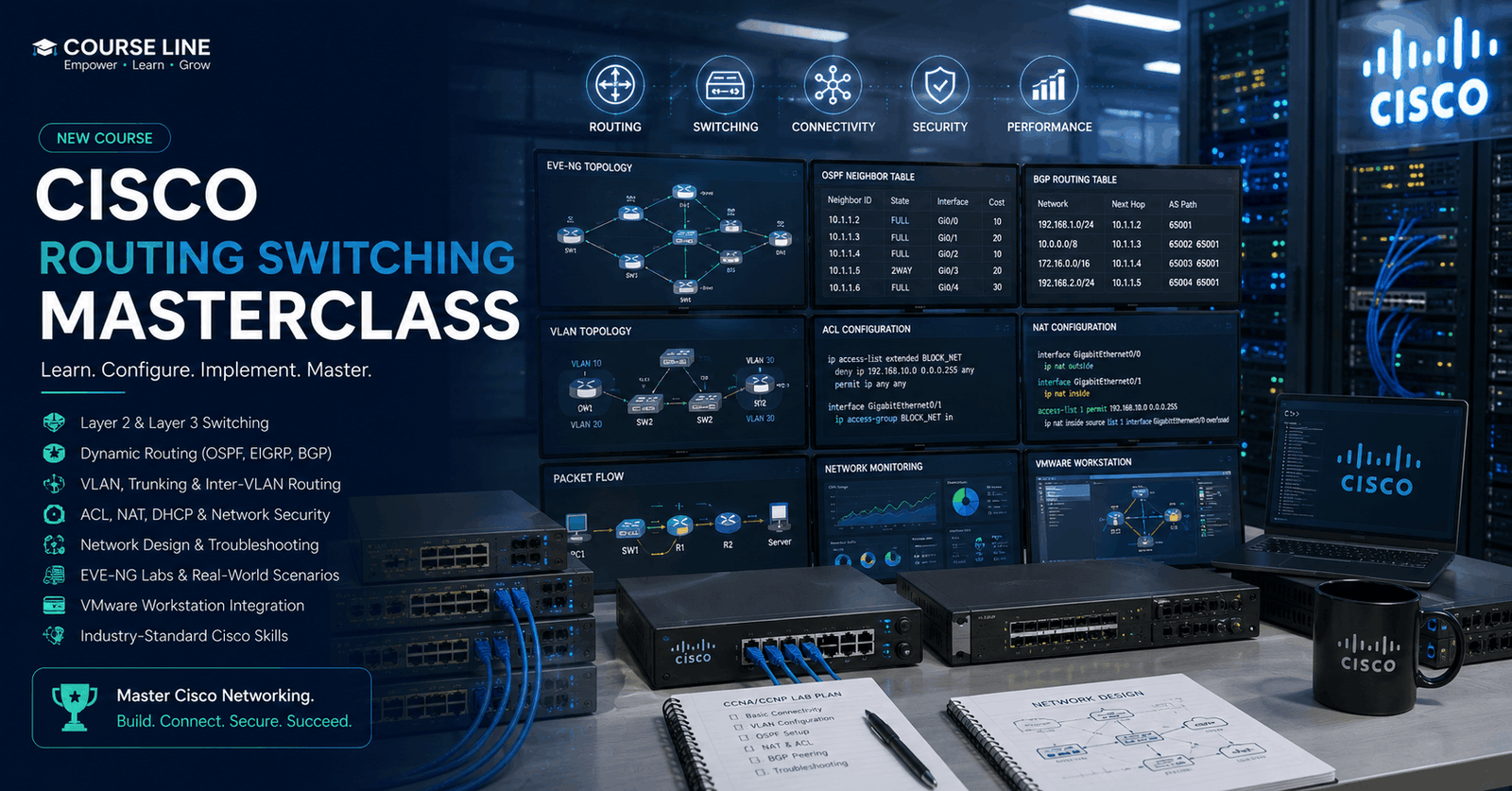
Cisco Routing Switching is a comprehensive networking course designed to help learners develop practical skills in configuring, managing, and troubleshooting enterprise networks. Covering concepts commonly associated with CCNA- and CCNP-level studies, this training combines theoretical knowledge with extensive hands-on demonstrations, enabling you to build confidence in real networking environments.
The course begins by establishing a solid understanding of routing fundamentals before progressing to advanced networking concepts. You will learn how data moves across networks, how routers and switches operate, and how routing decisions are made. Practical lab setup guidance using VMware Workstation and EVE-NG allows you to create your own virtual networking environment for safe experimentation and continuous practice.
As your knowledge grows, you'll explore static and dynamic routing, including detailed coverage of OSPF, route verification, troubleshooting techniques, and advanced topics such as LSA types, area design, virtual links, authentication, and route summarisation. The course also introduces Border Gateway Protocol (BGP), helping you understand autonomous systems, eBGP, iBGP, neighbour relationships, and route advertisement within enterprise networks.
Beyond routing, you'll strengthen your switching expertise by learning VLAN implementation, trunking, inter-VLAN routing, Switch Virtual Interfaces (SVIs), port security, Spanning Tree Protocol (STP), EtherChannel configuration, and Layer 2 network optimisation. Additional modules cover Access Control Lists (ACLs), Network Address Translation (NAT), and Port Address Translation (PAT), giving you practical security and connectivity skills widely used in production environments.
Every lesson focuses on real-world implementation rather than memorisation, allowing you to practise configurations, verify results, and troubleshoot common networking issues. This practical approach helps prepare you for professional networking responsibilities, technical interviews, certification studies, and enterprise infrastructure projects.
Whether your goal is career advancement, certification preparation, or strengthening your networking foundation, this course provides valuable skills that can be applied across organisations of all sizes. By completing the hands-on exercises, you'll gain greater confidence in deploying and managing modern IP networks using industry-standard technologies.
Upon successful completion, you will receive a free course completion certificate. If you require additional credentials, multiple premium certificate and transcript options are available for purchase. Throughout your learning experience, you'll also benefit from 5-star rated customer support available 24/7 via email, ensuring expert assistance whenever you need it.This course is ideal for aspiring network engineers, IT support professionals, system administrators, cybersecurity learners, university students, and anyone preparing for networking certifications. It is also suitable for professionals seeking practical experience with enterprise routing, switching, and network troubleshooting using industry-standard technologies and virtual lab environments.
Who is this course for?
Cisco Routing Switching is a comprehensive networking course designed to help learners develop practical skills in configuring, managing, and troubleshooting enterprise networks. Covering concepts commonly associated with CCNA- and CCNP-level studies, this training combines theoretical knowledge with extensive hands-on demonstrations, enabling you to build confidence in real networking environments.
The course begins by establishing a solid understanding of routing fundamentals before progressing to advanced networking concepts. You will learn how data moves across networks, how routers and switches operate, and how routing decisions are made. Practical lab setup guidance using VMware Workstation and EVE-NG allows you to create your own virtual networking environment for safe experimentation and continuous practice.
As your knowledge grows, you'll explore static and dynamic routing, including detailed coverage of OSPF, route verification, troubleshooting techniques, and advanced topics such as LSA types, area design, virtual links, authentication, and route summarisation. The course also introduces Border Gateway Protocol (BGP), helping you understand autonomous systems, eBGP, iBGP, neighbour relationships, and route advertisement within enterprise networks.
Beyond routing, you'll strengthen your switching expertise by learning VLAN implementation, trunking, inter-VLAN routing, Switch Virtual Interfaces (SVIs), port security, Spanning Tree Protocol (STP), EtherChannel configuration, and Layer 2 network optimisation. Additional modules cover Access Control Lists (ACLs), Network Address Translation (NAT), and Port Address Translation (PAT), giving you practical security and connectivity skills widely used in production environments.
Every lesson focuses on real-world implementation rather than memorisation, allowing you to practise configurations, verify results, and troubleshoot common networking issues. This practical approach helps prepare you for professional networking responsibilities, technical interviews, certification studies, and enterprise infrastructure projects.
Whether your goal is career advancement, certification preparation, or strengthening your networking foundation, this course provides valuable skills that can be applied across organisations of all sizes. By completing the hands-on exercises, you'll gain greater confidence in deploying and managing modern IP networks using industry-standard technologies.
Upon successful completion, you will receive a free course completion certificate. If you require additional credentials, multiple premium certificate and transcript options are available for purchase. Throughout your learning experience, you'll also benefit from 5-star rated customer support available 24/7 via email, ensuring expert assistance whenever you need it.This course is ideal for aspiring network engineers, IT support professionals, system administrators, cybersecurity learners, university students, and anyone preparing for networking certifications. It is also suitable for professionals seeking practical experience with enterprise routing, switching, and network troubleshooting using industry-standard technologies and virtual lab environments.
Requirements
Cisco Routing Switching is a comprehensive networking course designed to help learners develop practical skills in configuring, managing, and troubleshooting enterprise networks. Covering concepts commonly associated with CCNA- and CCNP-level studies, this training combines theoretical knowledge with extensive hands-on demonstrations, enabling you to build confidence in real networking environments.
The course begins by establishing a solid understanding of routing fundamentals before progressing to advanced networking concepts. You will learn how data moves across networks, how routers and switches operate, and how routing decisions are made. Practical lab setup guidance using VMware Workstation and EVE-NG allows you to create your own virtual networking environment for safe experimentation and continuous practice.
As your knowledge grows, you'll explore static and dynamic routing, including detailed coverage of OSPF, route verification, troubleshooting techniques, and advanced topics such as LSA types, area design, virtual links, authentication, and route summarisation. The course also introduces Border Gateway Protocol (BGP), helping you understand autonomous systems, eBGP, iBGP, neighbour relationships, and route advertisement within enterprise networks.
Beyond routing, you'll strengthen your switching expertise by learning VLAN implementation, trunking, inter-VLAN routing, Switch Virtual Interfaces (SVIs), port security, Spanning Tree Protocol (STP), EtherChannel configuration, and Layer 2 network optimisation. Additional modules cover Access Control Lists (ACLs), Network Address Translation (NAT), and Port Address Translation (PAT), giving you practical security and connectivity skills widely used in production environments.
Every lesson focuses on real-world implementation rather than memorisation, allowing you to practise configurations, verify results, and troubleshoot common networking issues. This practical approach helps prepare you for professional networking responsibilities, technical interviews, certification studies, and enterprise infrastructure projects.
Whether your goal is career advancement, certification preparation, or strengthening your networking foundation, this course provides valuable skills that can be applied across organisations of all sizes. By completing the hands-on exercises, you'll gain greater confidence in deploying and managing modern IP networks using industry-standard technologies.
Upon successful completion, you will receive a free course completion certificate. If you require additional credentials, multiple premium certificate and transcript options are available for purchase. Throughout your learning experience, you'll also benefit from 5-star rated customer support available 24/7 via email, ensuring expert assistance whenever you need it.This course is ideal for aspiring network engineers, IT support professionals, system administrators, cybersecurity learners, university students, and anyone preparing for networking certifications. It is also suitable for professionals seeking practical experience with enterprise routing, switching, and network troubleshooting using industry-standard technologies and virtual lab environments.
Career path
Cisco Routing Switching is a comprehensive networking course designed to help learners develop practical skills in configuring, managing, and troubleshooting enterprise networks. Covering concepts commonly associated with CCNA- and CCNP-level studies, this training combines theoretical knowledge with extensive hands-on demonstrations, enabling you to build confidence in real networking environments.
The course begins by establishing a solid understanding of routing fundamentals before progressing to advanced networking concepts. You will learn how data moves across networks, how routers and switches operate, and how routing decisions are made. Practical lab setup guidance using VMware Workstation and EVE-NG allows you to create your own virtual networking environment for safe experimentation and continuous practice.
As your knowledge grows, you'll explore static and dynamic routing, including detailed coverage of OSPF, route verification, troubleshooting techniques, and advanced topics such as LSA types, area design, virtual links, authentication, and route summarisation. The course also introduces Border Gateway Protocol (BGP), helping you understand autonomous systems, eBGP, iBGP, neighbour relationships, and route advertisement within enterprise networks.
Beyond routing, you'll strengthen your switching expertise by learning VLAN implementation, trunking, inter-VLAN routing, Switch Virtual Interfaces (SVIs), port security, Spanning Tree Protocol (STP), EtherChannel configuration, and Layer 2 network optimisation. Additional modules cover Access Control Lists (ACLs), Network Address Translation (NAT), and Port Address Translation (PAT), giving you practical security and connectivity skills widely used in production environments.
Every lesson focuses on real-world implementation rather than memorisation, allowing you to practise configurations, verify results, and troubleshoot common networking issues. This practical approach helps prepare you for professional networking responsibilities, technical interviews, certification studies, and enterprise infrastructure projects.
Whether your goal is career advancement, certification preparation, or strengthening your networking foundation, this course provides valuable skills that can be applied across organisations of all sizes. By completing the hands-on exercises, you'll gain greater confidence in deploying and managing modern IP networks using industry-standard technologies.
Upon successful completion, you will receive a free course completion certificate. If you require additional credentials, multiple premium certificate and transcript options are available for purchase. Throughout your learning experience, you'll also benefit from 5-star rated customer support available 24/7 via email, ensuring expert assistance whenever you need it.This course is ideal for aspiring network engineers, IT support professionals, system administrators, cybersecurity learners, university students, and anyone preparing for networking certifications. It is also suitable for professionals seeking practical experience with enterprise routing, switching, and network troubleshooting using industry-standard technologies and virtual lab environments.
-
- Welcome and Course Overview 00:10:00
-
- Routing Overview 00:10:00
- Prefix and Prefix-Length Concepts 00:10:00
- Big Picture of Routing 00:10:00
- Switching Types on Routers 00:10:00
- Understanding Data Flow in Networks 00:10:00
- Installing VMware Workstation Pro 16 00:10:00
- Configuring VMware Workstation Adapters 00:10:00
- Installing EVE-NG on Windows 00:10:00
- Adding Cisco vIOS Images to EVE-NG 00:10:00
- Static Routing Overview 00:10:00
- Default Routing Overview 00:10:00
- Administrative Distance vs Metric and ECMP 00:10:00
- Floating Static Routes Explained 00:10:00
- Dynamic Routing Protocols Overview 00:10:00
- Introduction to Open Shortest Path First (OSPF) 00:10:00
- Key OSPF Concepts 00:10:00
- OSPF Neighborships and Adjacency 00:10:00
- OSPF Neighborship State Machine 00:10:00
- OSPF Roles: DR, BDR, and DRother 00:10:00
- DR and BDR Election Process 00:10:00
- Overview of LSA Types 00:10:00
- OSPF LSA Type 1 (Router LSA) 00:10:00
- OSPF LSA Type 2 (Network LSA) 00:10:00
- OSPF LSA Type 3 (Summary LSA) 00:10:00
- OSPF LSA Types 4 & 5 00:10:00
- Lab: LSA Types 1 & 2 00:10:00
- LSA on Point-to-Point Networks (Area 1) 00:10:00
- LSA in Area 0 (Type 3) Lab 00:10:00
- OSPF Configuration Lab (Area 2) 00:10:00
- LSA Lab: External Type 4 & 5 00:10:00
- OSPF External E1 vs E2 Routes Explained 00:10:00
- OSPF LSA Summarization Theory 00:10:00
- : LSA Summarization Lab 00:10:00
- Configuring OSPF Virtual Links 00:10:00
- Understanding Autonomous Systems 00:10:00
- Why BGP Is Needed 00:10:00
- Single-Homed vs Multi-Homed BGP 00:10:00
- BGP Overview 00:10:00
- eBGP (External BGP) Overview 00:10:00
- eBGP Neighborship Process 00:10:00
- TTL in BGP Explained 00:10:00
- iBGP (Internal BGP) Overview 00:10:00
- Basic BGP Topology 00:10:00
- eBGP Lab 00:10:00
- Advertising Routes in eBGP 00:10:00
- BGP Next Hop Self Feature 00:10:00
- iBGP Split-Horizon Rule & Full Mesh Requirements 00:10:00
- Overview of Inter-VLAN Routing 00:10:00
- Inter-VLAN Routing Lab with Separate Router Interfaces 00:10:00
- Inter-VLAN Routing Lab Using Router Sub-Interfaces 00:10:00
- Inter-VLAN Routing on Multilayer Switche 00:10:00
- Switch Virtual Interface (SVI) Lab 00:10:00
- Implementing Port Security on Switches 00:10:00
- EtherChannel Concepts Explained 00:10:00
- EtherChannel Lab 00:10:00
- NAT Overview 00:10:00
- NAT Lab Topology and Initial Configuration 00:10:00
- Dynamic NAT Concepts 00:10:00
- Dynamic NAT Lab Demonstration 00:10:00
- Dynamic PAT (Port Address Translation) 00:10:00
- Static NAT 00:10:00
- Premium Certificate 00:15:00

No Reviews found for this course.
Is this certificate recognized?
Yes, our premium certificate and transcript are widely recognized and accepted by embassies worldwide, particularly by the UK embassy. This adds credibility to your qualification and enhances its value for professional and academic purposes.
I am a beginner. Is this course suitable for me?
Yes, this course is designed for learners of all levels, including beginners. The content is structured to provide step-by-step guidance, ensuring that even those with no prior experience can follow along and gain valuable knowledge.
I am a professional. Is this course suitable for me?
Yes, professionals will also benefit from this course. It covers advanced concepts, practical applications, and industry insights that can help enhance existing skills and knowledge. Whether you are looking to refine your expertise or expand your qualifications, this course provides valuable learning.
Does this course have an expiry date?
No, you have lifetime access to the course. Once enrolled, you can revisit the materials at any time as long as the course remains available. Additionally, we regularly update our content to ensure it stays relevant and up to date.
How do I claim my free certificate?
I trust you’re in good health. Your free certificate can be located in the Achievement section. The option to purchase a CPD certificate is available but entirely optional, and you may choose to skip it. Please be aware that it’s crucial to click the “Complete” button to ensure the certificate is generated, as this process is entirely automated.
Does this course have assessments and assignments?
Yes, the course includes both assessments and assignments. Your final marks will be determined by a combination of 20% from assignments and 80% from assessments. These evaluations are designed to test your understanding and ensure you have grasped the key concepts effectively.
Is this course accredited?
We are a recognized course provider with CPD, UKRLP, and AOHT membership. The logos of these accreditation bodies will be featured on your premium certificate and transcript, ensuring credibility and professional recognition.
Will I receive a certificate upon completion?
Yes, you will receive a free digital certificate automatically once you complete the course. If you would like a premium CPD-accredited certificate, either in digital or physical format, you can upgrade for a small fee.
Course Features
Price
Study Method
Online | Self-paced
Course Format
Interactive PDFs, Articles & Learning Resources
Duration
19 hours, 25 minutes
Qualification
Professional Skills Development Course
Assessment
Final MCQ Exam (included in price)
Certificate
Verifiable Digital Certificate - Free
Additional info
Lifetime Access | Start Instantly
- Share

Food Technology Level 8 Advanced Diploma
Course Line239৳ 80,783.26Original price was: ৳ 80,783.26.৳ 2,471.31Current price is: ৳ 2,471.31.Biology Level 5 Advanced Diploma
Course Line242৳ 80,783.26Original price was: ৳ 80,783.26.৳ 2,471.31Current price is: ৳ 2,471.31.Dog Training Level 3 Advanced Diploma
Course Line239৳ 80,783.26Original price was: ৳ 80,783.26.৳ 2,471.31Current price is: ৳ 2,471.31.


Related Courses
PRINCE2 in Practice: Simulated Projects & Case Studies
৳ 80,783.26Original price was: ৳ 80,783.26.৳ 2,471.31Current price is: ৳ 2,471.31.237PRINCE2 for Beginners: An Introduction to Project Governance
৳ 80,783.26Original price was: ৳ 80,783.26.৳ 2,471.31Current price is: ৳ 2,471.31.237PRINCE2 Project Documentation: Templates & Best Practice
৳ 80,783.26Original price was: ৳ 80,783.26.৳ 2,471.31Current price is: ৳ 2,471.31.237


Related Courses
PRINCE2 in Practice: Simulated Projects & Case Studies
৳ 80,783.26Original price was: ৳ 80,783.26.৳ 2,471.31Current price is: ৳ 2,471.31.237PRINCE2 for Beginners: An Introduction to Project Governance
৳ 80,783.26Original price was: ৳ 80,783.26.৳ 2,471.31Current price is: ৳ 2,471.31.237PRINCE2 Project Documentation: Templates & Best Practice
৳ 80,783.26Original price was: ৳ 80,783.26.৳ 2,471.31Current price is: ৳ 2,471.31.237

