
Course Features
Price
Study Method
Online | Self-paced
Course Format
Interactive PDFs, Articles & Learning Resources
Duration
9 hours, 5 minutes
Qualification
Professional Skills Development Course
Assessment
Final MCQ Exam (included in price)
Certificate
Verifiable Digital Certificate - Free
Additional info
Lifetime Access | Start Instantly
- Share
Overview
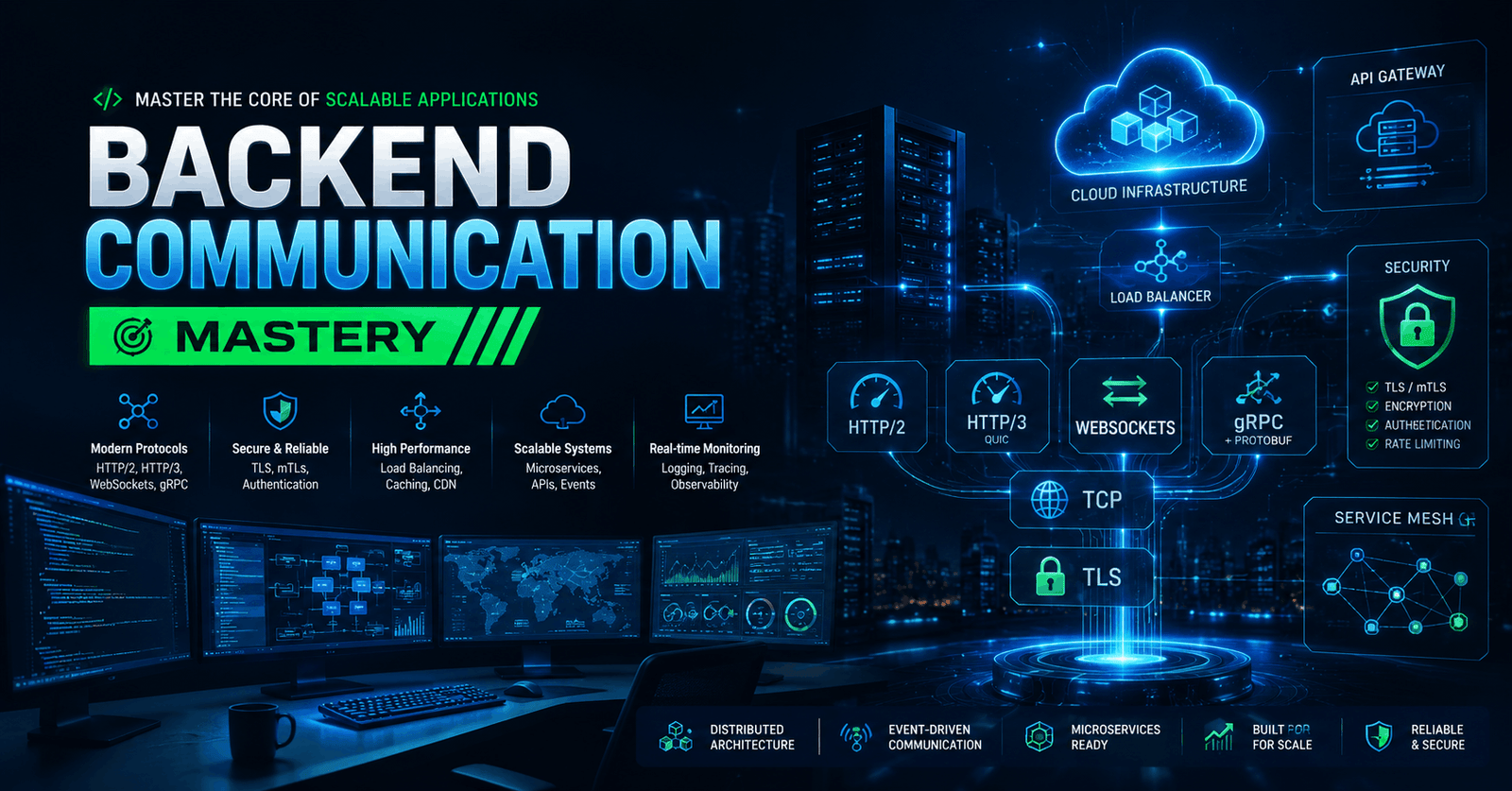
Backend Communication is a comprehensive software engineering course designed to help developers understand how modern backend systems exchange data, handle requests, maintain security, and achieve high performance. This training explores the essential concepts behind reliable communication between services, preparing learners to design and work with scalable backend architectures.
The course introduces the principles of backend communication design and explains how different communication patterns are used in real-world applications. You will explore request-response models, synchronous and asynchronous workloads, push communication, polling techniques, publish-subscribe systems, and stateful versus stateless approaches. These concepts provide a strong foundation for understanding how modern distributed applications operate.
You will also learn about important networking protocols and their role in backend development. The course covers core technologies such as IP, TCP, UDP, TLS, HTTP versions, WebSockets, gRPC, and WebRTC. By understanding how these protocols function, you will gain better insight into performance, reliability, and secure communication between applications and services.
A major focus of this training is practical system design. You will examine HTTPS communication methods, including different TLS versions, QUIC-based communication, and modern optimisation techniques. The course also introduces backend execution patterns, covering processes, threads, socket communication, connection handling, idempotency, and performance considerations that influence application behaviour.
In addition, you will explore proxying and load balancing concepts, including the differences between forward proxies, reverse proxies, and Layer 4 versus Layer 7 load balancers. These skills are valuable for developers working with scalable applications, cloud platforms, microservices, and distributed systems.
Designed for practical understanding, this course helps bridge the gap between theoretical networking concepts and real backend engineering challenges. Whether you are building APIs, designing services, improving application performance, or preparing for advanced software engineering roles, this training provides valuable knowledge for modern development environments.
By completing this course, you will develop a deeper understanding of how backend systems communicate and how engineering decisions impact scalability, security, and efficiency.
After successfully completing the course, you will receive a free course completion certificate to recognise your achievement. If you require additional credentials, multiple premium certificate and transcript options are also available for purchase. Throughout your learning journey, you will have access to 5-star rated customer support available 24/7 via email, ensuring reliable assistance whenever you need it.Who is this course for?
Backend Communication is a comprehensive software engineering course designed to help developers understand how modern backend systems exchange data, handle requests, maintain security, and achieve high performance. This training explores the essential concepts behind reliable communication between services, preparing learners to design and work with scalable backend architectures.
The course introduces the principles of backend communication design and explains how different communication patterns are used in real-world applications. You will explore request-response models, synchronous and asynchronous workloads, push communication, polling techniques, publish-subscribe systems, and stateful versus stateless approaches. These concepts provide a strong foundation for understanding how modern distributed applications operate.
You will also learn about important networking protocols and their role in backend development. The course covers core technologies such as IP, TCP, UDP, TLS, HTTP versions, WebSockets, gRPC, and WebRTC. By understanding how these protocols function, you will gain better insight into performance, reliability, and secure communication between applications and services.
A major focus of this training is practical system design. You will examine HTTPS communication methods, including different TLS versions, QUIC-based communication, and modern optimisation techniques. The course also introduces backend execution patterns, covering processes, threads, socket communication, connection handling, idempotency, and performance considerations that influence application behaviour.
In addition, you will explore proxying and load balancing concepts, including the differences between forward proxies, reverse proxies, and Layer 4 versus Layer 7 load balancers. These skills are valuable for developers working with scalable applications, cloud platforms, microservices, and distributed systems.
Designed for practical understanding, this course helps bridge the gap between theoretical networking concepts and real backend engineering challenges. Whether you are building APIs, designing services, improving application performance, or preparing for advanced software engineering roles, this training provides valuable knowledge for modern development environments.
By completing this course, you will develop a deeper understanding of how backend systems communicate and how engineering decisions impact scalability, security, and efficiency.
After successfully completing the course, you will receive a free course completion certificate to recognise your achievement. If you require additional credentials, multiple premium certificate and transcript options are also available for purchase. Throughout your learning journey, you will have access to 5-star rated customer support available 24/7 via email, ensuring reliable assistance whenever you need it.Requirements
Backend Communication is a comprehensive software engineering course designed to help developers understand how modern backend systems exchange data, handle requests, maintain security, and achieve high performance. This training explores the essential concepts behind reliable communication between services, preparing learners to design and work with scalable backend architectures.
The course introduces the principles of backend communication design and explains how different communication patterns are used in real-world applications. You will explore request-response models, synchronous and asynchronous workloads, push communication, polling techniques, publish-subscribe systems, and stateful versus stateless approaches. These concepts provide a strong foundation for understanding how modern distributed applications operate.
You will also learn about important networking protocols and their role in backend development. The course covers core technologies such as IP, TCP, UDP, TLS, HTTP versions, WebSockets, gRPC, and WebRTC. By understanding how these protocols function, you will gain better insight into performance, reliability, and secure communication between applications and services.
A major focus of this training is practical system design. You will examine HTTPS communication methods, including different TLS versions, QUIC-based communication, and modern optimisation techniques. The course also introduces backend execution patterns, covering processes, threads, socket communication, connection handling, idempotency, and performance considerations that influence application behaviour.
In addition, you will explore proxying and load balancing concepts, including the differences between forward proxies, reverse proxies, and Layer 4 versus Layer 7 load balancers. These skills are valuable for developers working with scalable applications, cloud platforms, microservices, and distributed systems.
Designed for practical understanding, this course helps bridge the gap between theoretical networking concepts and real backend engineering challenges. Whether you are building APIs, designing services, improving application performance, or preparing for advanced software engineering roles, this training provides valuable knowledge for modern development environments.
By completing this course, you will develop a deeper understanding of how backend systems communicate and how engineering decisions impact scalability, security, and efficiency.
After successfully completing the course, you will receive a free course completion certificate to recognise your achievement. If you require additional credentials, multiple premium certificate and transcript options are also available for purchase. Throughout your learning journey, you will have access to 5-star rated customer support available 24/7 via email, ensuring reliable assistance whenever you need it.Career path
Backend Communication is a comprehensive software engineering course designed to help developers understand how modern backend systems exchange data, handle requests, maintain security, and achieve high performance. This training explores the essential concepts behind reliable communication between services, preparing learners to design and work with scalable backend architectures.
The course introduces the principles of backend communication design and explains how different communication patterns are used in real-world applications. You will explore request-response models, synchronous and asynchronous workloads, push communication, polling techniques, publish-subscribe systems, and stateful versus stateless approaches. These concepts provide a strong foundation for understanding how modern distributed applications operate.
You will also learn about important networking protocols and their role in backend development. The course covers core technologies such as IP, TCP, UDP, TLS, HTTP versions, WebSockets, gRPC, and WebRTC. By understanding how these protocols function, you will gain better insight into performance, reliability, and secure communication between applications and services.
A major focus of this training is practical system design. You will examine HTTPS communication methods, including different TLS versions, QUIC-based communication, and modern optimisation techniques. The course also introduces backend execution patterns, covering processes, threads, socket communication, connection handling, idempotency, and performance considerations that influence application behaviour.
In addition, you will explore proxying and load balancing concepts, including the differences between forward proxies, reverse proxies, and Layer 4 versus Layer 7 load balancers. These skills are valuable for developers working with scalable applications, cloud platforms, microservices, and distributed systems.
Designed for practical understanding, this course helps bridge the gap between theoretical networking concepts and real backend engineering challenges. Whether you are building APIs, designing services, improving application performance, or preparing for advanced software engineering roles, this training provides valuable knowledge for modern development environments.
By completing this course, you will develop a deeper understanding of how backend systems communicate and how engineering decisions impact scalability, security, and efficiency.
After successfully completing the course, you will receive a free course completion certificate to recognise your achievement. If you require additional credentials, multiple premium certificate and transcript options are also available for purchase. Throughout your learning journey, you will have access to 5-star rated customer support available 24/7 via email, ensuring reliable assistance whenever you need it.-
- Welcome 00:10:00
- Who This Course Is For 00:10:00
- Course Overview 00:10:00
-
- Introduction to Design Patterns 00:10:00
- Request–Response Pattern 00:10:00
- Synchronous vs Asynchronous Workloads 00:10:00
- Push Communication 00:10:00
- Polling 00:10:00
- Long Polling 00:10:00
- Server-Sent Events 00:10:00
- Publish–Subscribe (Pub/Sub) 00:10:00
- Multiplexing vs Demultiplexing (HTTP/2 Proxying) 00:10:00
- Stateful vs Stateless Patterns 00:10:00
- Sidecar Pattern 00:10:00
- Introduction to Protocols 00:10:00
- Key Protocol Properties 00:10:00
- OSI Model Overview 00:10:00
- Internet Protocol (IP) 00:10:00
- User Datagram Protocol (UDP) 00:10:00
- Transmission Control Protocol (TCP) 00:10:00
- Transport Layer Security (TLS) 00:10:00
- HTTP/1.1 00:10:00
- WebSockets 00:10:00
- HTTP/2 00:10:00
- HTTP/3 00:10:00
- gRPC 00:10:00
- WebRTC 00:10:00
- Introduction to Execution Patterns 00:10:00
- Processes vs Threads (CPU Competition) 00:10:00
- How the Backend Accepts Connections 00:10:00
- Reading and Sending Socket Data 00:10:00
- Listener, Acceptor and Reader Roles 00:10:00
- Single Listener/Acceptor/Reader Thread Pattern 00:10:00
- Single Listener/Acceptor with Multiple Reader Threads 00:10:00
- Single Listener/Acceptor/Reader with Message Load 00:10:00
- Multiple Acceptor Threads on a Single Socket 00:10:00
- Multiple Listeners/Acceptors/Readers with Socket 00:10:00
- Backend Idempotency 00:10:00
- Nagle’s Algorithm 00:10:00
- Premium Certificate 00:15:00

No Reviews found for this course.
Is this certificate recognized?
Yes, our premium certificate and transcript are widely recognized and accepted by embassies worldwide, particularly by the UK embassy. This adds credibility to your qualification and enhances its value for professional and academic purposes.
I am a beginner. Is this course suitable for me?
Yes, this course is designed for learners of all levels, including beginners. The content is structured to provide step-by-step guidance, ensuring that even those with no prior experience can follow along and gain valuable knowledge.
I am a professional. Is this course suitable for me?
Yes, professionals will also benefit from this course. It covers advanced concepts, practical applications, and industry insights that can help enhance existing skills and knowledge. Whether you are looking to refine your expertise or expand your qualifications, this course provides valuable learning.
Does this course have an expiry date?
No, you have lifetime access to the course. Once enrolled, you can revisit the materials at any time as long as the course remains available. Additionally, we regularly update our content to ensure it stays relevant and up to date.
How do I claim my free certificate?
I trust you’re in good health. Your free certificate can be located in the Achievement section. The option to purchase a CPD certificate is available but entirely optional, and you may choose to skip it. Please be aware that it’s crucial to click the “Complete” button to ensure the certificate is generated, as this process is entirely automated.
Does this course have assessments and assignments?
Yes, the course includes both assessments and assignments. Your final marks will be determined by a combination of 20% from assignments and 80% from assessments. These evaluations are designed to test your understanding and ensure you have grasped the key concepts effectively.
Is this course accredited?
We are a recognized course provider with CPD, UKRLP, and AOHT membership. The logos of these accreditation bodies will be featured on your premium certificate and transcript, ensuring credibility and professional recognition.
Will I receive a certificate upon completion?
Yes, you will receive a free digital certificate automatically once you complete the course. If you would like a premium CPD-accredited certificate, either in digital or physical format, you can upgrade for a small fee.
Course Features
Price
Study Method
Online | Self-paced
Course Format
Interactive PDFs, Articles & Learning Resources
Duration
9 hours, 5 minutes
Qualification
Professional Skills Development Course
Assessment
Final MCQ Exam (included in price)
Certificate
Verifiable Digital Certificate - Free
Additional info
Lifetime Access | Start Instantly
- Share

Dietitian Level 3 Advanced Diploma
Course Line237£490.00Original price was: £490.00.£14.99Current price is: £14.99.Cybersecurity Fundamentals in 90 Minutes: Protect Your Systems, Networks & Data
Course Line237£490.00Original price was: £490.00.£14.99Current price is: £14.99.Mastering macOS: A Comprehensive Guide for Beginners
Course Line237£490.00Original price was: £490.00.£14.99Current price is: £14.99.



Related Courses
PRINCE2 in Practice: Simulated Projects & Case Studies
£490.00Original price was: £490.00.£14.99Current price is: £14.99.237PRINCE2 for Beginners: An Introduction to Project Governance
£490.00Original price was: £490.00.£14.99Current price is: £14.99.237PRINCE2 Project Documentation: Templates & Best Practice
£490.00Original price was: £490.00.£14.99Current price is: £14.99.237




Related Courses
PRINCE2 in Practice: Simulated Projects & Case Studies
£490.00Original price was: £490.00.£14.99Current price is: £14.99.237PRINCE2 for Beginners: An Introduction to Project Governance
£490.00Original price was: £490.00.£14.99Current price is: £14.99.237PRINCE2 Project Documentation: Templates & Best Practice
£490.00Original price was: £490.00.£14.99Current price is: £14.99.237

