
Course Features
Price
Study Method
Online | Self-paced
Course Format
Interactive PDFs, Articles & Learning Resources
Duration
8 hours, 35 minutes
Qualification
Professional Skills Development Course
Assessment
Final MCQ Exam (included in price)
Certificate
Verifiable Digital Certificate - Free
Additional info
Lifetime Access | Start Instantly
- Share
Overview
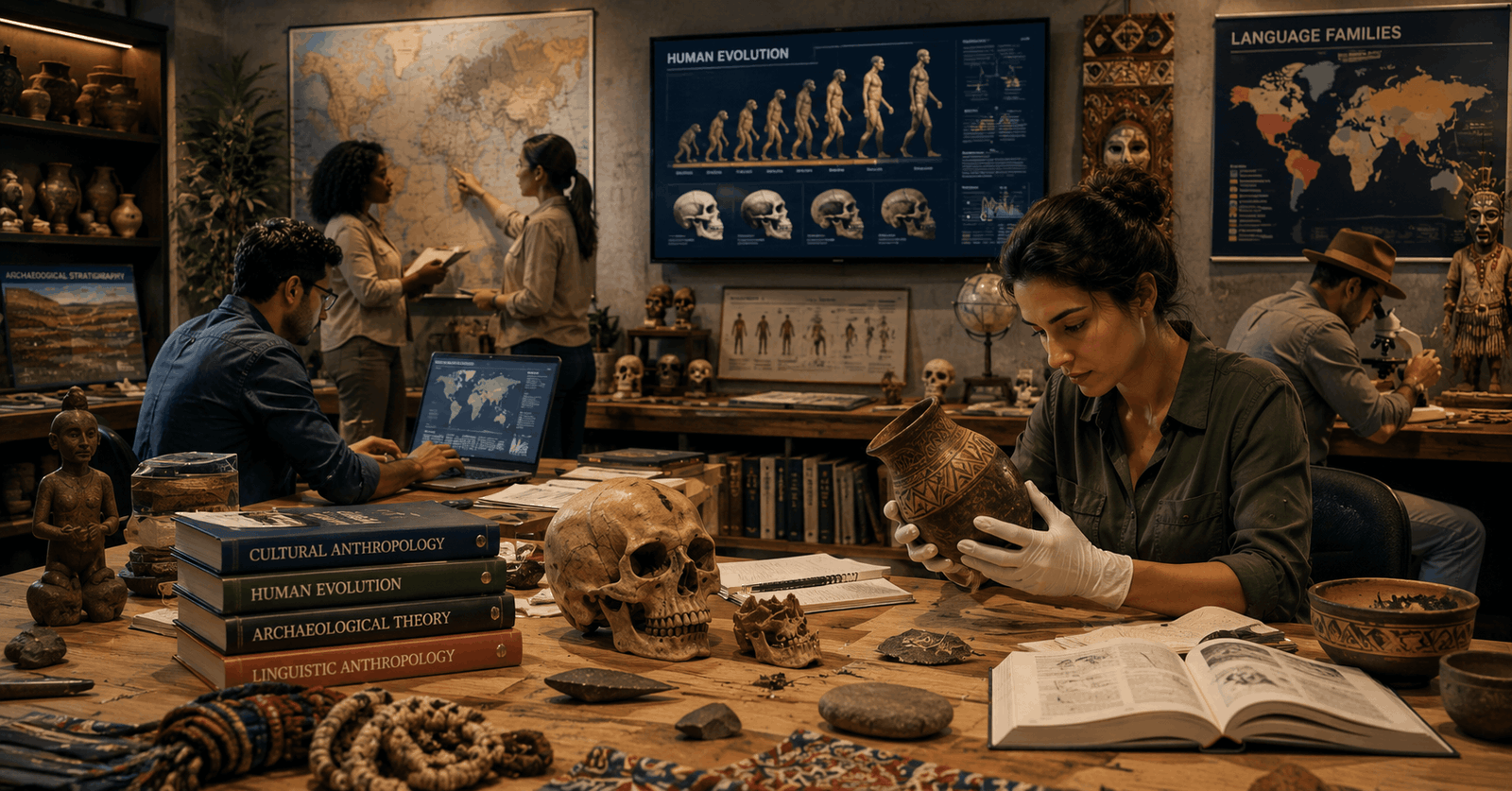
Anthropology Diploma is an advanced online learning programme designed to explore human societies, cultures, languages, behaviours, and biological development through a multidisciplinary anthropological perspective. This course provides learners with a strong understanding of how anthropology helps explain the diversity of human life, social structures, historical development, and cultural interaction across different societies and time periods.
The programme introduces learners to major anthropological disciplines, including cultural anthropology, biological anthropology, archaeology, and linguistic anthropology. Students will examine how human societies evolve, how cultures shape identity and communication, and how historical discoveries contribute to our understanding of civilisation and social change. The course also explores modern anthropological debates surrounding ethics, representation, gender, globalization, sustainability, and postcolonial perspectives.
Learners will gain valuable research and analytical skills through the study of ethnographic methods, participant observation, qualitative and quantitative research techniques, and anthropological data interpretation. The course encourages critical thinking while helping students understand how anthropology applies to contemporary issues such as public health, environmental sustainability, social policy, forensic investigations, and multicultural communication.
Special attention is given to real-world applications of anthropology in professional environments, including medical anthropology, business anthropology, public policy, and environmental studies. Through case studies and practical examples, learners will develop a broader understanding of human behaviour, cultural diversity, and social systems in global contexts.
Delivered through a flexible online learning format, the course allows students to study independently while building advanced academic and professional knowledge. The curriculum is structured to support learners interested in research, education, social sciences, cultural studies, and international development-related careers.
Learners will receive a free course completion certificate after successfully completing the programme. Multiple premium certificate and transcript options are also available for purchase for those wishing to enhance their academic or professional portfolio. Students also benefit from 5-star rated support available 24/7 through dedicated email assistance.
Who is this course for?
Anthropology Diploma is an advanced online learning programme designed to explore human societies, cultures, languages, behaviours, and biological development through a multidisciplinary anthropological perspective. This course provides learners with a strong understanding of how anthropology helps explain the diversity of human life, social structures, historical development, and cultural interaction across different societies and time periods.
The programme introduces learners to major anthropological disciplines, including cultural anthropology, biological anthropology, archaeology, and linguistic anthropology. Students will examine how human societies evolve, how cultures shape identity and communication, and how historical discoveries contribute to our understanding of civilisation and social change. The course also explores modern anthropological debates surrounding ethics, representation, gender, globalization, sustainability, and postcolonial perspectives.
Learners will gain valuable research and analytical skills through the study of ethnographic methods, participant observation, qualitative and quantitative research techniques, and anthropological data interpretation. The course encourages critical thinking while helping students understand how anthropology applies to contemporary issues such as public health, environmental sustainability, social policy, forensic investigations, and multicultural communication.
Special attention is given to real-world applications of anthropology in professional environments, including medical anthropology, business anthropology, public policy, and environmental studies. Through case studies and practical examples, learners will develop a broader understanding of human behaviour, cultural diversity, and social systems in global contexts.
Delivered through a flexible online learning format, the course allows students to study independently while building advanced academic and professional knowledge. The curriculum is structured to support learners interested in research, education, social sciences, cultural studies, and international development-related careers.
Learners will receive a free course completion certificate after successfully completing the programme. Multiple premium certificate and transcript options are also available for purchase for those wishing to enhance their academic or professional portfolio. Students also benefit from 5-star rated support available 24/7 through dedicated email assistance.
Requirements
Anthropology Diploma is an advanced online learning programme designed to explore human societies, cultures, languages, behaviours, and biological development through a multidisciplinary anthropological perspective. This course provides learners with a strong understanding of how anthropology helps explain the diversity of human life, social structures, historical development, and cultural interaction across different societies and time periods.
The programme introduces learners to major anthropological disciplines, including cultural anthropology, biological anthropology, archaeology, and linguistic anthropology. Students will examine how human societies evolve, how cultures shape identity and communication, and how historical discoveries contribute to our understanding of civilisation and social change. The course also explores modern anthropological debates surrounding ethics, representation, gender, globalization, sustainability, and postcolonial perspectives.
Learners will gain valuable research and analytical skills through the study of ethnographic methods, participant observation, qualitative and quantitative research techniques, and anthropological data interpretation. The course encourages critical thinking while helping students understand how anthropology applies to contemporary issues such as public health, environmental sustainability, social policy, forensic investigations, and multicultural communication.
Special attention is given to real-world applications of anthropology in professional environments, including medical anthropology, business anthropology, public policy, and environmental studies. Through case studies and practical examples, learners will develop a broader understanding of human behaviour, cultural diversity, and social systems in global contexts.
Delivered through a flexible online learning format, the course allows students to study independently while building advanced academic and professional knowledge. The curriculum is structured to support learners interested in research, education, social sciences, cultural studies, and international development-related careers.
Learners will receive a free course completion certificate after successfully completing the programme. Multiple premium certificate and transcript options are also available for purchase for those wishing to enhance their academic or professional portfolio. Students also benefit from 5-star rated support available 24/7 through dedicated email assistance.
Career path
Anthropology Diploma is an advanced online learning programme designed to explore human societies, cultures, languages, behaviours, and biological development through a multidisciplinary anthropological perspective. This course provides learners with a strong understanding of how anthropology helps explain the diversity of human life, social structures, historical development, and cultural interaction across different societies and time periods.
The programme introduces learners to major anthropological disciplines, including cultural anthropology, biological anthropology, archaeology, and linguistic anthropology. Students will examine how human societies evolve, how cultures shape identity and communication, and how historical discoveries contribute to our understanding of civilisation and social change. The course also explores modern anthropological debates surrounding ethics, representation, gender, globalization, sustainability, and postcolonial perspectives.
Learners will gain valuable research and analytical skills through the study of ethnographic methods, participant observation, qualitative and quantitative research techniques, and anthropological data interpretation. The course encourages critical thinking while helping students understand how anthropology applies to contemporary issues such as public health, environmental sustainability, social policy, forensic investigations, and multicultural communication.
Special attention is given to real-world applications of anthropology in professional environments, including medical anthropology, business anthropology, public policy, and environmental studies. Through case studies and practical examples, learners will develop a broader understanding of human behaviour, cultural diversity, and social systems in global contexts.
Delivered through a flexible online learning format, the course allows students to study independently while building advanced academic and professional knowledge. The curriculum is structured to support learners interested in research, education, social sciences, cultural studies, and international development-related careers.
Learners will receive a free course completion certificate after successfully completing the programme. Multiple premium certificate and transcript options are also available for purchase for those wishing to enhance their academic or professional portfolio. Students also benefit from 5-star rated support available 24/7 through dedicated email assistance.
-
- Overview of Anthropology: Key Concepts and Scope 00:10:00
- Subfields of Anthropology: Cultural, Biological, Linguistic 00:10:00
- History and Development of Anthropological Thought 00:10:00
- Ethics in Anthropological Research 00:10:00
- Anthropology in Contemporary Society 00:10:00
-
- Defining Culture and Society 00:10:00
- Social Institutions: Family, Religion, and Economy 00:10:00
- Rituals, Beliefs, and Worldviews 00:10:00
- Globalization and Cultural Change 00:10:00
- Identity, Race, and Ethnicity 00:10:00
- Human Evolution and Primate Behavior 00:10:00
- The Fossil Record and Human Ancestry 00:10:00
- Human Adaptation and Variation 00:10:00
- Evolutionary Theories in Anthropology 00:10:00
- Modern Human Genetics and Anthropology 00:10:00
- Language and Communication: An Overview 00:10:00
- Language, Culture, and Thought (Sapir-Whorf Hypothesis) 00:10:00
- Language Change and Language Death 00:10:00
- Linguistic Identity and Power 00:10:00
- Sociolinguistics and Multilingualism 00:10:00
- Anthropology in Public Policy and Development 00:10:00
- Medical Anthropology and Health Systems 00:10:00
- Business and Corporate Anthropology 00:10:00
- Forensic Anthropology: Techniques and Cases 00:10:00
- Environmental Anthropology and Sustainability 00:10:00
- Ethical Dilemmas in Fieldwork 00:10:00
- Cultural Sensitivity and Ethical Guidelines 00:10:00
- Representation and Bias in Anthropological Research 00:10:00
- Working with Indigenous Communities 00:10:00
- Navigating Political and Social Challenges in Anthropology 00:10:00
- Premium Certificate 00:15:00

No Reviews found for this course.
Is this certificate recognized?
Yes, our premium certificate and transcript are widely recognized and accepted by embassies worldwide, particularly by the UK embassy. This adds credibility to your qualification and enhances its value for professional and academic purposes.
I am a beginner. Is this course suitable for me?
Yes, this course is designed for learners of all levels, including beginners. The content is structured to provide step-by-step guidance, ensuring that even those with no prior experience can follow along and gain valuable knowledge.
I am a professional. Is this course suitable for me?
Yes, professionals will also benefit from this course. It covers advanced concepts, practical applications, and industry insights that can help enhance existing skills and knowledge. Whether you are looking to refine your expertise or expand your qualifications, this course provides valuable learning.
Does this course have an expiry date?
No, you have lifetime access to the course. Once enrolled, you can revisit the materials at any time as long as the course remains available. Additionally, we regularly update our content to ensure it stays relevant and up to date.
How do I claim my free certificate?
I trust you’re in good health. Your free certificate can be located in the Achievement section. The option to purchase a CPD certificate is available but entirely optional, and you may choose to skip it. Please be aware that it’s crucial to click the “Complete” button to ensure the certificate is generated, as this process is entirely automated.
Does this course have assessments and assignments?
Yes, the course includes both assessments and assignments. Your final marks will be determined by a combination of 20% from assignments and 80% from assessments. These evaluations are designed to test your understanding and ensure you have grasped the key concepts effectively.
Is this course accredited?
We are a recognized course provider with CPD, UKRLP, and AOHT membership. The logos of these accreditation bodies will be featured on your premium certificate and transcript, ensuring credibility and professional recognition.
Will I receive a certificate upon completion?
Yes, you will receive a free digital certificate automatically once you complete the course. If you would like a premium CPD-accredited certificate, either in digital or physical format, you can upgrade for a small fee.
Course Features
Price
Study Method
Online | Self-paced
Course Format
Interactive PDFs, Articles & Learning Resources
Duration
8 hours, 35 minutes
Qualification
Professional Skills Development Course
Assessment
Final MCQ Exam (included in price)
Certificate
Verifiable Digital Certificate - Free
Additional info
Lifetime Access | Start Instantly
- Share

QCF Level 3 Diploma in Leadership for Children and Young People’s Services
Course Line237د.إ2,375.85Original price was: د.إ2,375.85.د.إ72.68Current price is: د.إ72.68.NEBOSH: Control of Substances Hazardous to Health (COSHH) Awareness
Course Line237د.إ2,375.85Original price was: د.إ2,375.85.د.إ72.68Current price is: د.إ72.68.Mastering Image Segmentation with PyTorch: From Fundamentals to Advanced Implementation
Course Line237د.إ2,375.85Original price was: د.إ2,375.85.د.إ72.68Current price is: د.إ72.68.



Related Courses
Level 5 Youth Development Officer Course in Football
د.إ2,375.85Original price was: د.إ2,375.85.د.إ72.68Current price is: د.إ72.68.238Level 4 Youth Development Officer Course in Football
د.إ2,375.85Original price was: د.إ2,375.85.د.إ72.68Current price is: د.إ72.68.237Level 3 Youth Development Officer Course in Football
د.إ2,375.85Original price was: د.إ2,375.85.د.إ72.68Current price is: د.إ72.68.237



Related Courses
Level 5 Youth Development Officer Course in Football
د.إ2,375.85Original price was: د.إ2,375.85.د.إ72.68Current price is: د.إ72.68.238Level 4 Youth Development Officer Course in Football
د.إ2,375.85Original price was: د.إ2,375.85.د.إ72.68Current price is: د.إ72.68.237Level 3 Youth Development Officer Course in Football
د.إ2,375.85Original price was: د.إ2,375.85.د.إ72.68Current price is: د.إ72.68.237

