
Course Features
Price
Study Method
Online | Self-paced
Course Format
Interactive PDFs, Articles & Learning Resources
Duration
8 hours, 55 minutes
Qualification
Professional Skills Development Course
Assessment
Final MCQ Exam (included in price)
Certificate
Verifiable Digital Certificate - Free
Additional info
Lifetime Access | Start Instantly
- Share
Overview
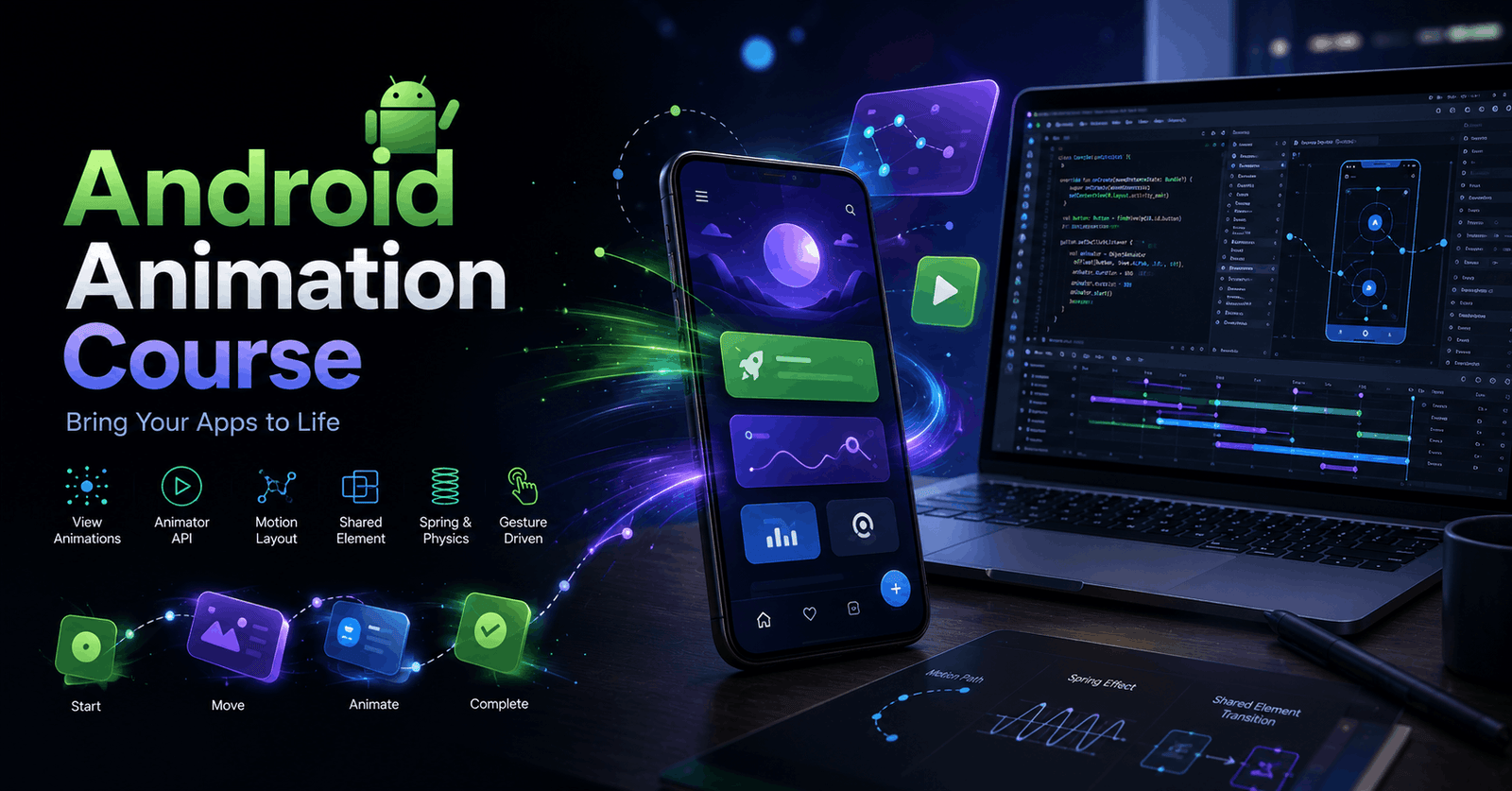
Android Animation Course provides a specialised learning experience for developers and aspiring mobile app creators who want to design smooth, engaging and professional Android user interfaces using Kotlin. This course focuses on helping learners understand how animation improves user experience, creates better interactions and brings mobile applications to life through modern motion techniques.
The course begins with the foundations of Android animation, explaining the purpose of animation in mobile applications and why Kotlin is an effective choice for creating interactive experiences. Learners explore different approaches to implementing animations, including View animations, programmatic animation techniques, XML-based animation resources and event handling through animation listeners.
As the course progresses, students develop deeper knowledge of Android’s animation frameworks. They learn how to work with the Animator API, create object animations, coordinate multiple animations and build reusable animation structures. The training also introduces Android transitions, allowing learners to create smooth UI changes, animated layouts and visually appealing screen movements using tools such as ConstraintLayout, ConstraintSet and placeholders.
The course expands into advanced transition techniques, covering complex effects such as explode, slide, transform and shared element transitions. Learners discover how to create seamless activity and fragment transitions that improve navigation and provide a more polished application experience.
Students also explore animated vector graphics, including creating SVG assets, importing graphics into Android Studio and building animated vector drawables. The course covers path animations, trim path effects and clip path techniques that help developers create customised visual elements.
A key section of the training focuses on physics-based animations and advanced UI motion. Learners gain practical knowledge of fling animations, spring animations and MotionLayout, enabling them to design realistic movement and complex interactive interfaces.
By completing this course, learners can strengthen their Android development abilities and create applications with professional-level animations and user experiences. These skills can support portfolio development, freelance projects, software engineering roles and further learning in mobile application development.
Upon successful completion, learners will receive a free course completion certificate. Multiple premium certificate and transcript options are also available for purchase if they wish to obtain additional documentation. Students also have access to 5-star-rated support available 24/7 through email, ensuring guidance throughout their learning journey.Who is this course for?
Android Animation Course provides a specialised learning experience for developers and aspiring mobile app creators who want to design smooth, engaging and professional Android user interfaces using Kotlin. This course focuses on helping learners understand how animation improves user experience, creates better interactions and brings mobile applications to life through modern motion techniques.
The course begins with the foundations of Android animation, explaining the purpose of animation in mobile applications and why Kotlin is an effective choice for creating interactive experiences. Learners explore different approaches to implementing animations, including View animations, programmatic animation techniques, XML-based animation resources and event handling through animation listeners.
As the course progresses, students develop deeper knowledge of Android’s animation frameworks. They learn how to work with the Animator API, create object animations, coordinate multiple animations and build reusable animation structures. The training also introduces Android transitions, allowing learners to create smooth UI changes, animated layouts and visually appealing screen movements using tools such as ConstraintLayout, ConstraintSet and placeholders.
The course expands into advanced transition techniques, covering complex effects such as explode, slide, transform and shared element transitions. Learners discover how to create seamless activity and fragment transitions that improve navigation and provide a more polished application experience.
Students also explore animated vector graphics, including creating SVG assets, importing graphics into Android Studio and building animated vector drawables. The course covers path animations, trim path effects and clip path techniques that help developers create customised visual elements.
A key section of the training focuses on physics-based animations and advanced UI motion. Learners gain practical knowledge of fling animations, spring animations and MotionLayout, enabling them to design realistic movement and complex interactive interfaces.
By completing this course, learners can strengthen their Android development abilities and create applications with professional-level animations and user experiences. These skills can support portfolio development, freelance projects, software engineering roles and further learning in mobile application development.
Upon successful completion, learners will receive a free course completion certificate. Multiple premium certificate and transcript options are also available for purchase if they wish to obtain additional documentation. Students also have access to 5-star-rated support available 24/7 through email, ensuring guidance throughout their learning journey.Requirements
Android Animation Course provides a specialised learning experience for developers and aspiring mobile app creators who want to design smooth, engaging and professional Android user interfaces using Kotlin. This course focuses on helping learners understand how animation improves user experience, creates better interactions and brings mobile applications to life through modern motion techniques.
The course begins with the foundations of Android animation, explaining the purpose of animation in mobile applications and why Kotlin is an effective choice for creating interactive experiences. Learners explore different approaches to implementing animations, including View animations, programmatic animation techniques, XML-based animation resources and event handling through animation listeners.
As the course progresses, students develop deeper knowledge of Android’s animation frameworks. They learn how to work with the Animator API, create object animations, coordinate multiple animations and build reusable animation structures. The training also introduces Android transitions, allowing learners to create smooth UI changes, animated layouts and visually appealing screen movements using tools such as ConstraintLayout, ConstraintSet and placeholders.
The course expands into advanced transition techniques, covering complex effects such as explode, slide, transform and shared element transitions. Learners discover how to create seamless activity and fragment transitions that improve navigation and provide a more polished application experience.
Students also explore animated vector graphics, including creating SVG assets, importing graphics into Android Studio and building animated vector drawables. The course covers path animations, trim path effects and clip path techniques that help developers create customised visual elements.
A key section of the training focuses on physics-based animations and advanced UI motion. Learners gain practical knowledge of fling animations, spring animations and MotionLayout, enabling them to design realistic movement and complex interactive interfaces.
By completing this course, learners can strengthen their Android development abilities and create applications with professional-level animations and user experiences. These skills can support portfolio development, freelance projects, software engineering roles and further learning in mobile application development.
Upon successful completion, learners will receive a free course completion certificate. Multiple premium certificate and transcript options are also available for purchase if they wish to obtain additional documentation. Students also have access to 5-star-rated support available 24/7 through email, ensuring guidance throughout their learning journey.Career path
Android Animation Course provides a specialised learning experience for developers and aspiring mobile app creators who want to design smooth, engaging and professional Android user interfaces using Kotlin. This course focuses on helping learners understand how animation improves user experience, creates better interactions and brings mobile applications to life through modern motion techniques.
The course begins with the foundations of Android animation, explaining the purpose of animation in mobile applications and why Kotlin is an effective choice for creating interactive experiences. Learners explore different approaches to implementing animations, including View animations, programmatic animation techniques, XML-based animation resources and event handling through animation listeners.
As the course progresses, students develop deeper knowledge of Android’s animation frameworks. They learn how to work with the Animator API, create object animations, coordinate multiple animations and build reusable animation structures. The training also introduces Android transitions, allowing learners to create smooth UI changes, animated layouts and visually appealing screen movements using tools such as ConstraintLayout, ConstraintSet and placeholders.
The course expands into advanced transition techniques, covering complex effects such as explode, slide, transform and shared element transitions. Learners discover how to create seamless activity and fragment transitions that improve navigation and provide a more polished application experience.
Students also explore animated vector graphics, including creating SVG assets, importing graphics into Android Studio and building animated vector drawables. The course covers path animations, trim path effects and clip path techniques that help developers create customised visual elements.
A key section of the training focuses on physics-based animations and advanced UI motion. Learners gain practical knowledge of fling animations, spring animations and MotionLayout, enabling them to design realistic movement and complex interactive interfaces.
By completing this course, learners can strengthen their Android development abilities and create applications with professional-level animations and user experiences. These skills can support portfolio development, freelance projects, software engineering roles and further learning in mobile application development.
Upon successful completion, learners will receive a free course completion certificate. Multiple premium certificate and transcript options are also available for purchase if they wish to obtain additional documentation. Students also have access to 5-star-rated support available 24/7 through email, ensuring guidance throughout their learning journey.-
- What is Animation? Understanding the Basics 00:10:00
- Why Animation Matters in Modern Apps 00:10:00
- Why Choose Kotlin for Android Animations? 00:10:00
- Course Roadmap: What You’ll Master 00:10:00
-
- Exploring View Animations in Android 00:10:00
- Creating Animations Programmatically in Kotlin 00:10:00
- Defining Animations with XML Resources 00:10:00
- Applying View Animations to Activities 00:10:00
- Using Animation Listeners for Event Handling 00:10:00
- Creating Frame-by-Frame Animations 00:10:00
- Designing Background Selectors with Animation 00:10:00
- Introduction to Animator API 00:10:00
- Understanding Different Types of Animators 00:10:00
- Creating Simple Object Animators 00:10:00
- Coordinating Multiple Animators Together 00:10:00
- Defining Animators via XML for Reusability 00:10:00
- Overview of Advanced Transitions 00:10:00
- Exploring the Advanced Transitions API 00:10:00
- Implementing Explode and Slide Transitions 00:10:00
- Creating Coordinated Slide Motions 00:10:00
- Using Transform Transitions for Complex Effects 00:10:00
- Mastering Shared Element Transitions 00:10:00
- Activity Content Transitions Explained 00:10:00
- Fragment Content Transitions 00:10:00
- Introduction to Physics-Based Animations 00:10:00
- Implementing Fling Animations 00:10:00
- Creating Spring Animations for Natural Motion 00:10:00
- Exam of The Ultimate Kotlin Android Animation Course: View, Transition, & Physics Animations 00:50:00

No Reviews found for this course.
Is this certificate recognized?
Yes, our premium certificate and transcript are widely recognized and accepted by embassies worldwide, particularly by the UK embassy. This adds credibility to your qualification and enhances its value for professional and academic purposes.
I am a beginner. Is this course suitable for me?
Yes, this course is designed for learners of all levels, including beginners. The content is structured to provide step-by-step guidance, ensuring that even those with no prior experience can follow along and gain valuable knowledge.
I am a professional. Is this course suitable for me?
Yes, professionals will also benefit from this course. It covers advanced concepts, practical applications, and industry insights that can help enhance existing skills and knowledge. Whether you are looking to refine your expertise or expand your qualifications, this course provides valuable learning.
Does this course have an expiry date?
No, you have lifetime access to the course. Once enrolled, you can revisit the materials at any time as long as the course remains available. Additionally, we regularly update our content to ensure it stays relevant and up to date.
How do I claim my free certificate?
I trust you’re in good health. Your free certificate can be located in the Achievement section. The option to purchase a CPD certificate is available but entirely optional, and you may choose to skip it. Please be aware that it’s crucial to click the “Complete” button to ensure the certificate is generated, as this process is entirely automated.
Does this course have assessments and assignments?
Yes, the course includes both assessments and assignments. Your final marks will be determined by a combination of 20% from assignments and 80% from assessments. These evaluations are designed to test your understanding and ensure you have grasped the key concepts effectively.
Is this course accredited?
We are a recognized course provider with CPD, UKRLP, and AOHT membership. The logos of these accreditation bodies will be featured on your premium certificate and transcript, ensuring credibility and professional recognition.
Will I receive a certificate upon completion?
Yes, you will receive a free digital certificate automatically once you complete the course. If you would like a premium CPD-accredited certificate, either in digital or physical format, you can upgrade for a small fee.
Course Features
Price
Study Method
Online | Self-paced
Course Format
Interactive PDFs, Articles & Learning Resources
Duration
8 hours, 55 minutes
Qualification
Professional Skills Development Course
Assessment
Final MCQ Exam (included in price)
Certificate
Verifiable Digital Certificate - Free
Additional info
Lifetime Access | Start Instantly
- Share

Child Sexual Abuse Awareness & Trauma-Informed Support (Professional Certificate)
Course Line237¥4,437.82Original price was: ¥4,437.82.¥135.76Current price is: ¥135.76.Certification in Reflexology for Chakra Healing: Integrative Energy and Reflex Point Therapy
Course Line237¥4,437.82Original price was: ¥4,437.82.¥135.76Current price is: ¥135.76.Travel and Tourism Level 3 Advanced Diploma
Course Line240¥4,437.82Original price was: ¥4,437.82.¥135.76Current price is: ¥135.76.



Related Courses
PRINCE2 in Practice: Simulated Projects & Case Studies
¥4,437.82Original price was: ¥4,437.82.¥135.76Current price is: ¥135.76.237PRINCE2 for Beginners: An Introduction to Project Governance
¥4,437.82Original price was: ¥4,437.82.¥135.76Current price is: ¥135.76.237PRINCE2 Project Documentation: Templates & Best Practice
¥4,437.82Original price was: ¥4,437.82.¥135.76Current price is: ¥135.76.237




Related Courses
PRINCE2 in Practice: Simulated Projects & Case Studies
¥4,437.82Original price was: ¥4,437.82.¥135.76Current price is: ¥135.76.237PRINCE2 for Beginners: An Introduction to Project Governance
¥4,437.82Original price was: ¥4,437.82.¥135.76Current price is: ¥135.76.237PRINCE2 Project Documentation: Templates & Best Practice
¥4,437.82Original price was: ¥4,437.82.¥135.76Current price is: ¥135.76.237

