
Course Features
Price
Study Method
Online | Self-paced
Course Format
Interactive PDFs, Articles & Learning Resources
Duration
9 hours, 25 minutes
Qualification
Professional Skills Development Course
Assessment
Final MCQ Exam (included in price)
Certificate
Verifiable Digital Certificate - Free
Additional info
Lifetime Access | Start Instantly
- Share
Overview
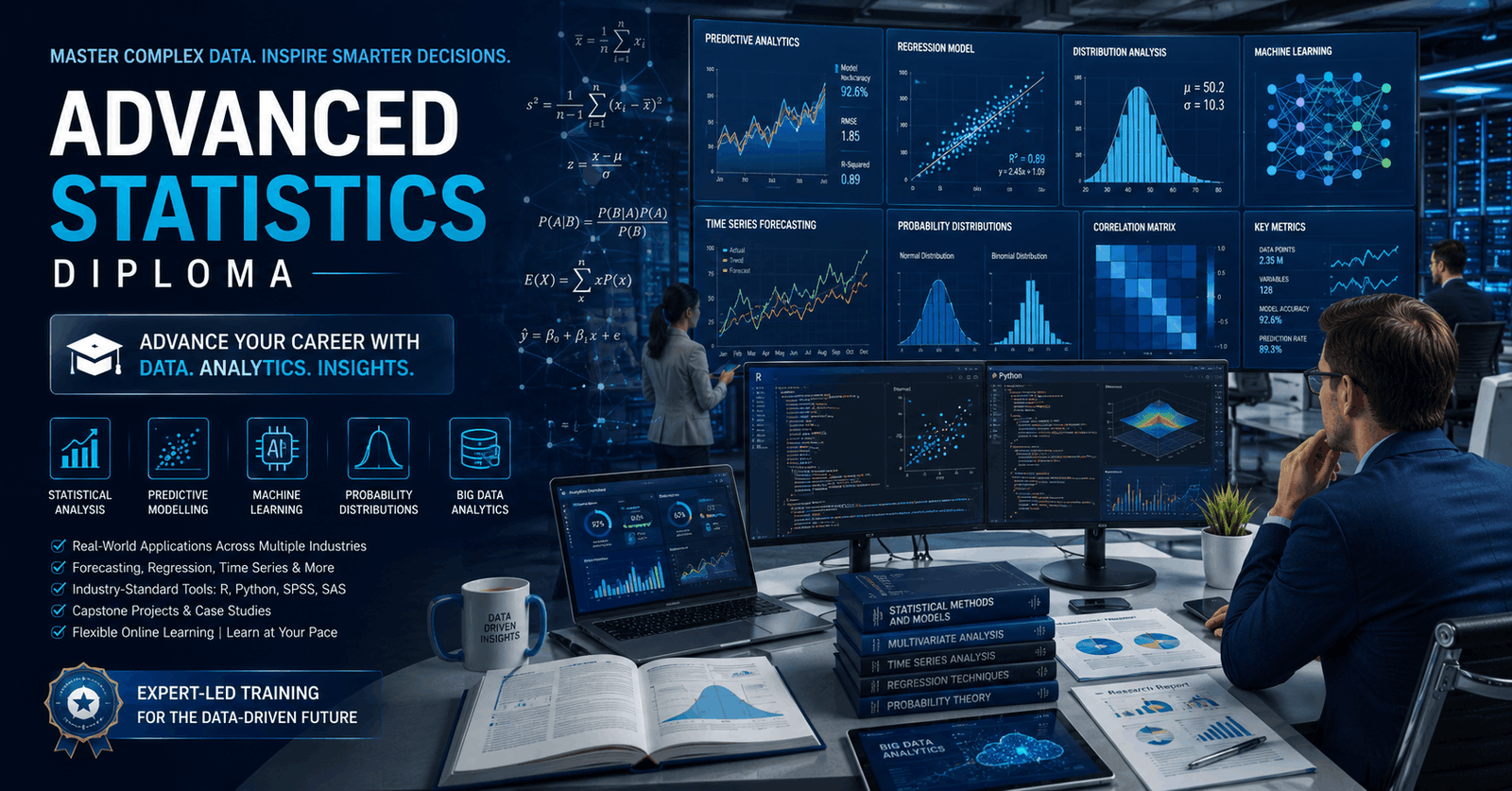
Advanced Statistics Diploma is designed for learners who want to develop high-level expertise in statistical analysis, predictive modelling, research methods, and modern data-driven decision-making. This advanced online programme provides comprehensive training in both foundational and sophisticated statistical techniques used across business, healthcare, finance, engineering, technology, and scientific research sectors.
The course introduces learners to the core principles of statistical analysis before progressing into advanced topics such as probability distributions, inferential statistics, regression analysis, multivariate techniques, time series forecasting, and machine learning applications within statistics. Students will also explore modern analytical approaches used for big data interpretation, predictive modelling, and research-based problem-solving in professional environments.
Throughout the programme, learners will strengthen their ability to analyse complex datasets, interpret statistical outcomes, evaluate research findings, and communicate insights effectively. The curriculum combines theoretical understanding with practical analytical applications to help students build confidence in using statistical tools and evidence-based reasoning within academic and professional settings.
In addition, learners will gain valuable exposure to modern data analytics technologies and statistical software commonly used in advanced research and business analysis. Topics including Bayesian statistics, cluster analysis, principal component analysis, forecasting techniques, and ethical considerations in data analytics help prepare students for the evolving demands of data-focused industries.
The flexible online learning format allows students to study at their own pace while balancing professional, academic, or personal commitments. Lessons are presented in a structured and accessible way to simplify complex concepts and support progressive skill development. By completing this diploma, learners can enhance their analytical thinking, quantitative reasoning, research interpretation, and decision-making capabilities that are highly valued in modern organisations.
Upon successful completion, learners will receive a free course completion certificate. Multiple premium certificate and transcript options are also available for purchase if desired. Students will additionally benefit from 5-star rated learner support available 24/7 through dedicated email assistance.
Who is this course for?
Advanced Statistics Diploma is designed for learners who want to develop high-level expertise in statistical analysis, predictive modelling, research methods, and modern data-driven decision-making. This advanced online programme provides comprehensive training in both foundational and sophisticated statistical techniques used across business, healthcare, finance, engineering, technology, and scientific research sectors.
The course introduces learners to the core principles of statistical analysis before progressing into advanced topics such as probability distributions, inferential statistics, regression analysis, multivariate techniques, time series forecasting, and machine learning applications within statistics. Students will also explore modern analytical approaches used for big data interpretation, predictive modelling, and research-based problem-solving in professional environments.
Throughout the programme, learners will strengthen their ability to analyse complex datasets, interpret statistical outcomes, evaluate research findings, and communicate insights effectively. The curriculum combines theoretical understanding with practical analytical applications to help students build confidence in using statistical tools and evidence-based reasoning within academic and professional settings.
In addition, learners will gain valuable exposure to modern data analytics technologies and statistical software commonly used in advanced research and business analysis. Topics including Bayesian statistics, cluster analysis, principal component analysis, forecasting techniques, and ethical considerations in data analytics help prepare students for the evolving demands of data-focused industries.
The flexible online learning format allows students to study at their own pace while balancing professional, academic, or personal commitments. Lessons are presented in a structured and accessible way to simplify complex concepts and support progressive skill development. By completing this diploma, learners can enhance their analytical thinking, quantitative reasoning, research interpretation, and decision-making capabilities that are highly valued in modern organisations.
Upon successful completion, learners will receive a free course completion certificate. Multiple premium certificate and transcript options are also available for purchase if desired. Students will additionally benefit from 5-star rated learner support available 24/7 through dedicated email assistance.
Requirements
Advanced Statistics Diploma is designed for learners who want to develop high-level expertise in statistical analysis, predictive modelling, research methods, and modern data-driven decision-making. This advanced online programme provides comprehensive training in both foundational and sophisticated statistical techniques used across business, healthcare, finance, engineering, technology, and scientific research sectors.
The course introduces learners to the core principles of statistical analysis before progressing into advanced topics such as probability distributions, inferential statistics, regression analysis, multivariate techniques, time series forecasting, and machine learning applications within statistics. Students will also explore modern analytical approaches used for big data interpretation, predictive modelling, and research-based problem-solving in professional environments.
Throughout the programme, learners will strengthen their ability to analyse complex datasets, interpret statistical outcomes, evaluate research findings, and communicate insights effectively. The curriculum combines theoretical understanding with practical analytical applications to help students build confidence in using statistical tools and evidence-based reasoning within academic and professional settings.
In addition, learners will gain valuable exposure to modern data analytics technologies and statistical software commonly used in advanced research and business analysis. Topics including Bayesian statistics, cluster analysis, principal component analysis, forecasting techniques, and ethical considerations in data analytics help prepare students for the evolving demands of data-focused industries.
The flexible online learning format allows students to study at their own pace while balancing professional, academic, or personal commitments. Lessons are presented in a structured and accessible way to simplify complex concepts and support progressive skill development. By completing this diploma, learners can enhance their analytical thinking, quantitative reasoning, research interpretation, and decision-making capabilities that are highly valued in modern organisations.
Upon successful completion, learners will receive a free course completion certificate. Multiple premium certificate and transcript options are also available for purchase if desired. Students will additionally benefit from 5-star rated learner support available 24/7 through dedicated email assistance.
Career path
Advanced Statistics Diploma is designed for learners who want to develop high-level expertise in statistical analysis, predictive modelling, research methods, and modern data-driven decision-making. This advanced online programme provides comprehensive training in both foundational and sophisticated statistical techniques used across business, healthcare, finance, engineering, technology, and scientific research sectors.
The course introduces learners to the core principles of statistical analysis before progressing into advanced topics such as probability distributions, inferential statistics, regression analysis, multivariate techniques, time series forecasting, and machine learning applications within statistics. Students will also explore modern analytical approaches used for big data interpretation, predictive modelling, and research-based problem-solving in professional environments.
Throughout the programme, learners will strengthen their ability to analyse complex datasets, interpret statistical outcomes, evaluate research findings, and communicate insights effectively. The curriculum combines theoretical understanding with practical analytical applications to help students build confidence in using statistical tools and evidence-based reasoning within academic and professional settings.
In addition, learners will gain valuable exposure to modern data analytics technologies and statistical software commonly used in advanced research and business analysis. Topics including Bayesian statistics, cluster analysis, principal component analysis, forecasting techniques, and ethical considerations in data analytics help prepare students for the evolving demands of data-focused industries.
The flexible online learning format allows students to study at their own pace while balancing professional, academic, or personal commitments. Lessons are presented in a structured and accessible way to simplify complex concepts and support progressive skill development. By completing this diploma, learners can enhance their analytical thinking, quantitative reasoning, research interpretation, and decision-making capabilities that are highly valued in modern organisations.
Upon successful completion, learners will receive a free course completion certificate. Multiple premium certificate and transcript options are also available for purchase if desired. Students will additionally benefit from 5-star rated learner support available 24/7 through dedicated email assistance.
-
- Introduction to Statistics and Its Applications 00:10:00
- Types of Data: Qualitative vs. Quantitative 00:10:00
- Data Collection Methods and Sampling Techniques 00:10:00
- Descriptive vs. Inferential Statistics 00:10:00
- Understanding Scales of Measurement 00:10:00
-
- Measures of Central Tendency (Mean, Median, Mode) 00:10:00
- Measures of Dispersion (Variance, Standard Deviation, Range) 00:10:00
- Skewness and Kurtosis in Data Distribution 00:10:00
- Graphical Representation of Data 00:10:00
- Data Summarization and Interpretation 00:10:00
- Basic Concepts of Probability 00:10:00
- Discrete Probability Distributions (Binomial, Poisson) 00:10:00
- Continuous Probability Distributions (Normal, Exponential, Uniform) 00:10:00
- The Central Limit Theorem and Its Importance 00:10:00
- Applications of Probability in Real-World Scenarios 00:10:00
- Introduction to Correlation (Pearson and Spearman) 00:10:00
- Simple Linear Regression: Model Development and Interpretation 00:10:00
- Multiple Regression Analysis and Assumptions 00:10:00
- Non-Linear Regression and Logistic Regression 00:10:00
- Evaluating Model Fit: R-Squared, Adjusted R-Squared, and Residual 00:10:00
- Introduction to Big Data and Its Role in Statistics 00:10:00
- Machine Learning Algorithms: Supervised vs. Unsupervised Learning 00:10:00
- Predictive Modelling and Statistical Learning Techniques 00:10:00
- Data Mining and Statistical Software (R, Python, SPSS, SAS) 00:10:00
- Ethical Considerations in Data Analytics 00:10:00
- Designing a Research Study and Data Collection Strategies 00:10:00
- Statistical Reporting and Interpretation of Results 00:10:00
- Writing Research Papers and Presenting Data Effectively 00:10:00
- Avoiding Common Statistical Mistakes and Misinterpretations 00:10:00
- Ethical Issues in Research and Data Reporting 00:10:00
- Exam of Statistics Level 7 Advanced Diploma 00:50:00

No Reviews found for this course.
Is this certificate recognized?
Yes, our premium certificate and transcript are widely recognized and accepted by embassies worldwide, particularly by the UK embassy. This adds credibility to your qualification and enhances its value for professional and academic purposes.
I am a beginner. Is this course suitable for me?
Yes, this course is designed for learners of all levels, including beginners. The content is structured to provide step-by-step guidance, ensuring that even those with no prior experience can follow along and gain valuable knowledge.
I am a professional. Is this course suitable for me?
Yes, professionals will also benefit from this course. It covers advanced concepts, practical applications, and industry insights that can help enhance existing skills and knowledge. Whether you are looking to refine your expertise or expand your qualifications, this course provides valuable learning.
Does this course have an expiry date?
No, you have lifetime access to the course. Once enrolled, you can revisit the materials at any time as long as the course remains available. Additionally, we regularly update our content to ensure it stays relevant and up to date.
How do I claim my free certificate?
I trust you’re in good health. Your free certificate can be located in the Achievement section. The option to purchase a CPD certificate is available but entirely optional, and you may choose to skip it. Please be aware that it’s crucial to click the “Complete” button to ensure the certificate is generated, as this process is entirely automated.
Does this course have assessments and assignments?
Yes, the course includes both assessments and assignments. Your final marks will be determined by a combination of 20% from assignments and 80% from assessments. These evaluations are designed to test your understanding and ensure you have grasped the key concepts effectively.
Is this course accredited?
We are a recognized course provider with CPD, UKRLP, and AOHT membership. The logos of these accreditation bodies will be featured on your premium certificate and transcript, ensuring credibility and professional recognition.
Will I receive a certificate upon completion?
Yes, you will receive a free digital certificate automatically once you complete the course. If you would like a premium CPD-accredited certificate, either in digital or physical format, you can upgrade for a small fee.
Course Features
Price
Study Method
Online | Self-paced
Course Format
Interactive PDFs, Articles & Learning Resources
Duration
9 hours, 25 minutes
Qualification
Professional Skills Development Course
Assessment
Final MCQ Exam (included in price)
Certificate
Verifiable Digital Certificate - Free
Additional info
Lifetime Access | Start Instantly
- Share

Massage Therapy Level 5 Advanced Diploma
Course Line243₩957,295.85Original price was: ₩957,295.85.₩29,285.44Current price is: ₩29,285.44.Environmental Acoustics Level 3 Advanced Diploma
Course Line239₩957,295.85Original price was: ₩957,295.85.₩29,285.44Current price is: ₩29,285.44.Handyperson Level 8 Advanced Diploma
Course Line238₩957,295.85Original price was: ₩957,295.85.₩29,285.44Current price is: ₩29,285.44.


Related Courses
Level 4 Academy Manager Course in Football
₩957,295.85Original price was: ₩957,295.85.₩29,285.44Current price is: ₩29,285.44.238Level 3 Academy Manager Course in Football
₩957,295.85Original price was: ₩957,295.85.₩29,285.44Current price is: ₩29,285.44.237PRINCE2 in Practice: Simulated Projects & Case Studies
₩957,295.85Original price was: ₩957,295.85.₩29,285.44Current price is: ₩29,285.44.237




Related Courses
Level 4 Academy Manager Course in Football
₩957,295.85Original price was: ₩957,295.85.₩29,285.44Current price is: ₩29,285.44.238Level 3 Academy Manager Course in Football
₩957,295.85Original price was: ₩957,295.85.₩29,285.44Current price is: ₩29,285.44.237PRINCE2 in Practice: Simulated Projects & Case Studies
₩957,295.85Original price was: ₩957,295.85.₩29,285.44Current price is: ₩29,285.44.237

