
Course Features
Price
Study Method
Online | Self-paced
Course Format
Reading Material - PDF, article
Duration
11 hours, 35 minutes
Qualification
No formal qualification
Certificate
At completion
Additional info
Coming soon
- Share
Overview
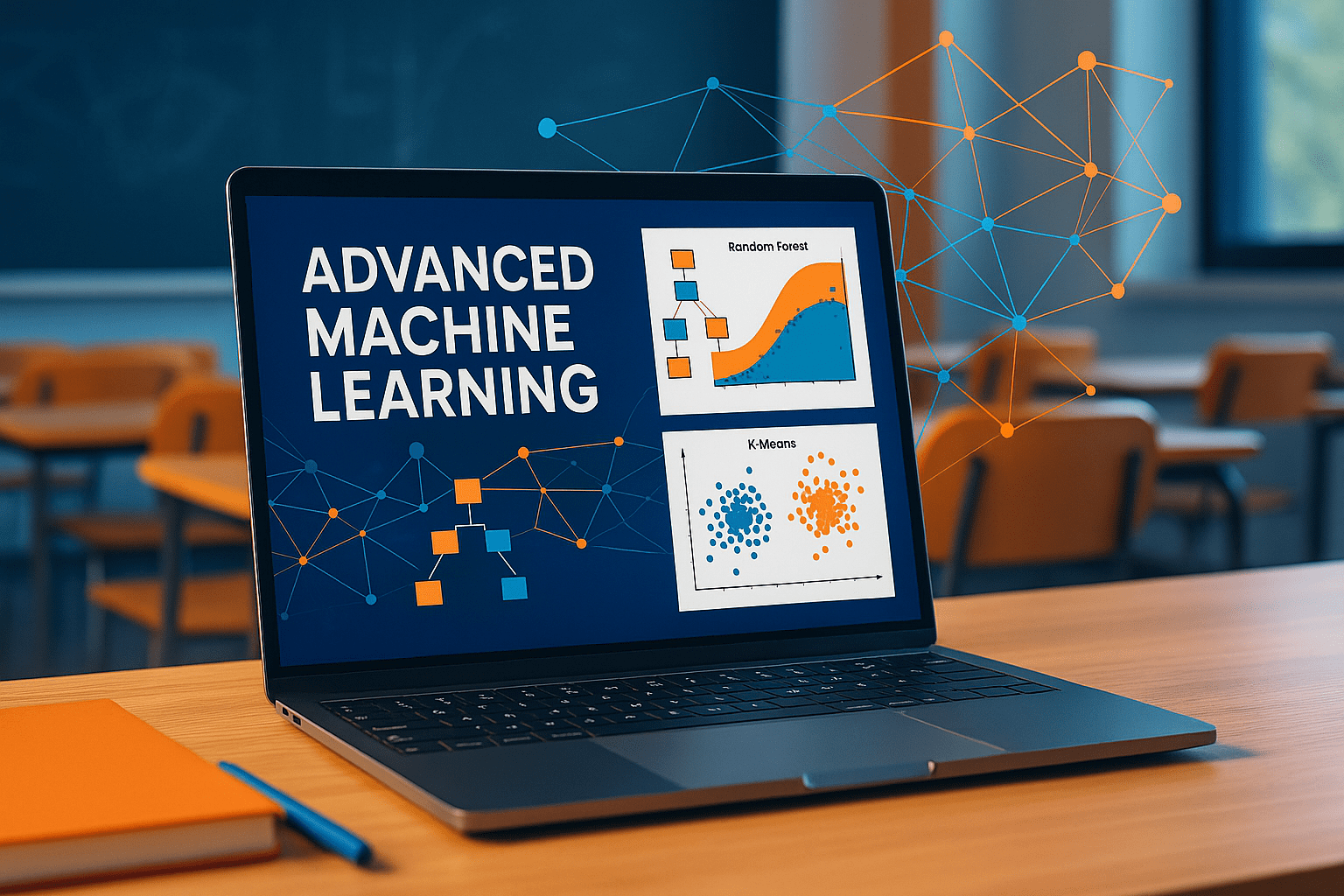
Advanced Machine Learning opens the door to powerful data-driven decision-making by combining theory, practice, and Python implementation. This course guides you through advanced algorithms such as K-Nearest Neighbors, Decision Trees, Random Forests, XGBoost, and K-Means Clustering. You’ll learn how to handle both supervised and unsupervised learning problems and gain a deeper understanding of model tuning, hyperparameter optimisation, and evaluation techniques that enhance predictive performance.
Starting with intuitive concepts like distance metrics in KNN and splitting criteria in Decision Trees, you’ll then explore ensemble learning — where multiple models are combined to reduce variance and improve accuracy. Through projects built with Scikit-learn and other leading Python libraries, you’ll learn to visualise datasets, interpret model outputs, and make informed analytical conclusions. The course also delves into clustering and density-based methods, helping you uncover hidden patterns and natural groupings in data.
By the end, you’ll have the practical skills to design, train, and evaluate high-performing machine learning models that can be applied to diverse domains such as finance, marketing, and healthcare. You’ll also gain the confidence to pursue data science roles or advanced research opportunities.
Learners will receive a free course completion certificate, while premium certificate and transcript options are available for purchase to further validate your expertise. In addition, you’ll enjoy 5-star rated support available 24/7 via email, ensuring you’re never alone on your learning journey.
Who is this course for?
Advanced Machine Learning opens the door to powerful data-driven decision-making by combining theory, practice, and Python implementation. This course guides you through advanced algorithms such as K-Nearest Neighbors, Decision Trees, Random Forests, XGBoost, and K-Means Clustering. You’ll learn how to handle both supervised and unsupervised learning problems and gain a deeper understanding of model tuning, hyperparameter optimisation, and evaluation techniques that enhance predictive performance.
Starting with intuitive concepts like distance metrics in KNN and splitting criteria in Decision Trees, you’ll then explore ensemble learning — where multiple models are combined to reduce variance and improve accuracy. Through projects built with Scikit-learn and other leading Python libraries, you’ll learn to visualise datasets, interpret model outputs, and make informed analytical conclusions. The course also delves into clustering and density-based methods, helping you uncover hidden patterns and natural groupings in data.
By the end, you’ll have the practical skills to design, train, and evaluate high-performing machine learning models that can be applied to diverse domains such as finance, marketing, and healthcare. You’ll also gain the confidence to pursue data science roles or advanced research opportunities.
Learners will receive a free course completion certificate, while premium certificate and transcript options are available for purchase to further validate your expertise. In addition, you’ll enjoy 5-star rated support available 24/7 via email, ensuring you’re never alone on your learning journey.
Requirements
Advanced Machine Learning opens the door to powerful data-driven decision-making by combining theory, practice, and Python implementation. This course guides you through advanced algorithms such as K-Nearest Neighbors, Decision Trees, Random Forests, XGBoost, and K-Means Clustering. You’ll learn how to handle both supervised and unsupervised learning problems and gain a deeper understanding of model tuning, hyperparameter optimisation, and evaluation techniques that enhance predictive performance.
Starting with intuitive concepts like distance metrics in KNN and splitting criteria in Decision Trees, you’ll then explore ensemble learning — where multiple models are combined to reduce variance and improve accuracy. Through projects built with Scikit-learn and other leading Python libraries, you’ll learn to visualise datasets, interpret model outputs, and make informed analytical conclusions. The course also delves into clustering and density-based methods, helping you uncover hidden patterns and natural groupings in data.
By the end, you’ll have the practical skills to design, train, and evaluate high-performing machine learning models that can be applied to diverse domains such as finance, marketing, and healthcare. You’ll also gain the confidence to pursue data science roles or advanced research opportunities.
Learners will receive a free course completion certificate, while premium certificate and transcript options are available for purchase to further validate your expertise. In addition, you’ll enjoy 5-star rated support available 24/7 via email, ensuring you’re never alone on your learning journey.
Career path
Advanced Machine Learning opens the door to powerful data-driven decision-making by combining theory, practice, and Python implementation. This course guides you through advanced algorithms such as K-Nearest Neighbors, Decision Trees, Random Forests, XGBoost, and K-Means Clustering. You’ll learn how to handle both supervised and unsupervised learning problems and gain a deeper understanding of model tuning, hyperparameter optimisation, and evaluation techniques that enhance predictive performance.
Starting with intuitive concepts like distance metrics in KNN and splitting criteria in Decision Trees, you’ll then explore ensemble learning — where multiple models are combined to reduce variance and improve accuracy. Through projects built with Scikit-learn and other leading Python libraries, you’ll learn to visualise datasets, interpret model outputs, and make informed analytical conclusions. The course also delves into clustering and density-based methods, helping you uncover hidden patterns and natural groupings in data.
By the end, you’ll have the practical skills to design, train, and evaluate high-performing machine learning models that can be applied to diverse domains such as finance, marketing, and healthcare. You’ll also gain the confidence to pursue data science roles or advanced research opportunities.
Learners will receive a free course completion certificate, while premium certificate and transcript options are available for purchase to further validate your expertise. In addition, you’ll enjoy 5-star rated support available 24/7 via email, ensuring you’re never alone on your learning journey.
-
- Introduction to the KNN Algorithm 00:10:00
- How KNN Works – Distance and Voting 00:10:00
- Loading the Wine Dataset 00:10:00
- Visualising Wine Dataset Features 00:10:00
- Train-Test Split and Standardisation 00:10:00
- Building and Training the KNN Model 00:10:00
- Tuning KNN with Optimal K Selection 00:10:00
- Advantages and Disadvantages of KNN 00:10:00
-
- Introduction to Decision Trees 00:10:00
- Understanding Decision Tree Mechanics 00:10:00
- What are Attribute Selection Measures (ASM)? 00:10:00
- Loading Data for Decision Tree Training 00:10:00
- Visualising Dataset Features 00:10:00
- Splitting Data for Training and Testing 00:10:00
- Training the Decision Tree Classifier 00:10:00
- Visualising the Decision Tree 00:10:00
- Tuning Decision Tree Hyperparameters 00:10:00
- Loading Diabetes Dataset for Regression 00:10:00
- Building a Decision Tree Regression Model 00:10:00
- Introduction to Ensemble Learning: Bagging & Boosting 00:10:00
- Random Forest Algorithm Overview 00:10:00
- Dataset Overview for Classification 00:10:00
- Visualising Classification Dataset 00:10:00
- Train-Test Split and One-Hot Encoding 00:10:00
- Training the Random Forest Classifier 00:10:00
- Loading Data for Random Forest Regression 00:10:00
- Building a Random Forest Regression Model 00:10:00
- Tuning Random Forest Hyperparameters 00:10:00
- Introduction to Unsupervised Learning 00:10:00
- Understanding K-Means Clustering 00:10:00
- Choosing the Optimal Number of Clusters 00:10:00
- Implementing K-Means with scikit-learn 00:10:00
- Practical Applications of Unsupervised Learning 00:10:00
- Loading Customer Segmentation Data 00:10:00
- Visualising Customer Data 00:10:00
- Data Preparation for K-Means Clustering 00:10:00
- Clustering by Age and Spending Score 00:10:00
- Cluster Visualisation in 2D 00:10:00
- Decision Boundary Plotting 00:10:00
- End-to-End K-Means Workflow 00:10:00
- Elbow Method for Optimal Clusters 00:10:00
- Annual Income vs Spending Score Clustering 00:10:00
- 3D K-Means Clustering – Part 1 00:10:00
- 3D K-Means Clustering – Part 2 00:10:00
- Introduction to Hierarchical Clustering 00:10:00
- Key Concepts in Hierarchical Clustering 00:10:00
- Loading and Exploring Stock Market Data 00:10:00
- Hierarchical Clustering in Python – Step-by-Step 00:10:00
- Premium Certificate 00:15:00

No Reviews found for this course.
Is this certificate recognized?
Yes, our premium certificate and transcript are widely recognized and accepted by embassies worldwide, particularly by the UK embassy. This adds credibility to your qualification and enhances its value for professional and academic purposes.
I am a beginner. Is this course suitable for me?
Yes, this course is designed for learners of all levels, including beginners. The content is structured to provide step-by-step guidance, ensuring that even those with no prior experience can follow along and gain valuable knowledge.
I am a professional. Is this course suitable for me?
Yes, professionals will also benefit from this course. It covers advanced concepts, practical applications, and industry insights that can help enhance existing skills and knowledge. Whether you are looking to refine your expertise or expand your qualifications, this course provides valuable learning.
Does this course have an expiry date?
No, you have lifetime access to the course. Once enrolled, you can revisit the materials at any time as long as the course remains available. Additionally, we regularly update our content to ensure it stays relevant and up to date.
How do I claim my free certificate?
I trust you’re in good health. Your free certificate can be located in the Achievement section. The option to purchase a CPD certificate is available but entirely optional, and you may choose to skip it. Please be aware that it’s crucial to click the “Complete” button to ensure the certificate is generated, as this process is entirely automated.
Does this course have assessments and assignments?
Yes, the course includes both assessments and assignments. Your final marks will be determined by a combination of 20% from assignments and 80% from assessments. These evaluations are designed to test your understanding and ensure you have grasped the key concepts effectively.
Is this course accredited?
We are a recognized course provider with CPD, UKRLP, and AOHT membership. The logos of these accreditation bodies will be featured on your premium certificate and transcript, ensuring credibility and professional recognition.
Will I receive a certificate upon completion?
Yes, you will receive a free digital certificate automatically once you complete the course. If you would like a premium CPD-accredited certificate, either in digital or physical format, you can upgrade for a small fee.
Course Features
Price
Study Method
Online | Self-paced
Course Format
Reading Material - PDF, article
Duration
11 hours, 35 minutes
Qualification
No formal qualification
Certificate
At completion
Additional info
Coming soon
- Share

Certificate in Counselling Children & Adolescents: Foundations and Practice
Course Line237¥4,501.66Original price was: ¥4,501.66.¥137.71Current price is: ¥137.71.British English Pronunciation: Stress, Vowels, Digraphs & Speech Clarity
Kazi Shofi Uddin Bablu237¥4,501.66Original price was: ¥4,501.66.¥137.71Current price is: ¥137.71.Nursery Assistant Level 3 Advanced Diploma
Course Line237¥4,501.66Original price was: ¥4,501.66.¥137.71Current price is: ¥137.71.



Related Courses
Microsoft Excel for Business: Beginner to Advanced Data Analysis
¥4,501.66Original price was: ¥4,501.66.¥137.71Current price is: ¥137.71.237C++ Programming for Beginners: From Zero to AI-Ready Developer
¥4,501.66Original price was: ¥4,501.66.¥137.71Current price is: ¥137.71.237Microsoft SQL Server & T-SQL Certification Training: Beginner to Advanced
¥4,501.66Original price was: ¥4,501.66.¥137.71Current price is: ¥137.71.237



Related Courses
Microsoft Excel for Business: Beginner to Advanced Data Analysis
¥4,501.66Original price was: ¥4,501.66.¥137.71Current price is: ¥137.71.237C++ Programming for Beginners: From Zero to AI-Ready Developer
¥4,501.66Original price was: ¥4,501.66.¥137.71Current price is: ¥137.71.237Microsoft SQL Server & T-SQL Certification Training: Beginner to Advanced
¥4,501.66Original price was: ¥4,501.66.¥137.71Current price is: ¥137.71.237

