
Course Features
Price
Study Method
Online | Self-paced
Course Format
Interactive PDFs, Articles & Learning Resources
Duration
15 minutes
Qualification
Professional Skills Development Course
Assessment
Final MCQ Exam (included in price)
Certificate
Verifiable Digital Certificate - Free
Additional info
Lifetime Access | Start Instantly
- Share
Overview
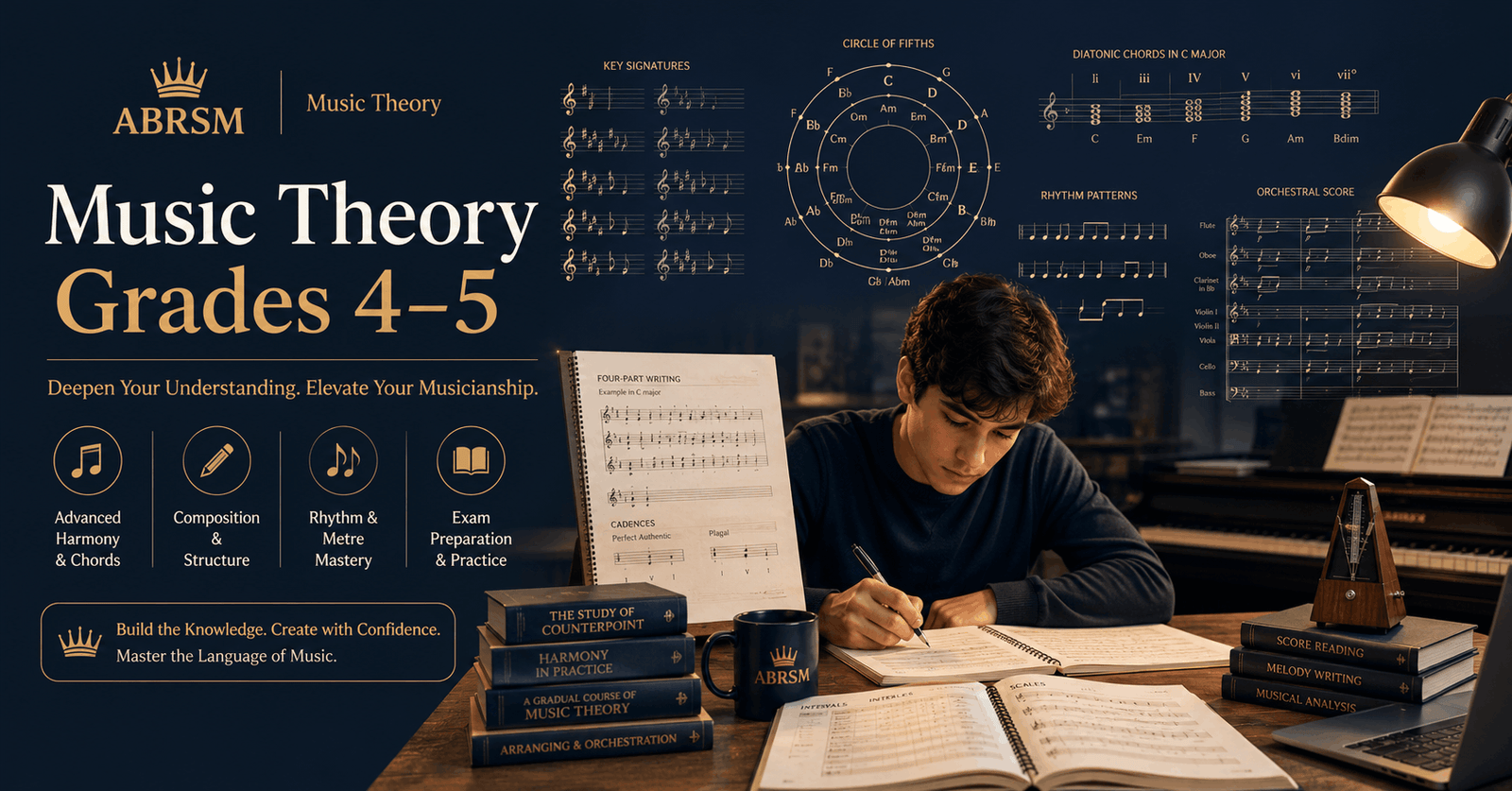
ABRSM Music Theory Grades 4–5 is an advanced foundation course designed to bridge the gap between intermediate and higher-level theoretical understanding. This programme focuses on developing a deep and practical knowledge of harmony, chords, rhythm structures, and composition techniques required for ABRSM Grade 4 and Grade 5 examinations. It is structured to help learners move beyond basic notation and begin thinking like musicians and composers with confidence and clarity.
Throughout the course, you will explore the full structure of keys and scales, including harmonic and melodic minor forms, key signatures, and modulation basics. You will also gain a strong understanding of intervals and chord construction, learning how triads are formed, how inversions work, and how cadences shape musical phrases. These core concepts are essential for both written exams and real-world musical application.
Rhythm and notation are developed in greater depth, with a focus on compound time signatures, dotted rhythms, triplets, and duplets. You will also practise structured rhythmic dictation exercises that strengthen your ability to interpret and reproduce complex rhythmic patterns accurately. This builds both speed and accuracy in exam conditions.
A key feature of this course is composition training. You will learn how to construct balanced melodies, develop musical motifs, and apply chord progressions such as I–IV–V–I in a structured way. This helps you understand how real music is built, not just analysed. You will also gain exposure to orchestral score reading, instrument families, and transposing instruments, giving you broader musical awareness.
The final section of the course focuses on revision and exam preparation. You will work through ABRSM-style practice papers, timed exercises, and self-assessment techniques to ensure full readiness for real exam conditions. This structured approach reduces exam pressure and builds confidence.
Upon completion, learners will receive a free course completion certificate. In addition, premium certificate and official transcript options are available for those who want enhanced academic or professional recognition. Students also benefit from 5-star rated support available 24/7 via email, ensuring expert help is always accessible throughout their learning journey.
Who is this course for?
ABRSM Music Theory Grades 4–5 is an advanced foundation course designed to bridge the gap between intermediate and higher-level theoretical understanding. This programme focuses on developing a deep and practical knowledge of harmony, chords, rhythm structures, and composition techniques required for ABRSM Grade 4 and Grade 5 examinations. It is structured to help learners move beyond basic notation and begin thinking like musicians and composers with confidence and clarity.
Throughout the course, you will explore the full structure of keys and scales, including harmonic and melodic minor forms, key signatures, and modulation basics. You will also gain a strong understanding of intervals and chord construction, learning how triads are formed, how inversions work, and how cadences shape musical phrases. These core concepts are essential for both written exams and real-world musical application.
Rhythm and notation are developed in greater depth, with a focus on compound time signatures, dotted rhythms, triplets, and duplets. You will also practise structured rhythmic dictation exercises that strengthen your ability to interpret and reproduce complex rhythmic patterns accurately. This builds both speed and accuracy in exam conditions.
A key feature of this course is composition training. You will learn how to construct balanced melodies, develop musical motifs, and apply chord progressions such as I–IV–V–I in a structured way. This helps you understand how real music is built, not just analysed. You will also gain exposure to orchestral score reading, instrument families, and transposing instruments, giving you broader musical awareness.
The final section of the course focuses on revision and exam preparation. You will work through ABRSM-style practice papers, timed exercises, and self-assessment techniques to ensure full readiness for real exam conditions. This structured approach reduces exam pressure and builds confidence.
Upon completion, learners will receive a free course completion certificate. In addition, premium certificate and official transcript options are available for those who want enhanced academic or professional recognition. Students also benefit from 5-star rated support available 24/7 via email, ensuring expert help is always accessible throughout their learning journey.
Requirements
ABRSM Music Theory Grades 4–5 is an advanced foundation course designed to bridge the gap between intermediate and higher-level theoretical understanding. This programme focuses on developing a deep and practical knowledge of harmony, chords, rhythm structures, and composition techniques required for ABRSM Grade 4 and Grade 5 examinations. It is structured to help learners move beyond basic notation and begin thinking like musicians and composers with confidence and clarity.
Throughout the course, you will explore the full structure of keys and scales, including harmonic and melodic minor forms, key signatures, and modulation basics. You will also gain a strong understanding of intervals and chord construction, learning how triads are formed, how inversions work, and how cadences shape musical phrases. These core concepts are essential for both written exams and real-world musical application.
Rhythm and notation are developed in greater depth, with a focus on compound time signatures, dotted rhythms, triplets, and duplets. You will also practise structured rhythmic dictation exercises that strengthen your ability to interpret and reproduce complex rhythmic patterns accurately. This builds both speed and accuracy in exam conditions.
A key feature of this course is composition training. You will learn how to construct balanced melodies, develop musical motifs, and apply chord progressions such as I–IV–V–I in a structured way. This helps you understand how real music is built, not just analysed. You will also gain exposure to orchestral score reading, instrument families, and transposing instruments, giving you broader musical awareness.
The final section of the course focuses on revision and exam preparation. You will work through ABRSM-style practice papers, timed exercises, and self-assessment techniques to ensure full readiness for real exam conditions. This structured approach reduces exam pressure and builds confidence.
Upon completion, learners will receive a free course completion certificate. In addition, premium certificate and official transcript options are available for those who want enhanced academic or professional recognition. Students also benefit from 5-star rated support available 24/7 via email, ensuring expert help is always accessible throughout their learning journey.
Career path
ABRSM Music Theory Grades 4–5 is an advanced foundation course designed to bridge the gap between intermediate and higher-level theoretical understanding. This programme focuses on developing a deep and practical knowledge of harmony, chords, rhythm structures, and composition techniques required for ABRSM Grade 4 and Grade 5 examinations. It is structured to help learners move beyond basic notation and begin thinking like musicians and composers with confidence and clarity.
Throughout the course, you will explore the full structure of keys and scales, including harmonic and melodic minor forms, key signatures, and modulation basics. You will also gain a strong understanding of intervals and chord construction, learning how triads are formed, how inversions work, and how cadences shape musical phrases. These core concepts are essential for both written exams and real-world musical application.
Rhythm and notation are developed in greater depth, with a focus on compound time signatures, dotted rhythms, triplets, and duplets. You will also practise structured rhythmic dictation exercises that strengthen your ability to interpret and reproduce complex rhythmic patterns accurately. This builds both speed and accuracy in exam conditions.
A key feature of this course is composition training. You will learn how to construct balanced melodies, develop musical motifs, and apply chord progressions such as I–IV–V–I in a structured way. This helps you understand how real music is built, not just analysed. You will also gain exposure to orchestral score reading, instrument families, and transposing instruments, giving you broader musical awareness.
The final section of the course focuses on revision and exam preparation. You will work through ABRSM-style practice papers, timed exercises, and self-assessment techniques to ensure full readiness for real exam conditions. This structured approach reduces exam pressure and builds confidence.
Upon completion, learners will receive a free course completion certificate. In addition, premium certificate and official transcript options are available for those who want enhanced academic or professional recognition. Students also benefit from 5-star rated support available 24/7 via email, ensuring expert help is always accessible throughout their learning journey.
-
-
- Premium Certificate 00:15:00

No Reviews found for this course.
Is this certificate recognized?
Yes, our premium certificate and transcript are widely recognized and accepted by embassies worldwide, particularly by the UK embassy. This adds credibility to your qualification and enhances its value for professional and academic purposes.
I am a beginner. Is this course suitable for me?
Yes, this course is designed for learners of all levels, including beginners. The content is structured to provide step-by-step guidance, ensuring that even those with no prior experience can follow along and gain valuable knowledge.
I am a professional. Is this course suitable for me?
Yes, professionals will also benefit from this course. It covers advanced concepts, practical applications, and industry insights that can help enhance existing skills and knowledge. Whether you are looking to refine your expertise or expand your qualifications, this course provides valuable learning.
Does this course have an expiry date?
No, you have lifetime access to the course. Once enrolled, you can revisit the materials at any time as long as the course remains available. Additionally, we regularly update our content to ensure it stays relevant and up to date.
How do I claim my free certificate?
I trust you’re in good health. Your free certificate can be located in the Achievement section. The option to purchase a CPD certificate is available but entirely optional, and you may choose to skip it. Please be aware that it’s crucial to click the “Complete” button to ensure the certificate is generated, as this process is entirely automated.
Does this course have assessments and assignments?
Yes, the course includes both assessments and assignments. Your final marks will be determined by a combination of 20% from assignments and 80% from assessments. These evaluations are designed to test your understanding and ensure you have grasped the key concepts effectively.
Is this course accredited?
We are a recognized course provider with CPD, UKRLP, and AOHT membership. The logos of these accreditation bodies will be featured on your premium certificate and transcript, ensuring credibility and professional recognition.
Will I receive a certificate upon completion?
Yes, you will receive a free digital certificate automatically once you complete the course. If you would like a premium CPD-accredited certificate, either in digital or physical format, you can upgrade for a small fee.
Course Features
Price
Study Method
Online | Self-paced
Course Format
Interactive PDFs, Articles & Learning Resources
Duration
15 minutes
Qualification
Professional Skills Development Course
Assessment
Final MCQ Exam (included in price)
Certificate
Verifiable Digital Certificate - Free
Additional info
Lifetime Access | Start Instantly
- Share

Concierge Level 3 Advanced Diploma
Course Line241$847.17Original price was: $847.17.$25.92Current price is: $25.92.Physics Level 3 Advanced Diploma
Course Line244$847.17Original price was: $847.17.$25.92Current price is: $25.92.Challenging Behaviour Level 8 Advanced Diploma
Course Line240$847.17Original price was: $847.17.$25.92Current price is: $25.92.



Related Courses
Communicating with Children: Theory to Practice
$847.17Original price was: $847.17.$25.92Current price is: $25.92.237Professional Photography Masterclass: Camera, Lighting, Composition & Portraits
$847.17Original price was: $847.17.$25.92Current price is: $25.92.237Adobe Photoshop CC MasterClass: From Beginner to Advanced Digital Artist
$847.17Original price was: $847.17.$25.92Current price is: $25.92.237




Related Courses
Communicating with Children: Theory to Practice
$847.17Original price was: $847.17.$25.92Current price is: $25.92.237Professional Photography Masterclass: Camera, Lighting, Composition & Portraits
$847.17Original price was: $847.17.$25.92Current price is: $25.92.237Adobe Photoshop CC MasterClass: From Beginner to Advanced Digital Artist
$847.17Original price was: $847.17.$25.92Current price is: $25.92.237

