
Course Features
Price
Study Method
Online | Self-paced
Course Format
Reading Material - PDF, article
Duration
6 hours, 25 minutes
Qualification
No formal qualification
Certificate
At completion
Additional info
Coming soon
- Share
Overview
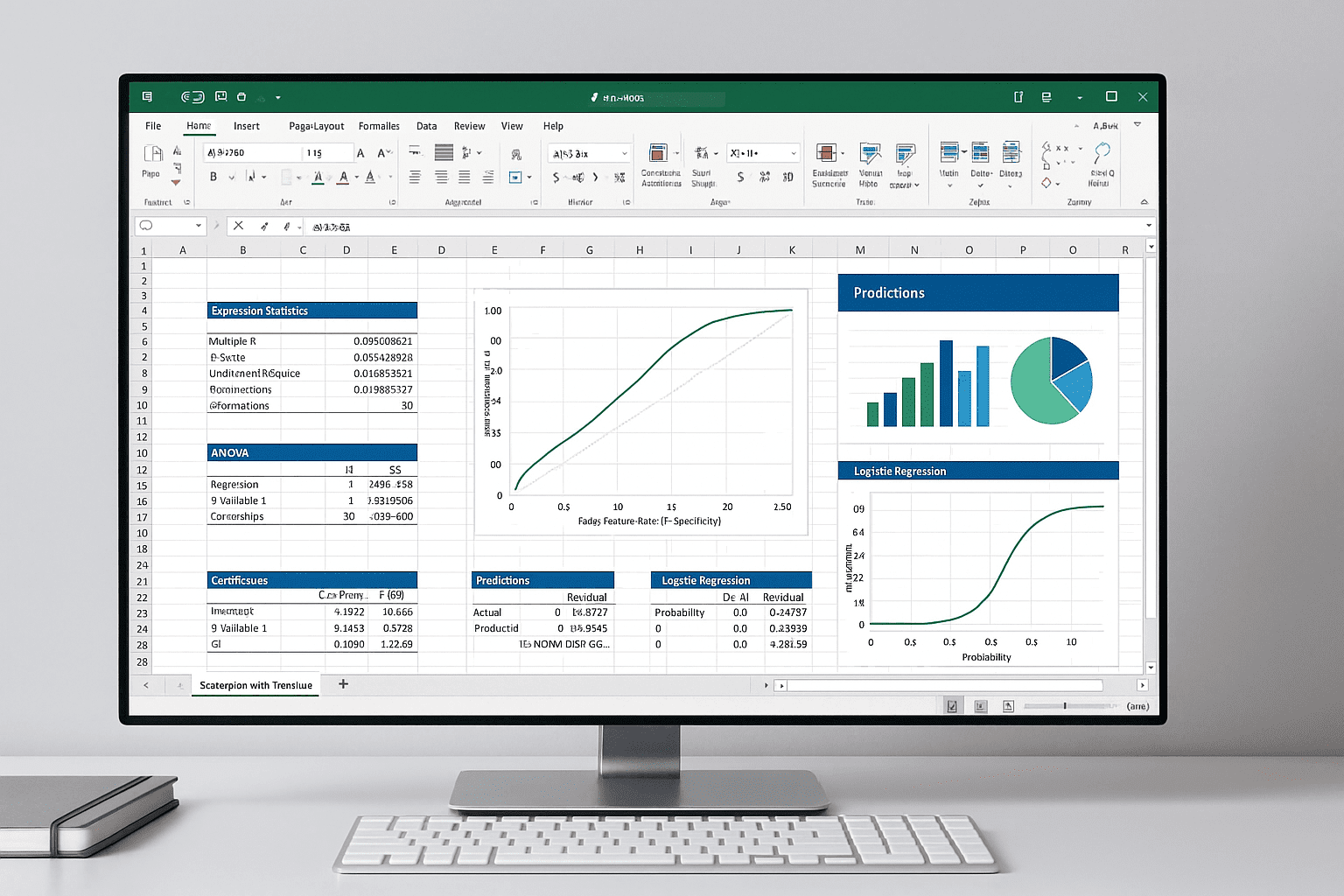
Excel Data Science is an increasingly valuable skill for professionals who want to analyse data, apply statistics, and build predictive models without relying on complex programming tools. This course is designed to show learners how Microsoft Excel can be used as a powerful platform for data science, statistical analysis, and introductory machine learning techniques.
The course begins by building a clear understanding of machine learning concepts and how they translate into Excel-based workflows. Learners then move into hands-on linear regression, where they learn how to prepare datasets, run models, interpret outputs, and understand key statistical measures. As confidence grows, the course expands into multiple regression analysis, focusing on model assumptions, diagnostic checks, and making reliable predictions using real-world data.
A major strength of this programme is its focus on interpretation, not just calculation. Learners develop the ability to read regression tables, understand variability, evaluate model performance, and avoid common analytical errors such as multicollinearity or overfitting. Logistic regression is also introduced for classification problems, including ROC curve analysis and model evaluation techniques, helping learners understand how predictive models are assessed in professional environments.
This course is ideal for those who want practical, job-relevant skills using a familiar tool. The learning approach is structured, applied, and accessible, making complex data science concepts easier to understand through Excel’s visual and analytical features.
Upon completion, learners receive a free course completion certificate. For those who require formal recognition, multiple premium certificate and transcript options are available for purchase. Students also benefit from 5-star rated learner support available 24/7 via email, ensuring help is always accessible throughout their learning journey.
This course is suitable for aspiring data analysts, business analysts, finance professionals, students, and professionals who work with data in Excel and want to expand into data science and machine learning concepts without learning advanced programming languages.
Who is this course for?
Excel Data Science is an increasingly valuable skill for professionals who want to analyse data, apply statistics, and build predictive models without relying on complex programming tools. This course is designed to show learners how Microsoft Excel can be used as a powerful platform for data science, statistical analysis, and introductory machine learning techniques.
The course begins by building a clear understanding of machine learning concepts and how they translate into Excel-based workflows. Learners then move into hands-on linear regression, where they learn how to prepare datasets, run models, interpret outputs, and understand key statistical measures. As confidence grows, the course expands into multiple regression analysis, focusing on model assumptions, diagnostic checks, and making reliable predictions using real-world data.
A major strength of this programme is its focus on interpretation, not just calculation. Learners develop the ability to read regression tables, understand variability, evaluate model performance, and avoid common analytical errors such as multicollinearity or overfitting. Logistic regression is also introduced for classification problems, including ROC curve analysis and model evaluation techniques, helping learners understand how predictive models are assessed in professional environments.
This course is ideal for those who want practical, job-relevant skills using a familiar tool. The learning approach is structured, applied, and accessible, making complex data science concepts easier to understand through Excel’s visual and analytical features.
Upon completion, learners receive a free course completion certificate. For those who require formal recognition, multiple premium certificate and transcript options are available for purchase. Students also benefit from 5-star rated learner support available 24/7 via email, ensuring help is always accessible throughout their learning journey.
This course is suitable for aspiring data analysts, business analysts, finance professionals, students, and professionals who work with data in Excel and want to expand into data science and machine learning concepts without learning advanced programming languages.
Requirements
Excel Data Science is an increasingly valuable skill for professionals who want to analyse data, apply statistics, and build predictive models without relying on complex programming tools. This course is designed to show learners how Microsoft Excel can be used as a powerful platform for data science, statistical analysis, and introductory machine learning techniques.
The course begins by building a clear understanding of machine learning concepts and how they translate into Excel-based workflows. Learners then move into hands-on linear regression, where they learn how to prepare datasets, run models, interpret outputs, and understand key statistical measures. As confidence grows, the course expands into multiple regression analysis, focusing on model assumptions, diagnostic checks, and making reliable predictions using real-world data.
A major strength of this programme is its focus on interpretation, not just calculation. Learners develop the ability to read regression tables, understand variability, evaluate model performance, and avoid common analytical errors such as multicollinearity or overfitting. Logistic regression is also introduced for classification problems, including ROC curve analysis and model evaluation techniques, helping learners understand how predictive models are assessed in professional environments.
This course is ideal for those who want practical, job-relevant skills using a familiar tool. The learning approach is structured, applied, and accessible, making complex data science concepts easier to understand through Excel’s visual and analytical features.
Upon completion, learners receive a free course completion certificate. For those who require formal recognition, multiple premium certificate and transcript options are available for purchase. Students also benefit from 5-star rated learner support available 24/7 via email, ensuring help is always accessible throughout their learning journey.
This course is suitable for aspiring data analysts, business analysts, finance professionals, students, and professionals who work with data in Excel and want to expand into data science and machine learning concepts without learning advanced programming languages.
Career path
Excel Data Science is an increasingly valuable skill for professionals who want to analyse data, apply statistics, and build predictive models without relying on complex programming tools. This course is designed to show learners how Microsoft Excel can be used as a powerful platform for data science, statistical analysis, and introductory machine learning techniques.
The course begins by building a clear understanding of machine learning concepts and how they translate into Excel-based workflows. Learners then move into hands-on linear regression, where they learn how to prepare datasets, run models, interpret outputs, and understand key statistical measures. As confidence grows, the course expands into multiple regression analysis, focusing on model assumptions, diagnostic checks, and making reliable predictions using real-world data.
A major strength of this programme is its focus on interpretation, not just calculation. Learners develop the ability to read regression tables, understand variability, evaluate model performance, and avoid common analytical errors such as multicollinearity or overfitting. Logistic regression is also introduced for classification problems, including ROC curve analysis and model evaluation techniques, helping learners understand how predictive models are assessed in professional environments.
This course is ideal for those who want practical, job-relevant skills using a familiar tool. The learning approach is structured, applied, and accessible, making complex data science concepts easier to understand through Excel’s visual and analytical features.
Upon completion, learners receive a free course completion certificate. For those who require formal recognition, multiple premium certificate and transcript options are available for purchase. Students also benefit from 5-star rated learner support available 24/7 via email, ensuring help is always accessible throughout their learning journey.
This course is suitable for aspiring data analysts, business analysts, finance professionals, students, and professionals who work with data in Excel and want to expand into data science and machine learning concepts without learning advanced programming languages.
-
- Welcome & What Is Machine Learning 00:10:00
- Understanding Types of Machine Learning 00:10:00
-
- Introduction to Linear Regression Concepts 00:10:00
- Understanding the Regression Line & Formula 00:10:00
- Visualising Linear Regression – Graphical Model 00:10:00
- Preparing & Formatting Excel Data for Regression 00:10:00
- Running Your First Regression in Excel [Hands-On] 00:10:00
- Understanding OLS (Ordinary Least Squares) 00:10:00
- Interpreting Regression Tables – Part 1 00:10:00
- Understanding Decomposition of Variability 00:10:00
- Interpreting Regression Tables – Part 2 00:10:00
- Interpreting Regression Tables – Part 3 00:10:00
- Introduction to Multiple Regression Analysis 00:10:00
- Building a Multiple Regression Example in Excel 00:10:00
- Analysing Multiple Regression Results 00:10:00
- Understanding OLS Assumptions 00:10:00
- Linearity & Independence in Regression 00:10:00
- Avoiding Endogeneity in Models 00:10:00
- Checking Normality & Homoscedasticity 00:10:00
- Detecting Autocorrelation Problems 00:10:00
- Avoiding Multicollinearity in Excel Models 00:10:00
- Working with Dummy Variables in Excel 00:10:00
- Making Predictions Using Multiple Regression [Hands-On] 00:10:00
- Exam of Master Excel for Data Science 2025: Learn Data Analysis, Statistics & Machine Learning 00:50:00

No Reviews found for this course.
Is this certificate recognized?
Yes, our premium certificate and transcript are widely recognized and accepted by embassies worldwide, particularly by the UK embassy. This adds credibility to your qualification and enhances its value for professional and academic purposes.
I am a beginner. Is this course suitable for me?
Yes, this course is designed for learners of all levels, including beginners. The content is structured to provide step-by-step guidance, ensuring that even those with no prior experience can follow along and gain valuable knowledge.
I am a professional. Is this course suitable for me?
Yes, professionals will also benefit from this course. It covers advanced concepts, practical applications, and industry insights that can help enhance existing skills and knowledge. Whether you are looking to refine your expertise or expand your qualifications, this course provides valuable learning.
Does this course have an expiry date?
No, you have lifetime access to the course. Once enrolled, you can revisit the materials at any time as long as the course remains available. Additionally, we regularly update our content to ensure it stays relevant and up to date.
How do I claim my free certificate?
I trust you’re in good health. Your free certificate can be located in the Achievement section. The option to purchase a CPD certificate is available but entirely optional, and you may choose to skip it. Please be aware that it’s crucial to click the “Complete” button to ensure the certificate is generated, as this process is entirely automated.
Does this course have assessments and assignments?
Yes, the course includes both assessments and assignments. Your final marks will be determined by a combination of 20% from assignments and 80% from assessments. These evaluations are designed to test your understanding and ensure you have grasped the key concepts effectively.
Is this course accredited?
We are a recognized course provider with CPD, UKRLP, and AOHT membership. The logos of these accreditation bodies will be featured on your premium certificate and transcript, ensuring credibility and professional recognition.
Will I receive a certificate upon completion?
Yes, you will receive a free digital certificate automatically once you complete the course. If you would like a premium CPD-accredited certificate, either in digital or physical format, you can upgrade for a small fee.
Course Features
Price
Study Method
Online | Self-paced
Course Format
Reading Material - PDF, article
Duration
6 hours, 25 minutes
Qualification
No formal qualification
Certificate
At completion
Additional info
Coming soon
- Share

Master MVVM Architecture with .NET MAUI: Build Modern Cross-Platform Apps
Course Line237£490.00Original price was: £490.00.£14.99Current price is: £14.99.Aiding Business Level Strategies
Course Line237£490.00Original price was: £490.00.£14.99Current price is: £14.99.Parapsychology Level 3 Advanced Diploma
Course Line241£490.00Original price was: £490.00.£14.99Current price is: £14.99.



Related Courses
PRINCE2 in Practice: Simulated Projects & Case Studies
£490.00Original price was: £490.00.£14.99Current price is: £14.99.237PRINCE2 Risk Management: Identifying, Assessing & Controlling Risk
£490.00Original price was: £490.00.£14.99Current price is: £14.99.237PRINCE2 Roles & Responsibilities: Managing Teams in a PRINCE2 Environment
£490.00Original price was: £490.00.£14.99Current price is: £14.99.237


Related Courses
PRINCE2 in Practice: Simulated Projects & Case Studies
£490.00Original price was: £490.00.£14.99Current price is: £14.99.237PRINCE2 Risk Management: Identifying, Assessing & Controlling Risk
£490.00Original price was: £490.00.£14.99Current price is: £14.99.237PRINCE2 Roles & Responsibilities: Managing Teams in a PRINCE2 Environment
£490.00Original price was: £490.00.£14.99Current price is: £14.99.237

