
Course Features
Price
Study Method
Online | Self-paced
Course Format
Interactive PDFs, Articles & Learning Resources
Duration
9 hours, 25 minutes
Qualification
Professional Skills Development Course
Assessment
Final MCQ Exam (included in price)
Certificate
Verifiable Digital Certificate - Free
Additional info
Lifetime Access | Start Instantly
- Share
Overview
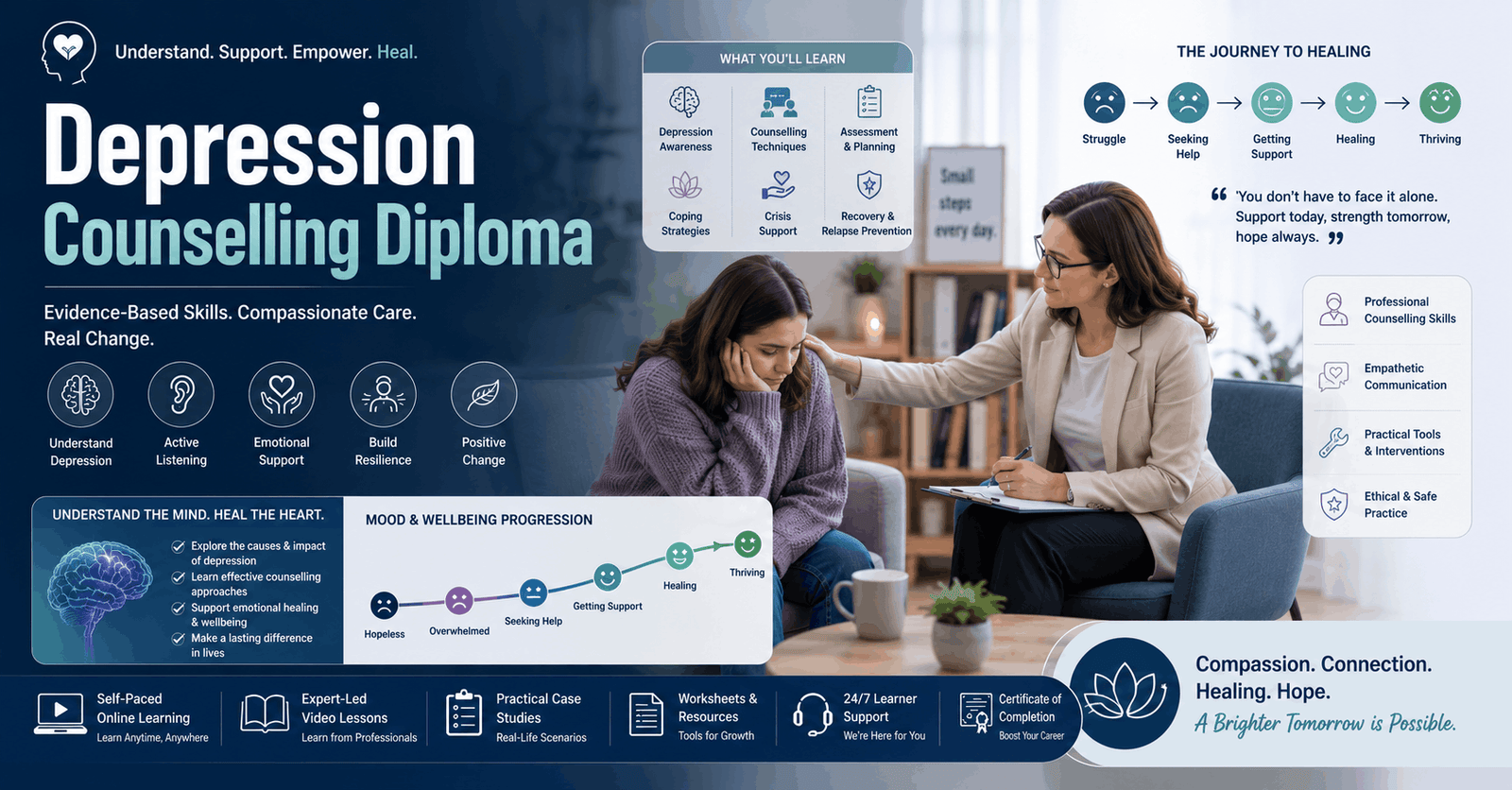
Depression Counselling Course is designed to provide learners with a comprehensive understanding of depression, its causes, symptoms, and evidence-based therapeutic approaches used to support mental health recovery. This course offers valuable insight into one of the most significant mental health challenges affecting individuals across all age groups and life stages.
Throughout this course, learners will explore the emotional, psychological, biological, and environmental factors associated with depression. You will gain a deeper understanding of how depression develops, how it affects the brain and behaviour, and how risk factors such as stress, sleep disorders, health conditions, and environmental influences contribute to mental health challenges. This foundation helps learners understand depression beyond surface-level symptoms.
The course also examines the different classifications and types of depression, including persistent depressive disorders, bipolar-related conditions, antenatal and postpartum depression, depression in children, and depression among older adults. This broad perspective helps learners understand how depression can present differently depending on individual circumstances and life stages.
In addition to understanding depression, this course introduces a wide range of therapeutic approaches used in counselling and mental health support. Learners will explore counselling methods such as person-centred therapy, family and couples therapy, psychodynamic approaches, interpersonal therapy, Cognitive Behavioural Therapy (CBT), Rational Emotive Behaviour Therapy (REBT), hypnotherapy, and Gestalt therapy. You will also gain insight into lifestyle and alternative therapies that may support mental wellbeing.
Whether you are interested in counselling, psychology, mental health support, healthcare, or personal development, this course provides practical and highly relevant knowledge. The structured learning approach makes complex concepts accessible for beginners while offering valuable insights for professionals seeking to expand their expertise.
Upon successful completion, learners will receive a free course completion certificate. Multiple premium certificate and transcript options are also available for purchase. Students also benefit from 5-star rated 24/7 email support, ensuring guidance is always available whenever needed.Who is this course for?
Depression Counselling Course is designed to provide learners with a comprehensive understanding of depression, its causes, symptoms, and evidence-based therapeutic approaches used to support mental health recovery. This course offers valuable insight into one of the most significant mental health challenges affecting individuals across all age groups and life stages.
Throughout this course, learners will explore the emotional, psychological, biological, and environmental factors associated with depression. You will gain a deeper understanding of how depression develops, how it affects the brain and behaviour, and how risk factors such as stress, sleep disorders, health conditions, and environmental influences contribute to mental health challenges. This foundation helps learners understand depression beyond surface-level symptoms.
The course also examines the different classifications and types of depression, including persistent depressive disorders, bipolar-related conditions, antenatal and postpartum depression, depression in children, and depression among older adults. This broad perspective helps learners understand how depression can present differently depending on individual circumstances and life stages.
In addition to understanding depression, this course introduces a wide range of therapeutic approaches used in counselling and mental health support. Learners will explore counselling methods such as person-centred therapy, family and couples therapy, psychodynamic approaches, interpersonal therapy, Cognitive Behavioural Therapy (CBT), Rational Emotive Behaviour Therapy (REBT), hypnotherapy, and Gestalt therapy. You will also gain insight into lifestyle and alternative therapies that may support mental wellbeing.
Whether you are interested in counselling, psychology, mental health support, healthcare, or personal development, this course provides practical and highly relevant knowledge. The structured learning approach makes complex concepts accessible for beginners while offering valuable insights for professionals seeking to expand their expertise.
Upon successful completion, learners will receive a free course completion certificate. Multiple premium certificate and transcript options are also available for purchase. Students also benefit from 5-star rated 24/7 email support, ensuring guidance is always available whenever needed.Requirements
Depression Counselling Course is designed to provide learners with a comprehensive understanding of depression, its causes, symptoms, and evidence-based therapeutic approaches used to support mental health recovery. This course offers valuable insight into one of the most significant mental health challenges affecting individuals across all age groups and life stages.
Throughout this course, learners will explore the emotional, psychological, biological, and environmental factors associated with depression. You will gain a deeper understanding of how depression develops, how it affects the brain and behaviour, and how risk factors such as stress, sleep disorders, health conditions, and environmental influences contribute to mental health challenges. This foundation helps learners understand depression beyond surface-level symptoms.
The course also examines the different classifications and types of depression, including persistent depressive disorders, bipolar-related conditions, antenatal and postpartum depression, depression in children, and depression among older adults. This broad perspective helps learners understand how depression can present differently depending on individual circumstances and life stages.
In addition to understanding depression, this course introduces a wide range of therapeutic approaches used in counselling and mental health support. Learners will explore counselling methods such as person-centred therapy, family and couples therapy, psychodynamic approaches, interpersonal therapy, Cognitive Behavioural Therapy (CBT), Rational Emotive Behaviour Therapy (REBT), hypnotherapy, and Gestalt therapy. You will also gain insight into lifestyle and alternative therapies that may support mental wellbeing.
Whether you are interested in counselling, psychology, mental health support, healthcare, or personal development, this course provides practical and highly relevant knowledge. The structured learning approach makes complex concepts accessible for beginners while offering valuable insights for professionals seeking to expand their expertise.
Upon successful completion, learners will receive a free course completion certificate. Multiple premium certificate and transcript options are also available for purchase. Students also benefit from 5-star rated 24/7 email support, ensuring guidance is always available whenever needed.Career path
Depression Counselling Course is designed to provide learners with a comprehensive understanding of depression, its causes, symptoms, and evidence-based therapeutic approaches used to support mental health recovery. This course offers valuable insight into one of the most significant mental health challenges affecting individuals across all age groups and life stages.
Throughout this course, learners will explore the emotional, psychological, biological, and environmental factors associated with depression. You will gain a deeper understanding of how depression develops, how it affects the brain and behaviour, and how risk factors such as stress, sleep disorders, health conditions, and environmental influences contribute to mental health challenges. This foundation helps learners understand depression beyond surface-level symptoms.
The course also examines the different classifications and types of depression, including persistent depressive disorders, bipolar-related conditions, antenatal and postpartum depression, depression in children, and depression among older adults. This broad perspective helps learners understand how depression can present differently depending on individual circumstances and life stages.
In addition to understanding depression, this course introduces a wide range of therapeutic approaches used in counselling and mental health support. Learners will explore counselling methods such as person-centred therapy, family and couples therapy, psychodynamic approaches, interpersonal therapy, Cognitive Behavioural Therapy (CBT), Rational Emotive Behaviour Therapy (REBT), hypnotherapy, and Gestalt therapy. You will also gain insight into lifestyle and alternative therapies that may support mental wellbeing.
Whether you are interested in counselling, psychology, mental health support, healthcare, or personal development, this course provides practical and highly relevant knowledge. The structured learning approach makes complex concepts accessible for beginners while offering valuable insights for professionals seeking to expand their expertise.
Upon successful completion, learners will receive a free course completion certificate. Multiple premium certificate and transcript options are also available for purchase. Students also benefit from 5-star rated 24/7 email support, ensuring guidance is always available whenever needed.-
- About the Course 00:10:00
- About the Tutor 00:10:00
- Introduction to Depression 00:10:00
- History of Melancholy 00:10:00
- Signs and Symptoms of Depression 00:10:00
- Brain and Depression 00:10:00
- Neurons and Depression 00:10:00
- Stress and Depression 00:10:00
- Environmental and Health Factors 00:10:00
- Sleep Disorders 00:10:00
- Somatic Symptoms 00:10:00
- Risk Factors 00:10:00
- Module 1 Quiz 00:10:00
-
- Classification Methods 00:10:00
- Cyclothymia 00:10:00
- Creativity and Depression 00:10:00
- Dysthymia and Atypical Depression 00:10:00
- Bipolar Disorder and Mania 00:10:00
- Antenatal and Postpartum Depression 00:10:00
- Bereavement and Grief 00:10:00
- Dysthymia in Children 00:10:00
- Depression in the Elderly 00:10:00
- Psychosocial Health in Elderly 00:10:00
- Module 2 Quiz 00:10:00
- Neurogenesis 00:10:00
- Mechanisms of Illness (MOI) 00:10:00
- Serotonin Syndrome 00:10:00
- SSRIs (Selective Serotonin Reuptake Inhibitors) 00:10:00
- Tyramine and Drug Interactions 00:10:00
- Medical Statistics in Depression 00:10:00
- Module 3 Quiz 00:10:00
- Person-Centred Approach 00:10:00
- Family and Couples Therapy 00:10:00
- Step Care Approach 00:10:00
- Psychodynamic Therapy and IPT (Interpersonal Therapy) 00:10:00
- Rational Emotive Behaviour Therapy (REBT) 00:10:00
- Hypnotherapy and CBT 00:10:00
- Hypnotherapy for PTSD 00:10:00
- Gestalt Therapy 00:10:00
- Building the Therapeutic Relationship 00:10:00
- Knowledge and Qualities of a Therapist 00:10:00
- Module 5 Quiz 00:10:00
- Premium Certificate 00:15:00

No Reviews found for this course.
Is this certificate recognized?
Yes, our premium certificate and transcript are widely recognized and accepted by embassies worldwide, particularly by the UK embassy. This adds credibility to your qualification and enhances its value for professional and academic purposes.
I am a beginner. Is this course suitable for me?
Yes, this course is designed for learners of all levels, including beginners. The content is structured to provide step-by-step guidance, ensuring that even those with no prior experience can follow along and gain valuable knowledge.
I am a professional. Is this course suitable for me?
Yes, professionals will also benefit from this course. It covers advanced concepts, practical applications, and industry insights that can help enhance existing skills and knowledge. Whether you are looking to refine your expertise or expand your qualifications, this course provides valuable learning.
Does this course have an expiry date?
No, you have lifetime access to the course. Once enrolled, you can revisit the materials at any time as long as the course remains available. Additionally, we regularly update our content to ensure it stays relevant and up to date.
How do I claim my free certificate?
I trust you’re in good health. Your free certificate can be located in the Achievement section. The option to purchase a CPD certificate is available but entirely optional, and you may choose to skip it. Please be aware that it’s crucial to click the “Complete” button to ensure the certificate is generated, as this process is entirely automated.
Does this course have assessments and assignments?
Yes, the course includes both assessments and assignments. Your final marks will be determined by a combination of 20% from assignments and 80% from assessments. These evaluations are designed to test your understanding and ensure you have grasped the key concepts effectively.
Is this course accredited?
We are a recognized course provider with CPD, UKRLP, and AOHT membership. The logos of these accreditation bodies will be featured on your premium certificate and transcript, ensuring credibility and professional recognition.
Will I receive a certificate upon completion?
Yes, you will receive a free digital certificate automatically once you complete the course. If you would like a premium CPD-accredited certificate, either in digital or physical format, you can upgrade for a small fee.
Course Features
Price
Study Method
Online | Self-paced
Course Format
Interactive PDFs, Articles & Learning Resources
Duration
9 hours, 25 minutes
Qualification
Professional Skills Development Course
Assessment
Final MCQ Exam (included in price)
Certificate
Verifiable Digital Certificate - Free
Additional info
Lifetime Access | Start Instantly
- Share

Agricultural Engineering Level 3 Advanced Diploma
Course Line240£490.00Original price was: £490.00.£14.99Current price is: £14.99.Counselling Skills Practitioner Certificate – Core Skills & Practical Techniques
Course Line237£490.00Original price was: £490.00.£14.99Current price is: £14.99.



Related Courses
Level 5 Youth Development Officer Course in Football
£490.00Original price was: £490.00.£14.99Current price is: £14.99.238Level 4 Youth Development Officer Course in Football
£490.00Original price was: £490.00.£14.99Current price is: £14.99.237Level 3 Youth Development Officer Course in Football
£490.00Original price was: £490.00.£14.99Current price is: £14.99.237



Related Courses
Level 5 Youth Development Officer Course in Football
£490.00Original price was: £490.00.£14.99Current price is: £14.99.238Level 4 Youth Development Officer Course in Football
£490.00Original price was: £490.00.£14.99Current price is: £14.99.237Level 3 Youth Development Officer Course in Football
£490.00Original price was: £490.00.£14.99Current price is: £14.99.237

