
Graduates can pursue careers as Risk Analyst, Financial Analyst, Compliance Associate, Market Risk Assistant, Credit Risk Assistant, Audit Support Officer, or Risk Modelling Trainee. This diploma also supports progression toward advanced qualifications in finance, investment analysis, quantitative modelling, or regulatory compliance.
Course Features
Price
Study Method
Online | Self-paced
Course Format
Reading Material - PDF, article
Duration
4 hours, 45 minutes
Qualification
No formal qualification
Certificate
At completion
Additional info
Coming soon
- Share
Overview
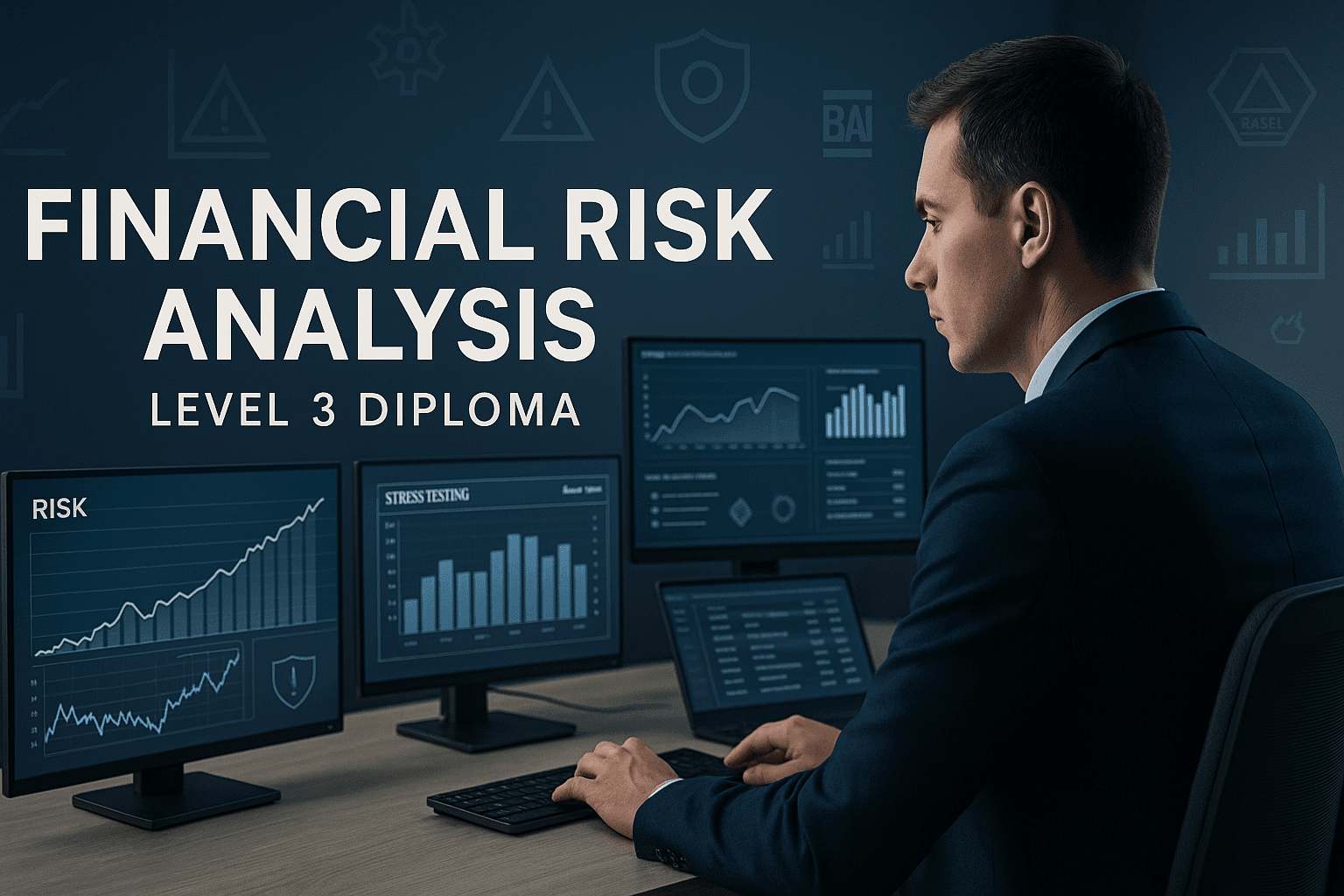
Financial Risk Analysis is essential for understanding how markets behave, how organisations measure exposure, and how financial institutions protect themselves against uncertainty. This Level 3 Advanced Diploma provides a structured, professional introduction to the techniques and frameworks used across banks, investment firms, and corporate finance departments. It is designed to help learners build strong analytical thinking, practical modelling abilities, and a clear awareness of regulatory expectations in today’s evolving financial landscape.
The course begins by helping you understand the role of risk analysis within finance—why it matters, how risks arise, and how professionals assess them across asset classes. You’ll explore key concepts such as market risk, credit risk, liquidity risk, and operational risk, developing the ability to evaluate how each can influence an organisation’s performance.
A major strength of this diploma is its emphasis on globally recognised frameworks, including the Basel Accords, Enterprise Risk Management, ISO 31000, and COSO principles. These standards form the backbone of modern financial governance, and learning them prepares you for real-world responsibilities in compliance and risk oversight.
You will also develop hands-on familiarity with advanced measurement tools such as Value at Risk (VaR), Expected Shortfall (ES), Monte Carlo simulation, stress testing, and scenario analysis. These are the models used by financial institutions every day to forecast losses, prepare for volatility, and meet regulatory expectations.
The course further introduces you to risk models used in equity, fixed-income, and derivative markets, helping you understand how professionals assess sensitivity, exposure, and price fluctuations across financial instruments. Governance, internal controls, and oversight mechanisms are also covered to help you appreciate the role of regulators and internal audit teams in safeguarding financial stability.
Every learner who completes the course receives a free course completion certificate. For those who want additional credentials, premium certificate and transcript packages are available for purchase. All students also benefit from 5-star rated, 24/7 email support throughout their studies.
This course is ideal for aspiring risk analysts, finance students, investment professionals, auditors, compliance officers, and anyone seeking to understand financial vulnerabilities and regulatory expectations. It also suits career changers who want a structured entry into financial risk roles.
No professional finance background is required. Basic numeracy, logical reasoning, and comfort with spreadsheets or digital tools will help you progress easily. The course is suitable for beginners and early-career professionals wanting solid risk-analysis fundamentals.
Who is this course for?
Financial Risk Analysis is essential for understanding how markets behave, how organisations measure exposure, and how financial institutions protect themselves against uncertainty. This Level 3 Advanced Diploma provides a structured, professional introduction to the techniques and frameworks used across banks, investment firms, and corporate finance departments. It is designed to help learners build strong analytical thinking, practical modelling abilities, and a clear awareness of regulatory expectations in today’s evolving financial landscape.
The course begins by helping you understand the role of risk analysis within finance—why it matters, how risks arise, and how professionals assess them across asset classes. You’ll explore key concepts such as market risk, credit risk, liquidity risk, and operational risk, developing the ability to evaluate how each can influence an organisation’s performance.
A major strength of this diploma is its emphasis on globally recognised frameworks, including the Basel Accords, Enterprise Risk Management, ISO 31000, and COSO principles. These standards form the backbone of modern financial governance, and learning them prepares you for real-world responsibilities in compliance and risk oversight.
You will also develop hands-on familiarity with advanced measurement tools such as Value at Risk (VaR), Expected Shortfall (ES), Monte Carlo simulation, stress testing, and scenario analysis. These are the models used by financial institutions every day to forecast losses, prepare for volatility, and meet regulatory expectations.
The course further introduces you to risk models used in equity, fixed-income, and derivative markets, helping you understand how professionals assess sensitivity, exposure, and price fluctuations across financial instruments. Governance, internal controls, and oversight mechanisms are also covered to help you appreciate the role of regulators and internal audit teams in safeguarding financial stability.
Every learner who completes the course receives a free course completion certificate. For those who want additional credentials, premium certificate and transcript packages are available for purchase. All students also benefit from 5-star rated, 24/7 email support throughout their studies.
This course is ideal for aspiring risk analysts, finance students, investment professionals, auditors, compliance officers, and anyone seeking to understand financial vulnerabilities and regulatory expectations. It also suits career changers who want a structured entry into financial risk roles.
No professional finance background is required. Basic numeracy, logical reasoning, and comfort with spreadsheets or digital tools will help you progress easily. The course is suitable for beginners and early-career professionals wanting solid risk-analysis fundamentals.
Graduates can pursue careers as Risk Analyst, Financial Analyst, Compliance Associate, Market Risk Assistant, Credit Risk Assistant, Audit Support Officer, or Risk Modelling Trainee. This diploma also supports progression toward advanced qualifications in finance, investment analysis, quantitative modelling, or regulatory compliance.
Requirements
Financial Risk Analysis is essential for understanding how markets behave, how organisations measure exposure, and how financial institutions protect themselves against uncertainty. This Level 3 Advanced Diploma provides a structured, professional introduction to the techniques and frameworks used across banks, investment firms, and corporate finance departments. It is designed to help learners build strong analytical thinking, practical modelling abilities, and a clear awareness of regulatory expectations in today’s evolving financial landscape.
The course begins by helping you understand the role of risk analysis within finance—why it matters, how risks arise, and how professionals assess them across asset classes. You’ll explore key concepts such as market risk, credit risk, liquidity risk, and operational risk, developing the ability to evaluate how each can influence an organisation’s performance.
A major strength of this diploma is its emphasis on globally recognised frameworks, including the Basel Accords, Enterprise Risk Management, ISO 31000, and COSO principles. These standards form the backbone of modern financial governance, and learning them prepares you for real-world responsibilities in compliance and risk oversight.
You will also develop hands-on familiarity with advanced measurement tools such as Value at Risk (VaR), Expected Shortfall (ES), Monte Carlo simulation, stress testing, and scenario analysis. These are the models used by financial institutions every day to forecast losses, prepare for volatility, and meet regulatory expectations.
The course further introduces you to risk models used in equity, fixed-income, and derivative markets, helping you understand how professionals assess sensitivity, exposure, and price fluctuations across financial instruments. Governance, internal controls, and oversight mechanisms are also covered to help you appreciate the role of regulators and internal audit teams in safeguarding financial stability.
Every learner who completes the course receives a free course completion certificate. For those who want additional credentials, premium certificate and transcript packages are available for purchase. All students also benefit from 5-star rated, 24/7 email support throughout their studies.
This course is ideal for aspiring risk analysts, finance students, investment professionals, auditors, compliance officers, and anyone seeking to understand financial vulnerabilities and regulatory expectations. It also suits career changers who want a structured entry into financial risk roles.
No professional finance background is required. Basic numeracy, logical reasoning, and comfort with spreadsheets or digital tools will help you progress easily. The course is suitable for beginners and early-career professionals wanting solid risk-analysis fundamentals.
Graduates can pursue careers as Risk Analyst, Financial Analyst, Compliance Associate, Market Risk Assistant, Credit Risk Assistant, Audit Support Officer, or Risk Modelling Trainee. This diploma also supports progression toward advanced qualifications in finance, investment analysis, quantitative modelling, or regulatory compliance.
Career path
Financial Risk Analysis is essential for understanding how markets behave, how organisations measure exposure, and how financial institutions protect themselves against uncertainty. This Level 3 Advanced Diploma provides a structured, professional introduction to the techniques and frameworks used across banks, investment firms, and corporate finance departments. It is designed to help learners build strong analytical thinking, practical modelling abilities, and a clear awareness of regulatory expectations in today’s evolving financial landscape.
The course begins by helping you understand the role of risk analysis within finance—why it matters, how risks arise, and how professionals assess them across asset classes. You’ll explore key concepts such as market risk, credit risk, liquidity risk, and operational risk, developing the ability to evaluate how each can influence an organisation’s performance.
A major strength of this diploma is its emphasis on globally recognised frameworks, including the Basel Accords, Enterprise Risk Management, ISO 31000, and COSO principles. These standards form the backbone of modern financial governance, and learning them prepares you for real-world responsibilities in compliance and risk oversight.
You will also develop hands-on familiarity with advanced measurement tools such as Value at Risk (VaR), Expected Shortfall (ES), Monte Carlo simulation, stress testing, and scenario analysis. These are the models used by financial institutions every day to forecast losses, prepare for volatility, and meet regulatory expectations.
The course further introduces you to risk models used in equity, fixed-income, and derivative markets, helping you understand how professionals assess sensitivity, exposure, and price fluctuations across financial instruments. Governance, internal controls, and oversight mechanisms are also covered to help you appreciate the role of regulators and internal audit teams in safeguarding financial stability.
Every learner who completes the course receives a free course completion certificate. For those who want additional credentials, premium certificate and transcript packages are available for purchase. All students also benefit from 5-star rated, 24/7 email support throughout their studies.
This course is ideal for aspiring risk analysts, finance students, investment professionals, auditors, compliance officers, and anyone seeking to understand financial vulnerabilities and regulatory expectations. It also suits career changers who want a structured entry into financial risk roles.
No professional finance background is required. Basic numeracy, logical reasoning, and comfort with spreadsheets or digital tools will help you progress easily. The course is suitable for beginners and early-career professionals wanting solid risk-analysis fundamentals.
Graduates can pursue careers as Risk Analyst, Financial Analyst, Compliance Associate, Market Risk Assistant, Credit Risk Assistant, Audit Support Officer, or Risk Modelling Trainee. This diploma also supports progression toward advanced qualifications in finance, investment analysis, quantitative modelling, or regulatory compliance.
-
- Overview of Financial Risk Analysis 00:10:00
- Importance of Risk Management in Finance 00:10:00
- Types of Financial Risks: Market Risk, Credit Risk, Operational Risk 00:10:00
- Risk Management Process: Identification, Measurement, Mitigation 00:10:00
-
- Basel Accords and Regulatory Frameworks 00:10:00
- Enterprise Risk Management (ERM) 00:10:00
- COSO Framework 00:10:00
- ISO 31000: Risk Management Principles and Guidelines 00:10:00
- Value at Risk (VaR) 00:10:00
- Expected Shortfall (ES) 00:10:00
- Stress Testing 00:10:00
- Scenario Analysis 00:10:00
- Monte Carlo Simulation 00:10:00
- Regulatory Environment for Financial Institutions 00:10:00
- Compliance with Basel III/IV 00:10:00
- Governance Structures in Risk Management 00:10:00
- Role of Internal Audit and External Regulators 00:10:00
- Premium Certificate 00:15:00

No Reviews found for this course.
Is this certificate recognized?
Yes, our premium certificate and transcript are widely recognized and accepted by embassies worldwide, particularly by the UK embassy. This adds credibility to your qualification and enhances its value for professional and academic purposes.
I am a beginner. Is this course suitable for me?
Yes, this course is designed for learners of all levels, including beginners. The content is structured to provide step-by-step guidance, ensuring that even those with no prior experience can follow along and gain valuable knowledge.
I am a professional. Is this course suitable for me?
Yes, professionals will also benefit from this course. It covers advanced concepts, practical applications, and industry insights that can help enhance existing skills and knowledge. Whether you are looking to refine your expertise or expand your qualifications, this course provides valuable learning.
Does this course have an expiry date?
No, you have lifetime access to the course. Once enrolled, you can revisit the materials at any time as long as the course remains available. Additionally, we regularly update our content to ensure it stays relevant and up to date.
How do I claim my free certificate?
I trust you’re in good health. Your free certificate can be located in the Achievement section. The option to purchase a CPD certificate is available but entirely optional, and you may choose to skip it. Please be aware that it’s crucial to click the “Complete” button to ensure the certificate is generated, as this process is entirely automated.
Does this course have assessments and assignments?
Yes, the course includes both assessments and assignments. Your final marks will be determined by a combination of 20% from assignments and 80% from assessments. These evaluations are designed to test your understanding and ensure you have grasped the key concepts effectively.
Is this course accredited?
We are a recognized course provider with CPD, UKRLP, and AOHT membership. The logos of these accreditation bodies will be featured on your premium certificate and transcript, ensuring credibility and professional recognition.
Will I receive a certificate upon completion?
Yes, you will receive a free digital certificate automatically once you complete the course. If you would like a premium CPD-accredited certificate, either in digital or physical format, you can upgrade for a small fee.
Course Features
Price
Study Method
Online | Self-paced
Course Format
Reading Material - PDF, article
Duration
4 hours, 45 minutes
Qualification
No formal qualification
Certificate
At completion
Additional info
Coming soon
- Share
{"title":"","show_title":"0","post_type":"course","taxonomy":"","term":"0","post_ids":"","course_style":"random","featured_style":"course4","masonry":"","grid_columns":"clear1 col-md-12","column_width":"268","gutter":"30","grid_number":"3","infinite":"","pagination":"","grid_excerpt_length":"100","grid_link":"1","grid_search":"0","course_type":"","css_class":"","container_css":"","custom_css":""}

Sport Psychology Practitioner Certificate – Mindset, Performance & Mental Skills
Kazi Shofi Uddin Bablu237£490.00Original price was: £490.00.£14.99Current price is: £14.99.CII: Ethics, Conduct & Professional Standards in Insurance
Course Line238£490.00Original price was: £490.00.£14.99Current price is: £14.99.Risk Management Level 3 Advanced Diploma
Course Line240£490.00Original price was: £490.00.£14.99Current price is: £14.99.


Related Courses
Introduction to System Design – Foundations, Techniques & Industrial Applications
£490.00Original price was: £490.00.£14.99Current price is: £14.99.238Advanced Visual Merchandising – Design Principles, Colour Theory & Display Excellence
£490.00Original price was: £490.00.£14.99Current price is: £14.99.237Visual Merchandising & Store Design – Foundations & Applications
£490.00Original price was: £490.00.£14.99Current price is: £14.99.237




Related Courses
Introduction to System Design – Foundations, Techniques & Industrial Applications
£490.00Original price was: £490.00.£14.99Current price is: £14.99.238Advanced Visual Merchandising – Design Principles, Colour Theory & Display Excellence
£490.00Original price was: £490.00.£14.99Current price is: £14.99.237Visual Merchandising & Store Design – Foundations & Applications
£490.00Original price was: £490.00.£14.99Current price is: £14.99.237

